What Is Pure Notation?
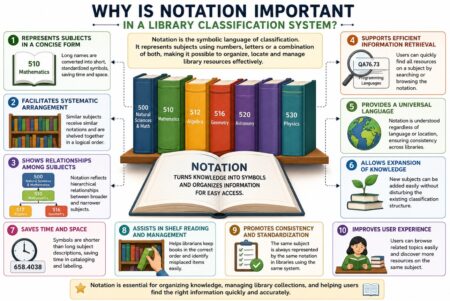
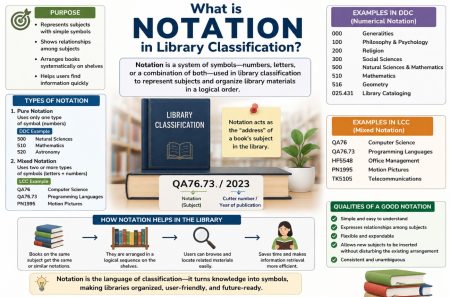
Pure notation is a system used in library classification that employs only one type of symbol, such as numerals or letters, to represent subjects and their relationships. In this context, notation serves as a symbolic code that identifies a subject and determines the placement of materials on library shelves. When a classification scheme relies exclusively on a single type of symbol throughout the system, it is referred to as pure notation. For example, the Dewey Decimal Classification (DDC) exclusively uses Arabic numerals to represent all subjects. In DDC, 500 denotes Natural Sciences and Mathematics, 510 represents Mathematics, and 512 stands for Algebra. The numerical progression clearly demonstrates the hierarchical relationship between broad and specific subjects.
The concept of pure notation emphasizes simplicity, uniformity, and logical arrangement. Since only one type of symbol is utilized, the notation is easy to read, understand, and apply. This consistency aids librarians in accurately classifying materials and enables users to locate resources efficiently. For instance, in DDC, a book on Computer Science may be assigned the classification 004, while a book on Programming may receive 005.1. The numerical sequence quickly indicates that programming is a more specific topic within the broader field of computer science.
The significance of pure notation in library classification lies in its potential to facilitate the systematic organization and retrieval of information. It provides a clear framework for arranging materials so that related subjects are grouped together. For example, books classified under 300 for Social Sciences are shelved together, while those under 600 for Technology are organized separately. This arrangement allows users to browse shelves effectively and discover related materials. Additionally, pure notation simplifies shelf management, as materials can be organized in a straightforward numerical or alphabetical order without needing multiple types of symbols.
Another important advantage of pure notation is its ability to support hierarchical subject representation. A broader subject is represented by a shorter notation, while more specific topics are indicated by longer notations. For example, 900 represents History and Geography as a broad category, 950 denotes the History of Asia as a slightly more specific topic, and 954 signifies the History of India as even more specific. This hierarchical structure helps users understand the relationships between subjects and navigate collections more easily.
However, pure notation does have its limitations. Because it employs only one type of symbol, it may lack the flexibility needed to express highly complex or interdisciplinary subjects compared to mixed notation systems. Despite this limitation, the simplicity, consistency, and ease of arrangement of pure notation have made it a fundamental aspect of many classification schemes. Therefore, pure notation remains an essential tool for organizing knowledge, improving information retrieval, and ensuring efficient access to library resources.