What Is a Call Number in a Library System?
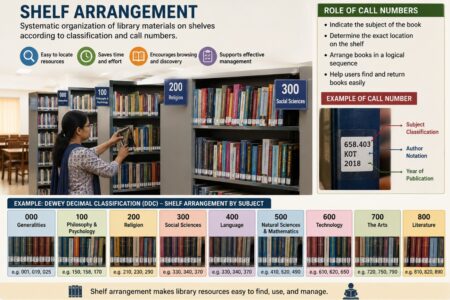
A call number is a unique alphanumeric code assigned to each item in a library collection to indicate its subject classification and exact physical location on the shelves. It functions like the address of a book, guiding users from a general subject area to a specific shelf and position. Call numbers are created according to standard classification systems, most commonly the Dewey Decimal Classification (DDC) and the Library of Congress Classification (LCC), and they appear both in the library’s online catalog (OPAC) and on the spine label of the book.
For example, in the Dewey Decimal Classification system, a book on computer science may have a call number such as 004.678 SHA, where 004.678 represents the subject area of the Internet, and SHA is derived from the author’s name. All books with similar numbers (e.g., 004–006) will be shelved together, allowing users interested in computing to find related materials nearby. Similarly, in the Library of Congress Classification system, a book on library automation might carry a call number like Z678 .A25 2022, where Z indicates library science, 678 narrows the topic to library automation, .A25 represents the author, and 2022 shows the year of publication.
By understanding and following these examples, users can move confidently from the OPAC to the shelves, read call numbers line by line, and locate the exact book they need. At the same time, call numbers support effective browsing, as users can explore adjacent shelves to discover additional books on the same or closely related subjects, making them an essential tool for both information retrieval and knowledge organization in libraries.
How Does the Call Number Help Users Locate Books on Shelves?
A call number helps users locate books on library shelves by acting as a precise guide from the library catalog to the book’s exact physical position. When a user searches the OPAC and notes a call number, that number tells the user where to go, which shelf to check, and how to identify the correct book among many others. Libraries arrange books in a strict alphanumeric order based on call numbers, so following this sequence allows users to move systematically from general subject areas to a specific item.
For example, in a library using the Dewey Decimal Classification (DDC) system, a book with the call number 025.3 RAH indicates that the book belongs to the library science section (025), specifically cataloging (025.3). Once the user reaches the 025 shelf range, they compare the decimal numbers first (e.g., 025.1, 025.3, 025.4) and then the author letters (RAH) to find the exact book. This step-by-step comparison helps avoid mistakes and ensures accurate location.
Similarly, in libraries using the Library of Congress Classification (LCC) system, a call number such as Z665 .M45 2021 directs users to the Z class (library science), then to a more specific topic within that class, followed by the author identifier and year of publication. By reading each part of the call number in order, users can narrow down the shelf location until the correct book is found.
In addition to locating a single item, call numbers support subject-based browsing. For instance, after finding a book on information technology at 004.6, users may notice nearby books with call numbers 004.62 or 004.65, which cover related topics. This arrangement allows users to discover additional relevant materials easily. Overall, call numbers simplify navigation, save users’ time, and encourage independent and confident use of library shelves.
Where Can a User Find the Call Number of a Book?
A user can find the call number of a book in several key places within the library system. Most commonly, the call number appears in the library’s Online Public Access Catalog (OPAC) or discovery system. When a user searches for a book by title, author, or subject in the OPAC, the bibliographic record clearly displays the call number along with the item’s availability and location, such as the floor or section of the library. This is usually the first place users check before going to the shelves.
The call number is also printed on the spine label of the physical book. This label is attached to the lower part of the book’s spine and allows users to quickly identify and verify the book once they reach the correct shelf. In addition, call numbers may appear on the title page verso (the back of the title page) or on an inside label, especially for older or reference materials.
Finally, users can obtain the call number with the help of library staff at the circulation or reference desk, who can look up the book in the catalog if needed. Together, these sources ensure that users can easily find and confirm the correct call number before and during their search for a book on the shelves.
Why Is the Call Number Important for Locating Books on Shelves?
The call number is important for locating books on shelves because it provides a precise and standardized location system that links the library catalog to the physical arrangement of books. Instead of searching randomly, users rely on the call number as a clear guide that directs them to the correct subject area, shelf range, and exact position of a book. This systematic arrangement ensures that every book has a unique “address,” making retrieval efficient even in large library collections.
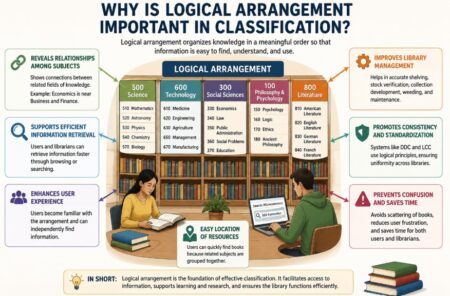
Call numbers also organize books by subject, placing materials on similar topics next to each other. For example, books on computer science, library science, or economics are grouped within specific call number ranges. Once users reach the correct range, they can follow the numerical and alphabetical sequence to locate the exact item. This not only saves time but also reduces confusion, especially for new users who may be unfamiliar with the library layout. Moreover, call numbers support browsing and discovery. While searching for one book, users often find related materials shelved nearby, which can be useful for research and study. For library staff, call numbers ensure accurate shelving, easy inventory control, and quick assistance to users. Overall, the call number is essential because it transforms a large, complex collection into an organized, navigable system that users can understand and use independently.