
Library classification is a fundamental process in library and information science that enables the systematic organization of knowledge and information resources. As libraries continue to acquire vast collections of books, journals, manuscripts, audiovisual materials, and digital resources, there is an increasing need for an effective method to arrange these materials logically and user-friendly. Library classification meets this need by grouping documents according to their subjects and assigning them specific class numbers or notations. These notations determine the location of materials within the library and help users retrieve information quickly and efficiently. Without a proper classification system, a library would become a disorganized collection of resources, making it difficult for users to find the information they need.
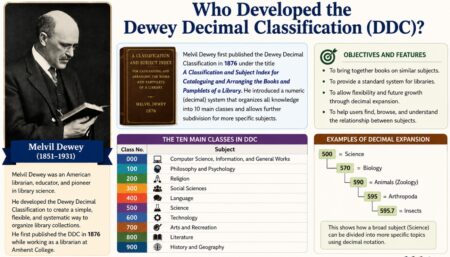
The concept of classification is based on the principle that documents dealing with the same or closely related subjects should be placed together. Through classification schemes such as the Dewey Decimal Classification (DDC), Universal Decimal Classification (UDC), and Colon Classification (CC), libraries create a structured arrangement of knowledge. For example, in the DDC system, books on computer science are generally placed in the 000 class, books on religion in the 200 class, and books on history in the 900 class. A book on computer programming may be assigned the number 005.13, while a book on world history may be placed under 909. This arrangement allows users to locate materials on similar topics within the same section of the library.
Library classification not only determines where a document is shelved but also reveals its subject content and relationship to other subjects. For instance, a student looking for books on environmental science may discover related materials on ecology, climate change, and natural resource management located nearby on the shelves. Similarly, a researcher studying artificial intelligence may find books on machine learning, data science, and computer algorithms grouped within the same broad subject area. This systematic arrangement promotes both precise retrieval and the accidental discovery of useful information.
In modern libraries, classification serves many functions beyond physical shelf arrangement. It supports online catalogs (OPACs), facilitates collection management, assists in stock verification, and helps librarians evaluate the strengths and weaknesses of subject collections. For example, by examining the distribution of books across classification numbers, librarians can identify whether the library has adequate resources in subjects such as medicine, engineering, or social sciences. In digital library systems, classification numbers continue to play an important role in organizing and retrieving electronic resources.
Therefore, library classification is much more than a technique for arranging books; it is a powerful tool for organizing knowledge and improving access to information. By bringing related subjects together, guiding users to relevant resources, and supporting efficient library operations, classification significantly contributes to the effectiveness of library services. Understanding its functions is essential for librarians, researchers, and students who seek to appreciate how libraries organize and provide access to the ever-growing universe of knowledge.
Functions of Library Classification
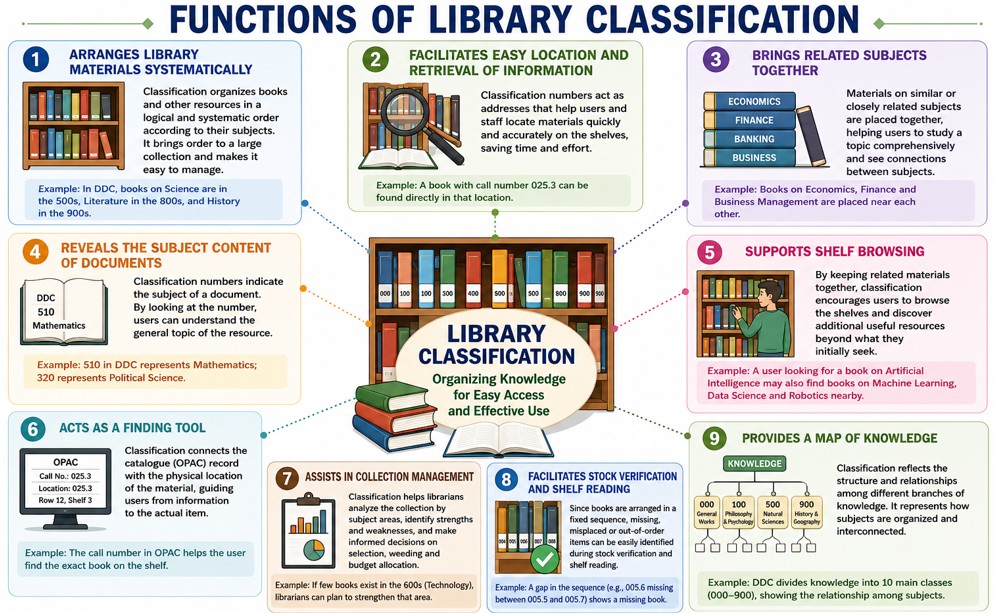
Library classification is a systematic method of organizing library materials based on their subjects and assigning them specific class numbers or notations. This process is crucial in a library because it arranges resources in a logical order, which facilitates easy access to information. Using classification schemes such as the Dewey Decimal Classification (DDC), Universal Decimal Classification (UDC), and Colon Classification (CC), libraries can effectively manage vast collections of knowledge in a way that is both efficient and user-friendly. Beyond simply organizing books on shelves, library classification serves various functions that aid in information retrieval, collection management, and the overall organization of knowledge.
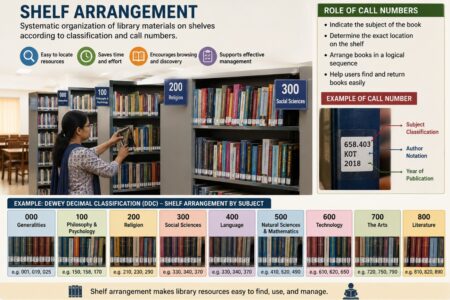
- Arranges Library Materials Systematically: One of the primary functions of library classification is to organize library materials in a systematic and logical manner. Libraries house thousands, or even millions, of information resources covering a wide range of subjects. Without a systematic arrangement, finding specific materials can become extremely difficult and time-consuming. Classification organizes documents based on their subject content and assigns each item a unique class number. This system ensures that materials are shelved in a consistent sequence, making the library collection orderly and manageable. For instance, in the Dewey Decimal Classification (DDC) system, books on science are grouped in the 500s, while literature books are placed in the 800s. This structure allows users to navigate the collection more efficiently.
- Facilitates Easy Location and Retrieval of Information: Library classification is an effective tool for locating and retrieving information. Each classified document is assigned a call number, which serves as its address within the library. Users can find this call number through the library catalog or Online Public Access Catalog (OPAC) and use it to locate the material on the shelves. This systematic approach saves time and effort by eliminating the need to search through large sections of the collection. For example, a student looking for a book on cataloging can use the assigned classification number to go directly to the appropriate shelf location, rather than browsing through unrelated materials.
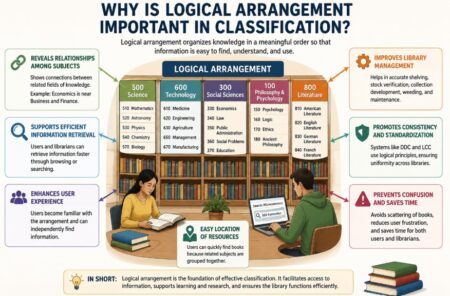
- Brings Related Subjects Together: The classification system serves an important function by grouping materials on similar or closely related subjects. This arrangement allows users to find multiple resources on a topic in a single location. By organizing related subjects together, classification illustrates the connections between different fields of knowledge and facilitates comprehensive study and research. For instance, books on economics, banking, finance, and business management are typically located near one another, as these disciplines are closely interconnected. Consequently, users can access a wider variety of relevant materials while exploring a specific subject area.
- Reveals the Subject Content of Documents: Classification numbers provide important insights into the subject matter of a document. By analyzing a classification number, librarians and users can identify the general or specific topics covered by a resource. This functionality is particularly helpful during cataloging, reference services, or collection management. For instance, in the Dewey Decimal Classification (DDC) system, books classified under 510 pertain to mathematics, while those under 020 are related to library and information science. Therefore, the classification number acts not only as a location indicator but also as a representation of a document’s intellectual content.
- Supports Shelf Browsing: Library classification improves the browsing experience by organizing related materials together. Many users visit a library with a general topic in mind rather than searching for a specific title. In such cases, browsing the shelves can lead to the discovery of additional relevant resources. Classification aids this process by placing books on similar subjects in close proximity. For example, a user looking for a book on artificial intelligence may come across related titles on machine learning, data science, robotics, and computer programming in the same section. This arrangement encourages unexpected discoveries and enhances learning opportunities.
- Acts as a Finding Tool: Classification serves as an essential tool for finding resources within a library. It links catalog records to the physical arrangement of materials, allowing users to transition from a bibliographic entry to the actual document. Whether utilizing a traditional card catalog or a modern Online Public Access Catalog (OPAC), users depend on classification numbers to identify where resources are located. For instance, if an OPAC record shows the call number 025.3, users can use that number to find the corresponding book in the library’s collection. In this way, classification acts as a bridge between discovering information and accessing it physically.
- Assists in Collection Management: Library classification is crucial for developing and managing collections. By organizing materials into subject categories, it enables librarians to evaluate the strengths and weaknesses of their collections. This classification helps identify well-represented areas as well as those that may need additional resources. For instance, a librarian might find that the library has a vast collection in computer science but very few books on environmental studies. This information supports informed decision-making regarding acquisitions, budgeting, and collection development policies.
- Facilitates Stock Verification and Shelf Reading: Classification greatly simplifies the tasks of stock verification and shelf-reading in libraries. By arranging books according to a predetermined numerical or alphanumerical sequence, librarians can easily verify whether items are in their correct locations. When this classified order is disrupted, it becomes easier to spot misplaced, missing, or lost books. During inventory checks, staff can quickly identify any gaps in the collection and take appropriate action. This systematic arrangement enhances collection control and helps maintain the accuracy and reliability of library holdings.
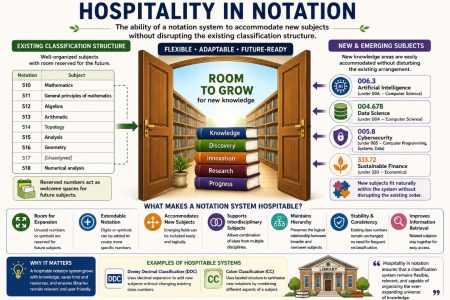
- Provides a Map of Knowledge: Library classification can be seen as a map of human knowledge because it organizes subjects based on their logical relationships. Classification schemes divide knowledge into broad disciplines, which are then further subdivided into more specific topics. This hierarchical structure helps users understand how different subjects are interconnected. For instance, in the Dewey Decimal Classification (DDC) system, natural sciences are categorized under the 500s, while social sciences are found under the 300s. Within each category, more specific subjects are systematically arranged, illustrating the overall structure and organization of knowledge.
Library classification is more than just a way to arrange books on shelves; it serves multiple important functions. It helps organize knowledge, facilitates information retrieval, supports browsing, assists in collection management, and improves overall library services. By grouping related subjects together and providing a systematic structure for organizing knowledge, classification enhances the effectiveness of both traditional and digital libraries. As libraries continue to evolve in the information age, the role of library classification remains crucial for ensuring efficient access to knowledge and information.
Reference Articles:
- Broughton, V. (2015). Essential Classification. Facet Publishing.
- Brown, J. D. (1898). Manual of Library Classification and Shelf Arrangement. Library supply Company.
- Carter, R. C., & Kao, M. L. (2020). Cataloging and Classification for Library Technicians, Second Edition (2nd ed.). Routledge. https://doi.org/10.4324/9781003063759
- Clarke, R. I. (2021). Library Classification Systems in the U.S.: Basic Ideas and Examples. In Cataloging and Classification. Routledge.
- Idrees, H. (2012). Library Classification Systems and Organization of Islamic Knowledge. Library Resources & Technical Services, 56(3), Article 3. https://doi.org/10.5860/lrts.56n3.171
- Satija, M. P., & Martinez-Avila, D. (2015). Features, Functions and Components of a Library Classification System in the LIS tradition for the e-Environment. Journal of Information Science Theory and Practice, 3(4), 62–77. https://doi.org/10.1633/JISTaP.2015.3.4.5
- Zins, C., & Santos, P. L. V. A. C. (2011). Mapping the knowledge covered by library classification systems. Journal of the American Society for Information Science and Technology, 62(5), 877–901. https://doi.org/10.1002/asi.21481


2 Comments
Materials in helpful sequence convenient to the readers, research workers and librarians.http://www.chillyads.com/pets/horses/
Thanks Mr class Jee for your valuable comment. (Admin)