
In modern connectivity, networks form the foundation of our digital world, enabling the seamless exchange of information and resources across varying distances. As we delve into the intricacies of networking, three fundamental categories emerge: Local Area Networks (LANs), Metropolitan Area Networks (MANs), and Wide Area Networks (WANs). Each of these network types serves a distinct purpose and exhibits unique characteristics that cater to different scales of communication requirements. Understanding the differences between LANs, MANs, and WANs is crucial in comprehending how our interconnected world operates and how organizations tailor their network infrastructures to suit specific needs. LAN, MAN & WAN
- Local Area Networks (LANs), the smallest of the three categories, are confined to a limited geographical area, typically within a single building or campus. LANs facilitate swift communication between devices such as computers, printers, and servers, empowering users to share resources and data effortlessly. Employed in homes, offices, and educational institutions, LANs offer high data transfer speeds and low latency, fostering an environment conducive to collaboration and resource sharing.
- Metropolitan Area Networks (MANs) extend their reach beyond LANs, covering larger geographic regions like cities or towns. These networks bridge the gap between local and wide area networks, catering to businesses and organizations that require interconnection across a metropolitan expanse. MANs balance coverage and performance, enabling entities within a city to communicate effectively while maintaining relatively faster data transfer rates.
- Wide Area Networks (WANs) encompass the broadest scope, connecting networks across vast distances that can span entire countries or even continents. WANs utilize a combination of technologies, such as leased lines, satellites, and internet connections, to facilitate global communication. While WANs offer unparalleled connectivity on a grand scale, they may exhibit higher latency due to the extensive distances data must traverse.
The distinctions between LANs, MANs, and WANs lie in their coverage areas, data transfer speeds, and purposes. LANs focus on localized communication, fostering immediate resource sharing, while MANs bridge the gap between local and wide-reaching networks suitable for urban connectivity. On the other hand, WANs extend their reach globally, facilitating communication across vast expanses despite potential latency. By grasping the nuances of these network types, we gain a clearer perspective on the intricate web of connectivity that underpins our interconnected world.
1.1 Difference Between LAN, MAN & WAN:
Local Area Networks (LANs), Metropolitan Area Networks (MANs), and Wide Area Networks (WANs) are three distinct categories of computer networks, each designed to serve specific geographical areas and communication needs. Here’s a concise overview of the key differences between them:
| Aspect | LAN (Local Area Network) | MAN (Metropolitan Area Network) | WAN (Wide Area Network) |
|---|---|---|---|
| Geographic Coverage | LANs cover a small and limited geographic area, typically within a single building, office, campus, or a small group of nearby buildings. Short distances and high data transfer speeds characterize them. | MANs span a larger geographical area, such as a city or a metropolitan region. They connect multiple LANs within this defined geographic boundary, allowing medium-distance communication. | WANs cover vast geographic regions, ranging from a country to a continent or even the entire globe. WANs are designed to connect networks across long distances, often using public or private telecommunication infrastructure. |
| Data Transfer Speed | LANs typically offer high data transfer speeds, often measured in gigabits per second (Gbps). This high speed is possible because LANs cover relatively short distances, minimizing data transmission delays. | MANs offer moderate data transfer speeds, generally lower than LANs but higher than WANs. The speed of a MAN depends on the technologies used and the network’s specific design. | WANs generally have lower data transfer speeds compared to LANs and MANs. The vast distances data must travel in WANs can result in higher latency and slower data transmission rates. |
| Ownership and Infrastructure | LANs are typically owned and managed by a single organization, such as a business, school, or household. The organization has complete control over the LAN’s hardware and configuration. | MANs can be owned by a single or multiple organizations working in collaboration. They often require shared infrastructure and coordination among multiple entities. | WANs often rely on a combination of public and private infrastructure. They may use telecommunications, internet service providers (ISPs), and other third-party services to connect distant locations. |
| Typical Use Cases | LANs are used for local communication within a building or campus. They are ideal for file sharing, printer access, and internal device communication. | MANs are suitable for connecting multiple LANs within a city or metropolitan area. Businesses and institutions often use them to interconnect branch offices, data centers, or remote facilities. | WANs are designed for long-distance communication and are commonly used by organizations with geographically dispersed locations. They enable global connectivity, including internet access, remote branch connections, and wide-scale data sharing. |
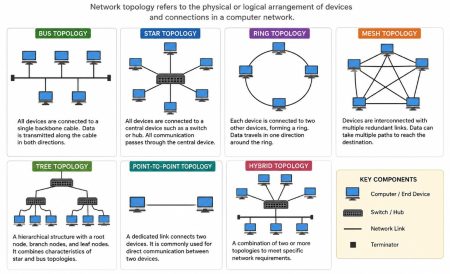
| Topology | LANs typically use simple topologies like star, bus, or ring within their confined areas. Ethernet and Wi-Fi are common technologies for LANs. | MANs may employ more complex topologies, such as ring or mesh, depending on the specific requirements of their metropolitan area. | WANs often use more intricate topologies, including fully meshed networks or hub-and-spoke configurations. They require sophisticated routing and switching technologies to manage long-distance traffic. |
| Latency and Reliability | LANs have minimal latency and high reliability due to their small coverage area, which reduces the chances of data packet loss or delays. | MANs typically offer moderate latency and reliability. While they are more robust than WANs, they may still experience occasional latency or network interruptions. | WANs can have higher latency and may be less reliable than LANs and MANs. Latency can vary significantly depending on the physical distance and the quality of the network infrastructure. |
| Cost and Complexity | LANs are generally the least expensive to set up and maintain since they cover small areas and require relatively simple equipment. | MANs can be more expensive and complex to establish as they involve more extensive infrastructure and may require collaboration with multiple service providers. | WANs are often the most expensive and complex, especially for global networks. They involve significant costs for long-distance data transmission and require advanced networking expertise. |
| Security | LANs are easier to secure since they are within a specific location. Security measures are typically implemented at the network perimeter. | MANs may require additional security measures due to their larger coverage area. Encryption and access control become more critical in MANs. | WANs, especially those connected to the internet, demand robust security protocols to protect data during long-distance transmissions. Firewalls, VPNs, and intrusion detection systems are commonly used. |
| Scalability | LANs are highly scalable within their defined boundaries. Adding new devices or expanding coverage within the exact location is relatively straightforward. | MANs can be scaled to accommodate additional locations or users within the metropolitan area but may require infrastructure upgrades and increased complexity. | WANs offer the greatest scalability, allowing organizations to connect numerous locations globally. However, scalability may involve significant logistical and financial considerations. |
| Examples | Examples of LANs include home networks, small office networks, and university campus networks. | A citywide Wi-Fi network or a network connecting multiple hospitals within a city are examples of MANs. | The global internet itself is the largest and most well-known WAN. Private WANs connecting multinational corporations’ offices worldwide are also common examples. |
In summary, LANs, MANs, and WANs differ primarily in geographic coverage, data transfer speeds, ownership, and typical use cases. Understanding these differences helps organizations select the appropriate network type to meet their communication requirements.







1 Comment
I wish you all the best