
In today’s interconnected world, the dissemination of knowledge plays a pivotal role in shaping the trajectory of human progress and innovation. As the global community strives to address complex challenges and unlock the boundless potential of collective intelligence, the concept of knowledge diffusion emerges as a transformative force in academic, scientific, and societal realms.
Knowledge diffusion, often referred to as the “spreading of ideas,” transcends the confines of traditional academia and extends into every aspect of our digital lives. From the rapid sharing of cutting-edge research findings to the exchange of creative insights through multimedia content, the internet and social media have revolutionized the way knowledge travels, amplifying its impact in ways unimaginable just a few decades ago. It is the lifeblood of progress and innovation in our ever-evolving world. It encompasses disseminating, sharing, and transferring knowledge, information, and ideas from one individual, organization, or community to another. Just as a pebble creates ripples that extend across a pond, the diffusion of knowledge creates a ripple effect that catalyzes learning, collaboration, and societal advancement. It is a dynamic process that transcends disciplinary boundaries, connecting diverse fields of study and igniting a collective pursuit of wisdom. By exploring the intricacies of knowledge diffusion, we can unlock its transformative power and harness its potential to shape the future of academia, science, and society.

Till this point, researchers have employed a wide range of theories, conceptual frameworks, models, and approaches to investigate the multifaceted aspects of knowledge diffusion. These inquiries seek to answer fundamental questions surrounding the process, dynamics, and outcomes of community knowledge diffusion. By delving into these research questions, scholars aim to shed light on:
(a) How knowledge is produced: Understanding the origins and creation of knowledge is crucial to comprehending its diffusion. Researchers explore the mechanisms and sources through which knowledge is generated, including academic research, scientific discoveries, technological innovations, and creative insights.
(b) The kind of knowledge diffused in the community: Knowledge can take various forms, such as theoretical frameworks, practical expertise, empirical findings, or experiential wisdom. Researchers investigate the nature, content, and characteristics of the knowledge disseminated within communities, discerning its relevance, applicability, and potential impact.
(c) The stages in knowledge diffusion: Knowledge diffusion is a dynamic process that unfolds over time. Scholars analyze the different stages, phases, or steps involved in disseminating knowledge, ranging from its initial generation to its adoption, adaptation, and eventual utilization by individuals or groups.
(d) The various modes of knowledge diffusion: Knowledge spreads through diverse channels, modes, and mediums. Researchers examine the different pathways through which knowledge is diffused, including formal channels such as academic publications, conferences, and educational institutions, as well as informal channels such as social networks, online platforms, and community interactions.
(e) Social structure and nature of knowledge diffusion: The social context and structure within which knowledge diffusion occurs significantly influence its patterns and outcomes. Scholars explore the social networks, relationships, and institutions that facilitate or hinder the spread of knowledge. They also examine how cultural, economic, and organizational factors shape the diffusion process and its effectiveness in different communities.
By addressing these research questions, scholars strive to unravel the complexities of knowledge diffusion and gain insights into how knowledge spreads, impacts society, and contributes to innovation and progress. The diverse theories, conceptual frameworks, models, and approaches employed in these investigations offer valuable perspectives and methodologies for understanding and optimizing the diffusion of knowledge in various academic and societal contexts.
What is Knowledge Diffusion?
Knowledge diffusion is the process by which knowledge, information, ideas, or innovations spread and disseminate from one individual, group, organization, or community to others. It involves transmitting and sharing knowledge through various channels, enabling its adoption, adaptation, and utilization by a broader audience. Knowledge diffusion is crucial in advancing societies, economies, and technological progress.
However, according to Chen, Chaomei, and Hicks, Diana (2004): “Knowledge diffusion can be defined as the adaptations and applications of knowledge documented in scientific publications and patents.”
Knowledge diffusion is not limited to any specific domain; it encompasses various fields, including academia, science, technology, arts, and social sciences. In academia, for instance, knowledge diffusion involves publishing research findings, exchanging scholarly ideas at conferences, and communicating new insights within academic communities.
Various factors can influence the speed and extent of knowledge diffusion, such as the accessibility of information, the effectiveness of communication channels, the openness of individuals and organizations to share knowledge, and the social and cultural context within which the diffusion occurs. Knowledge diffusion is transformative in fostering innovation, collaboration, and learning across disciplines and geographical boundaries. It facilitates the collective accumulation of knowledge and the generation of new ideas, driving progress and societal development.
In recent times, the internet and social media have significantly amplified the process of knowledge diffusion, allowing for rapid and widespread dissemination of information, research findings, and creative content among a global audience. Studying knowledge diffusion and understanding its mechanisms and dynamics is essential for researchers, policymakers, and individuals seeking to leverage the power of shared knowledge to address challenges, promote growth, and shape a more informed and connected world.
Why Knowledge Diffusion Is Important in Today’s Knowledge-Based Economy
In today’s knowledge-based economy, knowledge diffusion plays a central role in driving innovation, competitiveness, and sustainable development. Unlike traditional economies that depended heavily on physical labor and natural resources, the modern economy thrives on information, expertise, and creativity. Knowledge diffusion ensures that valuable insights, research findings, and technological advancements are shared across individuals, organizations, and nations, enabling continuous improvement and collective growth. For example, when universities share open-access research or industries collaborate through knowledge networks, they accelerate technological progress and create new opportunities for innovation.
Effective knowledge diffusion helps reduce duplication of effort and enhances productivity. When organizations exchange best practices, such as improved supply chain management in manufacturing or new data security methods in information technology, others can learn, adapt, and implement these innovations faster. This not only saves time and resources but also fosters a culture of collaboration. In developing countries, knowledge diffusion can be transformative; for instance, agricultural knowledge shared through mobile platforms or online training enables farmers to adopt modern techniques, increasing yields and improving livelihoods.
Moreover, knowledge diffusion fuels economic growth by bridging the gap between knowledge creation and its practical application. Industries that quickly absorb new scientific discoveries, such as biotechnology, artificial intelligence, or renewable energy, gain a competitive advantage and contribute to national economic resilience. Governments and institutions also benefit when policies and educational reforms are informed by shared research and global experiences. In essence, knowledge diffusion transforms information into innovation, individual learning into institutional progress, and local insights into global development. In a world where information travels instantly, fostering efficient knowledge diffusion is not merely beneficial; it is essential for progress in every sector of society.
The Main Goals and Outcomes of Knowledge Diffusion
Knowledge diffusion is a fundamental process that underpins innovation, education, and economic growth in the modern world. It involves the systematic transmission of ideas, information, and expertise from one source to another, ensuring that knowledge created in one context can be adapted and applied elsewhere. In a globalized and technology-driven economy, the importance of knowledge diffusion cannot be overstated. It enables individuals, organizations, and nations to learn, evolve, and solve complex problems collectively. The following sections provide a detailed discussion of the main goals and outcomes of knowledge diffusion.
- Promoting Innovation and Creativity: One of the central goals of knowledge diffusion is to stimulate innovation and creativity by encouraging the exchange of ideas across disciplines and institutions. When new knowledge is disseminated, it becomes a catalyst for generating fresh perspectives and innovative solutions. For example, the diffusion of biotechnology research from universities to the pharmaceutical industry has led to groundbreaking medical treatments and vaccines. Similarly, the open sharing of coding frameworks and data in the technology sectors, such as open-source software, has accelerated innovation in artificial intelligence, cybersecurity, and digital transformation.
Knowledge diffusion helps prevent stagnation by allowing innovators to build upon existing ideas rather than starting from scratch. The continuous exchange of research outcomes, technological blueprints, and best practices ensures that creative thinking becomes a shared endeavor, benefiting not only inventors but society as a whole. - Enhancing Learning and Capacity Building: Knowledge diffusion significantly contributes to education, lifelong learning, and professional development. It ensures that information is not confined within academic or corporate boundaries but is accessible to learners everywhere. Through online learning platforms, open-access journals, and institutional repositories, individuals can gain exposure to the latest research and emerging trends in their fields.
For instance, platforms like Research4Life, Coursera, and edX democratize knowledge by offering free or affordable access to scientific publications and courses from leading universities. Libraries also play a crucial role by organizing training programs, workshops, and digital literacy sessions to enhance research and information-seeking skills. In developing countries, such access empowers students, educators, and professionals to strengthen their expertise, improving employability and innovation capacity. Ultimately, knowledge diffusion enhances human capital, which is the foundation of a nation’s intellectual and economic progress. - Improving Organizational Performance and Efficiency: In the context of organizations, knowledge diffusion directly impacts productivity and effectiveness. When employees share their insights, lessons learned, or innovative practices, it creates a cumulative knowledge base that strengthens institutional performance. For example, multinational corporations like Google, IBM, or Toyota promote internal knowledge-sharing networks that allow employees from different countries to exchange experiences and solutions to common challenges.
This internal diffusion of knowledge helps avoid repetition of mistakes, reduces operational costs, and enhances service quality. Similarly, academic and research institutions often hold seminars, symposia, or communities of practice where members exchange findings and discuss challenges. Such initiatives foster a culture of collaboration and continuous improvement, ensuring that the organization remains adaptive and competitive in a rapidly changing environment. - Bridging Knowledge Gaps and Reducing Inequality: Knowledge diffusion serves as an equalizing force that helps bridge social, economic, and technological divides. In many developing countries, access to relevant information and expertise can dramatically improve the quality of life and promote inclusive growth. For instance, the diffusion of agricultural knowledge through digital platforms or radio programs helps farmers adopt modern farming techniques, improve soil fertility, and increase crop yields.
Similarly, public health campaigns that share knowledge about disease prevention, sanitation, or nutrition have saved countless lives. By ensuring that information reaches marginalized and rural communities, knowledge diffusion contributes to social justice and equitable development. Furthermore, open-access scientific repositories and global collaborations allow developing countries to benefit from research produced elsewhere without bearing heavy financial burdens. Hence, knowledge diffusion empowers people at all levels, narrowing the gap between information-rich and information-poor societies. - Supporting Evidence-Based Decision Making: Another significant outcome of knowledge diffusion is the promotion of evidence-based decision making in policy formulation, business strategy, and research planning. When knowledge is freely exchanged and made accessible, decision-makers can rely on data-driven insights rather than assumptions or intuition. For example, during global crises like the COVID-19 pandemic, the rapid diffusion of medical research and data among scientists and governments facilitated faster policy responses and the development of vaccines.
In the corporate sector, knowledge diffusion supports evidence-based management by allowing leaders to analyze past trends, employee feedback, and market data before making strategic choices. Academic and governmental institutions also rely on shared research and statistical reports to design effective education, healthcare, and environmental policies. Therefore, the flow of reliable information across networks is essential for making informed, transparent, and impactful decisions. - Advancing Global Collaboration and Sustainable Development: In an interconnected world, global collaboration has become vital for addressing issues that transcend national boundaries, such as climate change, poverty, and digital inequality. Knowledge diffusion facilitates this collaboration by enabling experts, organizations, and governments to share solutions, technologies, and best practices. For example, international conferences and research partnerships allow scientists from different countries to exchange climate data and jointly develop clean energy technologies.
The United Nations Sustainable Development Goals (SDGs) explicitly emphasize the importance of partnerships and knowledge sharing as pathways to achieving sustainable progress. Open science initiatives and international academic networks play a critical role in aligning global efforts toward innovation and inclusivity. By diffusing knowledge across sectors and regions, societies can build resilience, encourage responsible innovation, and promote global peace and prosperity.
The goals and outcomes of knowledge diffusion are multifaceted and deeply interconnected. It promotes innovation, enhances learning, boosts organizational performance, reduces inequality, enables evidence-based decisions, and fosters global collaboration. The benefits extend beyond individual or institutional success; they shape how societies evolve and address emerging challenges. As the world continues to shift toward a knowledge-based economy, investing in systems that facilitate the free and ethical flow of information is essential. Encouraging openness, digital literacy, and collaborative networks ensures that knowledge diffusion remains a driving force for economic growth, social development, and sustainable global progress.
The Key Stages Involved in the Process of Knowledge Diffusion
Knowledge diffusion is a dynamic and multidimensional process that enables the transfer of knowledge, skills, and innovations from one source to another, ensuring that information is transformed into practical understanding and action. It is not a single event but a series of interrelated stages through which knowledge moves from creation to widespread application. Each stage plays a vital role in determining how effectively knowledge is communicated, understood, and utilized across individuals, organizations, or societies. The following sections discuss the key stages involved in the process of knowledge diffusion in detail.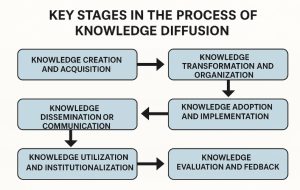
- Knowledge Creation and Acquisition: The first stage of knowledge diffusion begins with the creation or acquisition of new knowledge. Knowledge can originate from various sources such as scientific research, professional experience, experimentation, or collaboration. Universities, research institutions, industries, and libraries are major contributors to this stage. For example, a research team may develop a new method for renewable energy production, or a library may design a new information retrieval system.
In addition to creation, knowledge can also be acquired externally through partnerships, literature reviews, training programs, or digital platforms. At this stage, knowledge is often tacit, embedded in people’s experiences, or explicit, documented in reports, journals, or databases. The quality and credibility of this knowledge are essential since they influence how effectively it can be shared and applied in later stages. - Knowledge Transformation and Organization: Once knowledge is created or collected, it must be organized, refined, and transformed into formats that are understandable and usable by others. This stage involves structuring raw information into meaningful content through documentation, categorization, and contextual interpretation. For example, a research article may be summarized into a policy brief, or raw experimental data may be transformed into visual charts and analytical reports.
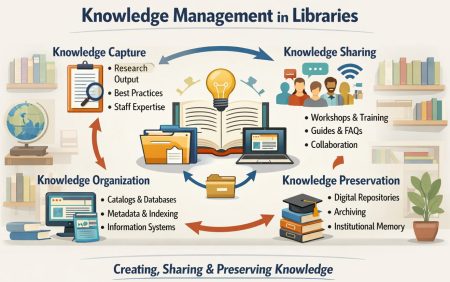
In organizations, knowledge management systems and databases play a critical role at this stage by storing and structuring information so it can be easily accessed and retrieved. Librarians, information managers, and data curators often contribute to this process by ensuring accuracy, standardization, and accessibility. The transformation stage essentially prepares knowledge for efficient communication and practical use. - Knowledge Dissemination or Communication: The third stage involves the dissemination or communication of knowledge to intended audiences. This is the core phase of diffusion, where the knowledge moves beyond its origin and reaches new users. Dissemination can occur through both formal and informal channels—such as academic journals, conferences, workshops, institutional repositories, websites, and social media platforms.
For instance, when North South University Library shares research guides, workshops, or e-resources via its website or social media, it is actively participating in knowledge dissemination. Similarly, open-access databases like Research4Life or platforms like Google Scholar facilitate global access to academic and professional knowledge. Effective dissemination depends on clear communication, appropriate media selection, and audience understanding. The broader and more inclusive the reach, the greater the impact of diffusion. - Knowledge Adoption and Implementation: After knowledge is shared, the next stage is adoption and implementation, where individuals or organizations decide to accept, adapt, and apply the knowledge in their own contexts. This phase transforms theoretical understanding into practical outcomes. For example, a university may adopt an innovative teaching method learned from another institution, or a healthcare organization may implement a new diagnostic technology based on shared research.
The adoption stage often involves experimentation, adaptation, and contextualization to meet local or institutional needs. Factors such as leadership support, resource availability, and organizational culture significantly influence the success of this stage. Without proper adoption and application, even the most well-disseminated knowledge fails to create a meaningful impact. - Knowledge Utilization and Institutionalization: Once adopted, knowledge becomes utilized and institutionalized when it becomes a routine part of practices, policies, or systems. This stage represents the long-term integration of knowledge into organizational or societal structures. For example, when digital literacy training becomes a standard part of library user education programs, or when open-access policies become embedded in university research practices, the knowledge has been institutionalized.
At this stage, knowledge begins to generate sustained value by influencing decisions, improving performance, or shaping innovation. Institutionalization also ensures continuity so that even as people change roles or organizations evolve, the knowledge remains embedded within processes and systems. - Knowledge Evaluation and Feedback: The final stage of knowledge diffusion involves evaluation and feedback, where the effectiveness and impact of the diffusion process are assessed. Evaluation helps determine whether the shared knowledge has achieved its intended outcomes and how it can be improved. For instance, organizations may conduct surveys, performance analyses, or impact studies to assess how new knowledge has influenced productivity or decision-making.
Feedback mechanisms are vital because they close the loop of the diffusion cycle, allowing creators and disseminators to refine their methods, update content, or identify barriers to adoption. Continuous feedback promotes learning and ensures that the diffusion process remains adaptive, relevant, and sustainable.
The process of knowledge diffusion involves a sequence of interconnected stages: creation and acquisition, transformation and organization, dissemination, adoption and implementation, utilization and institutionalization, and finally, evaluation and feedback. Each stage contributes to transforming knowledge from a localized insight into a widely shared and applied resource. The effectiveness of knowledge diffusion depends on how well each stage is managed—ensuring that knowledge remains accurate, accessible, and actionable. In today’s interconnected and fast-evolving world, understanding and optimizing these stages is essential for fostering innovation, informed decision-making, and long-term societal progress.



2 Comments
Please, is it possible for you to send me the PDF of this wonderful article? I will really appreciate because my PhD.study is along this.
It really seems like we are trying very, very hard to come up with a solution for everything.Why do we need this? Who is wasting their money trying to develop a method for Identifying, analyzing, and developing a case use for something or toss it in the waste basket.This line of reasoning is dangerous to humans at best. We are not predictable one on one. Only in large masses do we become predictable up to about 66% of the time. What humans will do is the same thing they always do with something they don’t understand. Kill It. There is a good reason we have not been visited by aliens on a mass scale. They know we will either put them in jail where they will be presumed innocent for how ever long the police department wants to keep them or until someone or something waltz’s in and accuses them of something. We might also eat them if they taste good, or we would take them hostage and send their planet a ransom note. For sure though…they would not encounter very many “cows” )(humans) with any signs of advanced communications skills, engineering skills, Astrology, etc…We are way backward compared to intelligent life forms that have mastered interplanetary travel. Way behind. Check it out…sometimes we do shit for no fucking reason too…that should go over well.