Knowledge Creation in an Organizational Context
Knowledge creation in an organizational context refers to the continuous and systematic process through which an organization generates, develops, shares, and applies knowledge to enhance performance, decision-making, and innovation. It involves transforming individual experiences, skills, and insights into shared organizational knowledge that can be reused across departments and over time. For example, when employees identify recurring problems in their daily work and propose improved procedures, their individual understanding gradually becomes part of the organization’s standard practices.
In practice, organizations create knowledge through both formal and informal mechanisms. Formal processes include staff training programs, research and development activities, project reports, policy manuals, and documented best practices. For instance, after completing a major project, a team may prepare a “lessons learned” report that helps future teams avoid similar challenges. Informal processes, such as peer discussions, mentoring, and collaborative problem-solving, are equally important. For example, when senior staff mentor new employees and share practical tips gained from experience, tacit knowledge that is not written down becomes embedded in the organization.
Both tacit knowledge and explicit knowledge play critical roles in organizational knowledge creation. Tacit knowledge includes personal expertise, intuition, and skills—such as a librarian’s ability to guide users efficiently to relevant resources or a technician’s troubleshooting experience. Explicit knowledge, on the other hand, is codified and easily shared, such as user manuals, databases, guidelines, or standard operating procedures. Knowledge creation occurs when tacit knowledge is articulated into documents or systems, or when explicit knowledge is internalized by staff through practice and training.
Difference Between Organizational Knowledge and Individual Knowledge
Organizational knowledge and individual knowledge differ primarily in their scope, ownership, and application, even though they are closely interconnected. Individual knowledge resides within a person and is shaped by personal education, skills, experiences, and insights. It is often tacit and may include problem-solving skills, professional judgment, or practical know-how gained through daily work. For example, an experienced employee may know how to handle complex tasks efficiently or resolve user complaints based on years of hands-on experience, even if this knowledge is not formally documented.
In contrast, organizational knowledge exists beyond any single individual and is embedded within the organization’s structures, processes, systems, and culture. It includes documented policies, standard operating procedures, databases, institutional guidelines, and shared best practices that can be accessed and used by multiple members of the organization. For instance, when an organization documents workflows, creates training manuals, or maintains a centralized knowledge repository, individual insights are transformed into collective assets that remain available even when staff members leave.
Another key difference lies in continuity and transferability. Individual knowledge may be lost if an employee leaves the organization, retires, or changes roles. Organizational knowledge, however, is designed to be retained and transferred over time through documentation, training, and knowledge-sharing systems. For example, an organization that regularly records meeting outcomes, project evaluations, and lessons learned ensures that valuable knowledge is preserved for future use.
Finally, while individual knowledge is often personal and context-specific, organizational knowledge is standardized and aligned with institutional goals. Individual knowledge supports personal performance, whereas organizational knowledge supports consistency, coordination, and strategic decision-making. When organizations effectively capture and integrate individual knowledge into organizational systems, they create a sustainable knowledge base that enhances learning, efficiency, and long-term organizational success.
Key Stages in the Organizational Knowledge Creation Process
In today’s knowledge-driven environment, organizations rely heavily on their ability to create, manage, and use knowledge effectively. Organizational knowledge creation is not a single event; rather, it is a continuous and dynamic process through which ideas, experiences, and information are transformed into valuable organizational assets. Understanding the key stages involved in this process helps organizations strengthen learning, improve decision-making, and foster innovation. This article discusses the major stages of the organizational knowledge creation process in a clear and practical manner.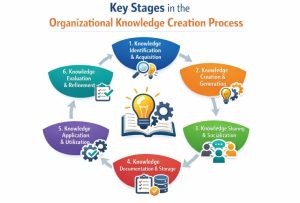
- Knowledge Identification and Acquisition: The first stage of organizational knowledge creation involves identifying existing knowledge and acquiring new knowledge from both internal and external sources. Internally, organizations recognize the skills, expertise, and experiences of their employees. Externally, knowledge may be acquired through research, professional networks, training programs, customer feedback, or collaboration with other organizations. For example, an organization may identify that certain staff members possess specialized problem-solving skills and seek to capture that expertise, or it may acquire new knowledge by attending workshops or adopting best practices from industry leaders.
- Knowledge Creation and Generation: At this stage, new knowledge is generated through interaction, learning, and experience. Employees create knowledge by working together, experimenting with new ideas, solving problems, and reflecting on their experiences. Brainstorming sessions, team discussions, research activities, and innovation projects are common ways knowledge is created. For instance, when a project team develops a new service workflow based on trial and error, the insights gained during this process represent newly created organizational knowledge.
- Knowledge Sharing and Socialization: Knowledge creation becomes meaningful only when it is shared. This stage focuses on the exchange of knowledge among individuals and groups within the organization. Both formal channels (meetings, workshops, training sessions) and informal interactions (peer discussions, mentoring, collaborative work) play a vital role. For example, when experienced employees share their practical insights with newer staff through mentoring, personal knowledge is transferred and gradually becomes collective knowledge. A culture that encourages openness and collaboration significantly strengthens this stage.
- Knowledge Documentation and Storage: Once knowledge is shared, it needs to be captured and stored so that it can be reused in the future. This stage involves converting knowledge into documented forms such as manuals, guidelines, reports, databases, or digital repositories. Documentation helps transform experience-based knowledge into explicit organizational resources. For example, recording “lessons learned” after completing a project ensures that valuable insights are not lost and can guide future initiatives.
- Knowledge Application and Utilization: The true value of knowledge creation lies in its application. In this stage, organizations use stored and shared knowledge to improve operations, make informed decisions, solve problems, and innovate. Knowledge is applied when employees follow documented procedures, use past experiences to address new challenges, or implement improved practices based on earlier learning. For instance, using previous project evaluations to plan a new project demonstrates effective knowledge utilization.
- Knowledge Evaluation and Refinement: The final stage involves reviewing and refining existing knowledge to ensure its relevance and accuracy. Organizational knowledge must be updated as environments, technologies, and user needs change. Feedback, performance evaluation, and continuous learning help organizations identify outdated knowledge and improve existing practices. For example, revising policies or guidelines based on user feedback and performance outcomes ensures that organizational knowledge remains current and effective.
The organizational knowledge creation process is a continuous cycle that moves from identifying and generating knowledge to sharing, storing, applying, and refining it. Each stage is interconnected, and weaknesses in any stage can limit the overall effectiveness of knowledge management. Organizations that consciously support these stages through leadership, culture, and appropriate systems are better positioned to learn, adapt, and innovate. By understanding and strengthening the key stages of knowledge creation, organizations can build a sustainable knowledge base that supports long-term growth and success.
Contribution of Tacit and Explicit Knowledge to Organizational Learning
Tacit knowledge and explicit knowledge both play essential and complementary roles in organizational learning. Tacit knowledge refers to personal, experience-based knowledge that is difficult to formalize or articulate, such as skills, intuition, insights, and professional judgment. It develops through hands-on experience, observation, and social interaction. In organizations, tacit knowledge contributes to learning by enabling employees to solve complex problems, adapt to new situations, and apply creativity in their work. For example, an experienced staff member’s ability to handle unexpected challenges efficiently is rooted in tacit knowledge gained over time. When this knowledge is shared through mentoring, teamwork, or informal discussions, it enhances collective learning and strengthens organizational capability.
Explicit knowledge, on the other hand, is formalized, documented, and easily communicated. It includes manuals, policies, procedures, reports, databases, and training materials. Explicit knowledge contributes to organizational learning by ensuring consistency, standardization, and continuity across the organization. For instance, documented guidelines and best practices allow employees to learn established methods quickly and perform tasks according to organizational standards. Explicit knowledge also supports large-scale knowledge dissemination, making it possible for learning to occur beyond individual interactions.
Organizational learning is most effective when tacit and explicit knowledge interact dynamically. Tacit knowledge becomes valuable to the organization when it is articulated and documented as explicit knowledge, such as converting personal experience into written guidelines or case studies. Conversely, explicit knowledge contributes to learning when employees internalize it through practice, training, and experience, thereby transforming it into tacit understanding. This continuous interaction between tacit and explicit knowledge enables organizations to learn, innovate, and adapt over time, creating a sustainable learning environment that supports long-term organizational growth and effectiveness.
Theoretical Models Explaining How Organizations Create and Expand Knowledge
Understanding how organizations create and expand knowledge has been a central concern in management, organizational learning, and knowledge management studies. Over time, scholars have proposed several theoretical models to explain how individual knowledge becomes collective organizational knowledge and how this knowledge evolves to support learning and innovation. These models provide structured explanations of knowledge dynamics, emphasizing human interaction, learning processes, and organizational systems. This article discusses some of the most influential theoretical models that explain organizational knowledge creation and expansion.
1. The SECI Model of Knowledge Creation:
One of the most widely recognized models is the SECI model, developed by Ikujiro Nonaka and Hirotaka Takeuchi. The SECI model explains knowledge creation as a continuous interaction between tacit and explicit knowledge through four modes: Socialization, Externalization, Combination, and Internalization. Socialization involves sharing tacit knowledge through shared experiences; externalization converts tacit knowledge into explicit forms; combination integrates different pieces of explicit knowledge; and internalization occurs when individuals absorb explicit knowledge through practice. This spiral process explains how knowledge expands from individuals to groups and eventually to the entire organization.
2. Organizational Learning Theory:
Organizational learning theory focuses on how organizations learn from experience and adapt their behavior accordingly. Scholars such as Chris Argyris and Donald Schön introduced concepts such as single-loop learning and double-loop learning. Single-loop learning involves correcting errors without changing underlying assumptions, while double-loop learning questions and modifies organizational norms, values, and strategies. This theory explains knowledge expansion as a result of reflection, feedback, and continuous improvement within organizations.
3. Knowledge-Based View of the Firm:
The knowledge-based view (KBV) of the firm treats knowledge as the most strategic organizational resource. According to this perspective, organizations exist primarily to integrate and apply specialized knowledge held by individuals. Knowledge creation and expansion occur through coordination mechanisms such as routines, processes, and organizational structures. This model emphasizes that competitive advantage arises not merely from possessing knowledge, but from the organization’s ability to combine, transfer, and apply knowledge effectively across different functional areas.
4. Communities of Practice Model:
The Communities of Practice (CoP) model, proposed by Etienne Wenger, explains knowledge creation as a social process rooted in shared practice. Communities of practice are groups of individuals who share a common professional interest and learn through regular interaction. Knowledge expands as members exchange experiences, develop shared meanings, and refine practices over time. This model highlights the importance of informal learning, collaboration, and social participation in organizational knowledge creation.
5. Experiential Learning Theory:
Experiential learning theory, associated with David Kolb, explains knowledge creation as a cyclical process involving concrete experience, reflective observation, abstract conceptualization, and active experimentation. In organizational contexts, employees learn by doing, reflecting on outcomes, forming concepts, and testing new approaches. This theory helps explain how practical experience contributes to organizational knowledge growth, particularly in dynamic and problem-solving environments.
Theoretical models of organizational knowledge creation provide valuable frameworks for understanding how knowledge emerges, evolves, and expands within organizations. The SECI model emphasizes the dynamic interaction between tacit and explicit knowledge, organizational learning theory highlights reflection and adaptation, the knowledge-based view underscores knowledge as a strategic resource, communities of practice focus on social learning, and experiential learning theory explains learning through experience. Together, these models offer complementary perspectives that help organizations design effective strategies for learning, innovation, and sustainable knowledge development.
How Employees Convert Personal Experiences into Shared Organizational Knowledge
Employees convert personal experiences into shared organizational knowledge through a combination of reflection, interaction, documentation, and structured knowledge-sharing practices. Personal experiences initially exist as tacit knowledge, embedded in an individual’s skills, judgments, and problem-solving abilities. When employees reflect on their work—such as analyzing what worked well or what challenges they faced—they begin to make sense of these experiences in ways that can be communicated to others. This reflective process is the first step in transforming individual learning into organizational knowledge.
Interaction and collaboration play a critical role in this conversion process. Through team discussions, meetings, mentoring, and collaborative problem-solving, employees articulate their experiences and share insights with colleagues. For example, when a staff member explains how they successfully resolved a complex issue during a team meeting, their personal experience becomes accessible to others. Informal exchanges, such as peer conversations or on-the-job coaching, are particularly effective in transferring experiential knowledge that may not yet be formally documented.
Documentation and formalization further help embed personal experiences into organizational systems. Employees may record their insights in reports, guidelines, best-practice documents, or case studies. For instance, after completing a project, teams often prepare “lessons learned” documents that capture practical experiences and recommendations for future work. By documenting experiences, tacit knowledge is transformed into explicit knowledge that can be stored, shared, and reused across the organization.
Finally, organizational support mechanisms—such as training programs, knowledge management systems, and a culture that encourages knowledge sharing—ensure that personal experiences are continuously integrated into organizational learning. When organizations value openness, recognize contributions, and provide platforms for sharing knowledge, employees are more willing to contribute their experiences. Through this ongoing process, individual experiences evolve into collective knowledge that strengthens organizational performance, learning, and innovation.
Barriers That Prevent Effective Knowledge Creation in Organizations
Knowledge creation is a critical driver of organizational learning, innovation, and long-term competitiveness. However, many organizations struggle to create, share, and utilize knowledge effectively due to various internal and external barriers. These obstacles can limit the flow of ideas, discourage collaboration, and result in the loss of valuable expertise. Understanding these barriers is essential for designing strategies that support a strong knowledge-creation culture. The key barriers to effective knowledge creation in organizations are discussed below.
- Lack of a Knowledge-Sharing Culture: One of the most significant barriers is the absence of a culture that encourages openness and collaboration. In organizations where employees are reluctant to share ideas due to fear of criticism, competition, or lack of trust, knowledge creation becomes fragmented. When knowledge is treated as personal power rather than a shared resource, individuals tend to hoard information instead of contributing to collective learning.
- Weak Leadership Support: Effective knowledge creation requires strong leadership commitment. When leaders do not prioritize learning, knowledge sharing, or innovation, employees may perceive these activities as unimportant. A lack of clear vision, encouragement, and recognition from leadership often results in minimal participation in knowledge-related initiatives, reducing opportunities for organizational learning.
- Poor Communication and Collaboration: Inefficient communication channels and limited collaboration across departments can significantly hinder knowledge creation. Organizational silos prevent the exchange of ideas and experiences between teams. When departments work in isolation, valuable insights remain confined to specific units and are not transformed into organization-wide knowledge.
- Inadequate Documentation and Knowledge Capture: Organizations often fail to systematically document experiences, best practices, and lessons learned. As a result, knowledge remains tacit and is lost when employees leave, retire, or change roles. Without proper documentation and storage systems, organizations cannot preserve or reuse valuable knowledge effectively.
- Insufficient Technological Infrastructure: The absence of appropriate technological tools and knowledge management systems can limit knowledge creation and sharing. Without digital platforms such as intranets, repositories, or collaboration tools, employees may find it difficult to store, retrieve, or share knowledge efficiently. Technology that is poorly designed or underutilized can also discourage participation.
- Time Constraints and Work Pressure: Heavy workloads and strict deadlines often leave employees with little time for reflection, learning, or knowledge-sharing activities. When performance is measured solely by short-term output, employees may prioritize task completion over activities such as documentation, discussion, or innovation, thereby limiting knowledge creation.
- Resistance to Change: Employees may resist new ideas, technologies, or processes due to comfort with existing practices or fear of uncertainty. This resistance can block experimentation and learning, both of which are essential for knowledge creation. Organizations that discourage risk-taking or penalize mistakes further reinforce this barrier.
- Lack of Incentives and Recognition: When organizations do not recognize or reward knowledge-sharing efforts, employees may lack motivation to contribute their ideas and experiences. Knowledge creation requires active participation, and without appropriate incentives—such as recognition, career advancement, or professional acknowledgment—employees may not see value in sharing what they know.
Barriers to effective knowledge creation in organizations are often rooted in cultural, structural, technological, and managerial challenges. Issues such as weak leadership support, poor communication, lack of documentation, and resistance to change can significantly limit organizational learning and innovation. By identifying and addressing these barriers, organizations can create an environment that encourages collaboration, continuous learning, and the effective transformation of individual knowledge into shared organizational assets.