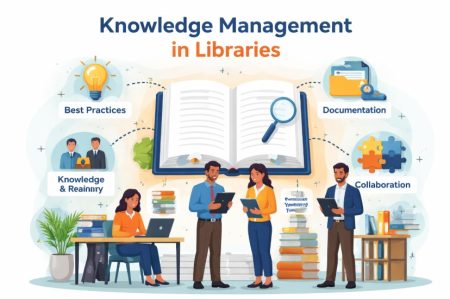
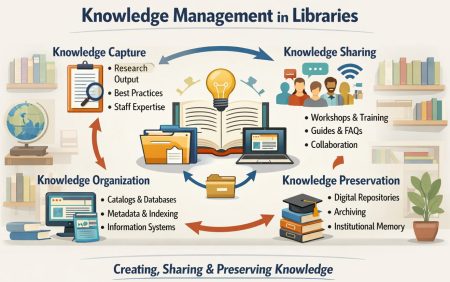
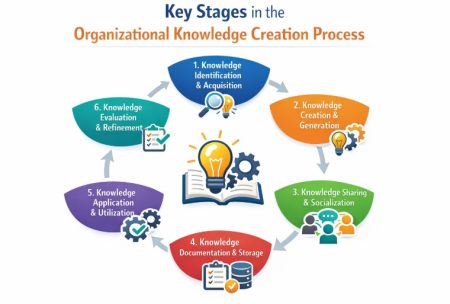
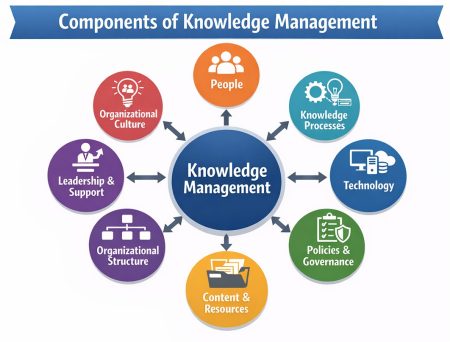
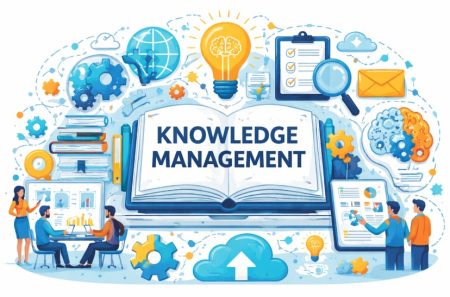
The concepts of Knowledge Management (KM) revolve around understanding how knowledge is created, shared, stored, and used to achieve organizational goals. At its core, KM recognizes knowledge as a critical organizational asset that extends beyond raw data and processed information to encompass human experience, expertise, judgment, and insights. A core concept is the distinction between tacit knowledge and explicit knowledge. Tacit knowledge exists in individuals, for example, a senior librarian’s ability to guide researchers to the most relevant databases based on experience, or a faculty member’s skill in supervising research projects. Explicit knowledge, on the other hand, can be documented and shared, such as library user guides, institutional policies, research manuals, or standard operating procedures. Effective Knowledge Management aims to convert valuable tacit knowledge into explicit forms so it can be reused across the organization.
Another key concept of Knowledge Management is the use of systematic processes supported by appropriate technologies and human practices. These processes include knowledge creation and acquisition (such as collecting research outputs or best practices), organization and storage (for example, maintaining digital repositories, knowledge bases, or databases), sharing and dissemination (through workshops, intranets, or collaborative platforms), and application in daily work. For instance, in an academic institution, storing faculty research papers in an institutional repository allows students and researchers to access and reuse knowledge, while in a corporate setting, documenting successful project experiences helps teams avoid repeating past mistakes. KM frameworks also emphasize the role of organizational culture, leadership support, collaboration, and trust. An environment that encourages staff to share ideas, such as regular knowledge-sharing meetings or communities of practice, significantly enhances the effectiveness of KM initiatives.
Knowledge Management concepts highlight continuous learning and innovation as central objectives. KM is not a one-time activity but an ongoing cycle in which knowledge is constantly updated, evaluated, and refined. For example, libraries regularly update training materials on database searching as platforms change, and organizations revise best-practice documents based on new experiences or technologies. By effectively managing knowledge resources, organizations can improve decision-making, enhance productivity, preserve institutional memory, and remain adaptable and competitive in an increasingly complex and knowledge-driven environment.
What is Knowledge Management?
Knowledge Management (KM) is a systematic and strategic approach to identifying, creating, organizing, sharing, and applying knowledge within an organization to improve performance, decision-making, and innovation. It recognizes knowledge as a valuable organizational asset that includes not only documented information but also human experience, skills, insights, and expertise. In the modern knowledge-driven economy, organizations increasingly depend on their ability to manage knowledge effectively in order to remain competitive, responsive, and sustainable.
At its core, Knowledge Management focuses on both tacit knowledge—the personal, experience-based knowledge that resides in individuals’ minds—and explicit knowledge, which is formally documented in reports, manuals, databases, and digital repositories. Effective Knowledge Management seeks to capture tacit knowledge through interaction, collaboration, and documentation, and transform it into explicit knowledge that can be stored, shared, and reused. This process helps prevent knowledge loss caused by staff turnover and ensures that valuable expertise is accessible across the organization.
Knowledge Management also involves a continuous knowledge lifecycle, including knowledge creation, capture, organization, storage, sharing, and application. Knowledge is generated through learning, research, problem-solving, and daily work activities, and becomes meaningful when applied to improve services, policies, or practices. Technologies such as knowledge management systems, intranets, digital libraries, and collaborative platforms support these processes, but technology alone is not sufficient. Human factors such as organizational culture, leadership support, trust, and motivation play a crucial role in encouraging knowledge sharing and use.
Why Is Knowledge Management Important in Modern Organizations?
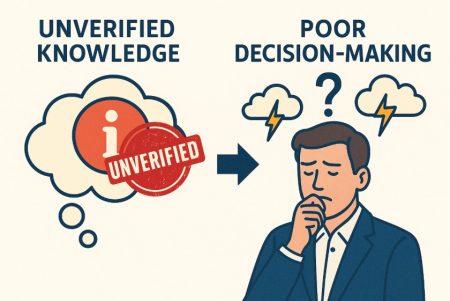
Knowledge Management (KM) is critically important in modern organizations because knowledge has become one of the most valuable strategic resources in today’s information- and innovation-driven economy. Organizations now operate in environments characterized by rapid technological change, intense competition, and increasing complexity. In such conditions, the ability to capture, organize, and use knowledge effectively enables organizations to respond quickly to challenges, make informed decisions, and maintain operational efficiency. Without systematic Knowledge Management, valuable expertise often remains fragmented, underutilized, or lost due to employee turnover.
One of the key reasons Knowledge Management is essential is its role in improving decision-making and organizational performance. When knowledge is properly documented and shared, employees can access accurate and relevant information at the right time. This reduces duplication of effort, minimizes errors, and enhances productivity. For example, documented best practices, lessons learned, and standard operating procedures allow staff to solve problems more efficiently and consistently. As a result, organizations can deliver higher-quality services and achieve better outcomes.
Knowledge Management also supports innovation and continuous learning, both of which are vital to long-term organizational success. By encouraging knowledge sharing and collaboration, KM creates an environment where new ideas can emerge from existing knowledge. Organizations that systematically manage knowledge are better able to learn from past experiences, adapt to change, and develop innovative products, services, or processes. In learning-oriented institutions such as libraries, universities, and research organizations, Knowledge Management enhances teaching, research, and knowledge creation.
Knowledge Management plays a crucial role in preserving organizational memory and ensuring sustainability. Experienced employees possess valuable tacit knowledge gained over years of practice, and without KM practices, this knowledge may be lost when they retire or leave. Knowledge Management helps capture this expertise through documentation, mentoring, and knowledge repositories, ensuring continuity and resilience. Overall, Knowledge Management is important in modern organizations because it transforms individual knowledge into a shared organizational asset, enabling efficiency, innovation, and sustainable growth in an increasingly knowledge-centric world.
Benefits of Knowledge Management
Knowledge has become one of the most valuable assets of modern organizations. In an era driven by information, innovation, and rapid change, organizations must go beyond simply collecting data and focus on effectively managing knowledge. Knowledge Management (KM) refers to the systematic process of creating, organizing, sharing, and applying knowledge to achieve organizational goals. Implementing Knowledge Management brings numerous benefits that enhance efficiency, learning, and long-term sustainability. The major benefits of Knowledge Management are discussed below.
- Improved Decision-Making: Knowledge Management significantly enhances decision-making quality by ensuring that accurate, relevant, and up-to-date knowledge is readily available to decision-makers. When organizations systematically document past experiences, research findings, policies, and best practices, managers can analyze problems more comprehensively and avoid relying solely on intuition or incomplete information. Access to shared knowledge reduces uncertainty, supports evidence-based decisions, and minimizes the risk of costly errors. As a result, decisions become more consistent, transparent, and aligned with organizational goals.
- Increased Organizational Efficiency and Productivity: One of the most practical benefits of Knowledge Management is increased efficiency. By storing and organizing knowledge in accessible systems, employees can quickly find solutions to routine problems without repeating work that has already been done. Knowledge Management reduces duplication of effort, saves time, and streamlines workflows. Employees can learn from existing documents, guidelines, and case studies, allowing them to complete tasks faster and with greater accuracy. This improved efficiency leads to higher productivity and better overall performance.
- Enhanced Knowledge Sharing and Collaboration: Knowledge Management fosters a culture of openness and collaboration by providing platforms and practices for knowledge sharing. When employees freely exchange ideas, experiences, and expertise, organizational silos are reduced. Knowledge-sharing activities such as team meetings, communities of practice, and collaborative digital platforms help employees learn from one another and work together more effectively. This collaborative environment strengthens teamwork, improves communication, and enables organizations to solve complex problems collectively.
- Preservation of Organizational Knowledge: Organizations risk losing valuable knowledge when experienced employees retire, resign, or change roles. Knowledge Management helps capture and preserve this knowledge through documentation, mentoring, interviews, and training programs. Tacit knowledge, often gained through years of experience, can be transformed into explicit knowledge stored in manuals, guidelines, or digital repositories. Preserving organizational knowledge ensures continuity, reduces dependency on individuals, and helps new employees adapt more quickly.
- Support for Innovation and Creativity: Knowledge Management provides a strong foundation for innovation by enabling organizations to build upon existing knowledge. When employees have access to diverse knowledge resources and past experiences, they can combine ideas in new and creative ways. Knowledge sharing exposes individuals to different perspectives, which stimulates critical thinking and problem-solving. By learning from both successes and failures, organizations can develop innovative products, services, and processes that support growth and competitiveness.
- Improved Learning and Skill Development: Knowledge Management supports continuous learning by making learning resources and expert knowledge easily accessible. Employees can improve their skills by consulting training materials, documented experiences, and lessons learned. This ongoing learning environment encourages professional development and helps employees adapt to changing job requirements. In educational and research-oriented organizations, Knowledge Management strengthens teaching, learning, and knowledge creation activities by supporting academic collaboration and resource sharing.
- Better Customer and User Services: Effective Knowledge Management enables organizations to deliver more consistent services to customers and users. When employees have access to updated service guidelines, user histories, and frequently asked questions, they can respond quickly and accurately to inquiries. Knowledge Management helps ensure consistency in service delivery, reduces response time, and improves service quality. As a result, customer satisfaction and trust in the organization increase.
- Competitive Advantage: Knowledge is a unique and valuable resource that can differentiate one organization from another. Knowledge Management helps organizations leverage their collective expertise to respond quickly to environmental changes. By using knowledge strategically, organizations can improve efficiency, innovate continuously, and provide superior services. This ability to apply knowledge effectively creates a competitive advantage that is difficult for competitors to replicate.
- Support for Organizational Learning and Growth: Knowledge Management enables organizations to learn from their experiences by systematically documenting lessons learned and best practices. This learning-oriented approach helps organizations avoid repeating past mistakes and build on successful strategies. Continuous learning supports organizational growth by improving processes, strengthening capabilities, and fostering adaptability. Over time, Knowledge Management contributes to sustainable development and long-term success.
Knowledge Management offers extensive benefits that influence every aspect of organizational functioning. By improving decision-making, efficiency, innovation, learning, and service quality, Knowledge Management transforms individual knowledge into a shared organizational asset. In a rapidly changing, knowledge-driven world, effective Knowledge Management is essential for achieving organizational excellence and long-term sustainability.
How Does Knowledge Management Differ from Information Management?
Although Knowledge Management (KM) and Information Management (IM) are closely related and often used interchangeably, they differ significantly in scope, focus, and purpose. Both aim to support organizational effectiveness, but they deal with different levels of understanding and value creation. Understanding the distinction between the two is essential for appreciating the strategic role of Knowledge Management in modern organizations.
Information Management primarily focuses on the systematic handling of information resources. It involves the collection, organization, storage, retrieval, and dissemination of structured and unstructured information such as documents, reports, databases, records, and digital files. The main objective of Information Management is to ensure that accurate information is available to the right users at the right time. It deals largely with explicit content and emphasizes efficiency, accuracy, and control over information flows. For example, managing library catalogs, databases, records management systems, and document repositories falls under Information Management.
In contrast, Knowledge Management goes beyond managing information and focuses on managing knowledge, which includes human experience, expertise, skills, insights, and contextual understanding. KM addresses both explicit knowledge (documented knowledge) and tacit knowledge (personal, experience-based knowledge that is difficult to formalize). While Information Management answers questions such as “What information do we have?”, Knowledge Management addresses deeper questions like “How do we use what we know to improve decisions, innovation, and performance?” KM emphasizes learning, collaboration, and the practical application of knowledge rather than just its storage.
Another key difference lies in their orientation and scope. Information Management is largely technology- and system-oriented, relying heavily on databases, information systems, classification schemes, and retrieval tools. Knowledge Management, on the other hand, is more people-centric and strategic. It integrates people, processes, and technology to encourage knowledge sharing, organizational learning, and innovation. Cultural factors, leadership support, trust, and motivation play a much greater role in Knowledge Management than in traditional Information Management.
Furthermore, value creation distinguishes the two approaches. Information Management adds value by improving access to information and reducing information overload. Knowledge Management adds value by transforming information and experience into actionable insights that support decision-making, problem-solving, and competitive advantage. Information can exist without being used, but knowledge, in the KM sense, becomes meaningful only when it is applied.
What Types of Knowledge Are Addressed in Knowledge Management?
Knowledge Management (KM) deals with different forms of knowledge that exist within individuals and organizations. Understanding these types of knowledge is essential for designing effective KM strategies, as each type requires different methods for capture, storage, sharing, and application. Knowledge Management does not focus on a single kind of knowledge; rather, it addresses multiple dimensions of knowledge that together contribute to organizational learning, decision-making, and innovation. The major types of knowledge addressed in Knowledge Management are discussed below.
- Tacit Knowledge: Tacit knowledge is personal, experience-based knowledge that resides in the minds of individuals. It includes skills, intuition, insights, beliefs, and practical know-how that are difficult to articulate or document. Tacit knowledge is developed through experience and practice, such as a librarian’s ability to understand users’ information needs quickly or a manager’s judgment in handling complex situations. Knowledge Management seeks to share tacit knowledge through mentoring, teamwork, storytelling, and social interaction, even though it cannot always be fully codified.
- Explicit Knowledge: Explicit knowledge is formal, documented, and easily communicated. It includes manuals, reports, policies, research articles, databases, guidelines, and digital resources. This type of knowledge can be stored, organized, and retrieved using information systems and repositories. Knowledge Management places strong emphasis on managing explicit knowledge because it can be readily shared across the organization and reused to support consistent practices, training, and decision-making.
- Implicit Knowledge: Implicit knowledge lies between tacit and explicit knowledge. It refers to knowledge that is not yet documented but can be articulated if required. For example, an experienced employee may not have written down a procedure but can explain it clearly when asked. Knowledge Management aims to convert implicit knowledge into explicit knowledge through documentation, interviews, and process mapping, thereby making it accessible to others.
- Individual Knowledge: Individual knowledge is possessed by a single person and includes personal expertise, experience, education, and skills. This knowledge becomes valuable to the organization only when it is shared and applied. Knowledge Management focuses on transforming individual knowledge into collective organizational knowledge by encouraging collaboration, knowledge sharing, and participation in communities of practice.
- Organizational Knowledge: Organizational knowledge is the collective knowledge embedded in an organization’s processes, policies, routines, culture, and systems. It includes standard operating procedures, best practices, institutional memory, and shared values. Knowledge Management helps identify, preserve, and update organizational knowledge so that it supports consistency, efficiency, and long-term sustainability.
- Procedural Knowledge: Procedural knowledge refers to knowledge about how tasks and processes are performed. It includes workflows, methods, rules, and step-by-step instructions. Examples include circulation procedures in a library or operational guidelines in an organization. Knowledge Management ensures that procedural knowledge is clearly documented, standardized, and accessible so that tasks can be performed accurately and consistently.
- Declarative Knowledge: Declarative knowledge is knowledge about facts, concepts, and principles. It answers the question “what is” rather than “how to.” This type of knowledge includes subject knowledge, theoretical concepts, and factual information found in textbooks, databases, and reference sources. Knowledge Management organizes declarative knowledge to support learning, research, and informed decision-making.
- Strategic Knowledge: Strategic knowledge supports long-term planning and decision-making. It includes knowledge about organizational goals, competitive environments, market trends, policies, and future directions. Knowledge Management helps decision-makers access and analyze strategic knowledge so that organizations can adapt to change, manage risks, and achieve sustainable growth.
Knowledge Management addresses a wide range of knowledge types, from tacit and explicit knowledge to individual, organizational, procedural, and strategic knowledge. Each type plays a unique role in organizational effectiveness and requires tailored management approaches. By systematically managing these diverse forms of knowledge, Knowledge Management transforms fragmented information and personal expertise into shared organizational intelligence, enabling learning, innovation, and long-term success.
What Role Does Human Experience Play in Knowledge Management?
Human experience plays a central and irreplaceable role in Knowledge Management (KM) because knowledge is not created or applied in isolation from people. While documents, databases, and digital systems store information, it is human experience that gives knowledge its meaning, context, and practical value. Experience shapes how individuals interpret information, solve problems, and make decisions, making it a core component of effective Knowledge Management.
A significant part of organizational knowledge exists as tacit knowledge, which is deeply rooted in human experience. Tacit knowledge develops through years of practice, observation, and interaction, and includes skills, intuition, judgment, and problem-solving abilities. For example, an experienced librarian’s ability to guide a user to the most relevant resource or a manager’s skill in handling complex situations comes from accumulated experience rather than written rules. Knowledge Management recognizes this experiential knowledge as a valuable asset and seeks ways to share it through mentoring, collaboration, and storytelling.
Human experience also plays a key role in knowledge creation and learning. New knowledge often emerges when individuals reflect on their experiences, evaluate outcomes, and adapt their approaches. Through experience-based learning, organizations improve processes, refine strategies, and innovate. Knowledge Management supports this by encouraging reflection, documentation of lessons learned, and discussion of successes and failures, allowing experiential insights to be transformed into shared organizational knowledge. Furthermore, human experience is essential for the application of knowledge. Knowledge becomes valuable only when it is used effectively in real situations, and this application relies heavily on experience. Individuals draw on past experiences to interpret knowledge, assess relevance, and apply it appropriately in different contexts. Knowledge Management systems may provide information, but it is human experience that determines how that knowledge is used to achieve practical outcomes.
In summary, human experience is the foundation of Knowledge Management. It transforms information into knowledge, supports learning and innovation, and enables effective application of knowledge in real-world situations. By valuing and integrating human experience with technological tools and organizational processes, Knowledge Management ensures that knowledge remains dynamic, meaningful, and impactful.
Applications of Knowledge Management
Knowledge Management (KM) is widely applied across different sectors to improve efficiency, learning, innovation, and decision-making. By systematically managing knowledge resources, organizations can transform individual expertise and information into shared organizational intelligence. The applications of Knowledge Management extend beyond business organizations and play an important role in libraries, education, healthcare, government, and industry. The major applications of Knowledge Management are discussed below.
- Knowledge Management in Organizations and Business: In business organizations, Knowledge Management is applied to improve operational efficiency and strategic decision-making. Companies use KM to document best practices, capture lessons learned from projects, and share expertise among employees. This helps reduce duplication of work, improve productivity, and ensure consistency in operations. KM also supports strategic planning by enabling managers to access market knowledge, competitive intelligence, and organizational insights.
- Knowledge Management in Libraries: Libraries are natural environments for Knowledge Management because they deal directly with knowledge creation, organization, and dissemination. KM is applied in libraries to manage institutional knowledge, improve reference and information services, and support research activities. Librarians use Knowledge Management practices to share professional expertise, manage digital repositories, preserve institutional memory, and enhance user services through better access to knowledge resources.
- Knowledge Management in Education and Academic Institutions: In educational institutions, Knowledge Management supports teaching, learning, and research. KM helps capture and share teaching materials, research outputs, academic policies, and best practices among faculty and students. It promotes collaborative learning, supports curriculum development, and improves access to scholarly knowledge through digital libraries and institutional repositories. Knowledge Management also strengthens academic research by facilitating knowledge sharing and interdisciplinary collaboration.
- Knowledge Management in Research and Innovation: Knowledge Management plays a crucial role in research and innovation by enabling researchers to access existing knowledge, share findings, and build upon previous work. Research organizations use KM to manage research data, publications, and project knowledge. By documenting research processes and outcomes, Knowledge Management helps avoid duplication of research efforts and accelerates innovation and knowledge creation.
- Knowledge Management in Healthcare: In healthcare organizations, Knowledge Management is applied to improve patient care and clinical decision-making. KM helps capture and share medical knowledge, clinical guidelines, treatment protocols, and best practices among healthcare professionals. By providing access to updated medical knowledge and experiential insights, Knowledge Management supports accurate diagnosis, effective treatment, and improved healthcare outcomes.
- Knowledge Management in Government and Public Sector: Governments and public institutions apply Knowledge Management to improve policy-making, service delivery, and administrative efficiency. KM helps preserve institutional knowledge, support evidence-based policymaking, and ensure continuity despite staff changes. Public sector organizations use Knowledge Management to share knowledge across departments, improve transparency, and enhance public services.
- Knowledge Management in Information Technology and Software Development: In IT and software development, Knowledge Management is essential for managing technical knowledge, coding practices, system documentation, and troubleshooting experiences. KM supports collaborative development, reduces dependency on individual experts, and helps teams solve technical problems more efficiently. Documented knowledge bases and shared platforms enable faster development and system maintenance.
- Knowledge Management for Training and Human Resource Development: Knowledge Management is widely used in training and human resource development to support employee learning and skill development. Organizations apply KM to design training programs, capture expert knowledge, and support mentoring and onboarding processes. Access to shared knowledge resources helps employees adapt to new roles and technologies more quickly.
- Knowledge Management in Customer Service: In customer service operations, Knowledge Management helps organizations provide consistent and high-quality services. KM systems store frequently asked questions, service guidelines, and user feedback, enabling staff to respond quickly and accurately to customer inquiries. This application improves customer satisfaction and strengthens organizational reputation.
The applications of Knowledge Management are diverse and far-reaching, covering organizational management, libraries, education, healthcare, government, and technology-driven environments. By applying Knowledge Management effectively, organizations can improve learning, innovation, decision-making, and service quality. In today’s knowledge-driven society, Knowledge Management has become an essential tool for achieving efficiency, sustainability, and long-term success across all sectors.
Reference Article:
-
Bhanumathi, P. (2015). Knowledge management enablers processes and organizational performance a case study of select SMEs in Bangalore. Retrieved from: http://hdl.handle.net/10603/139374
- Kalaiselvi, K. (n.d.). A knowledge management approach for sharing and transferring tacit knowledge in higher education domain. Retrieved from: http://hdl.handle.net/10603/22202