Subject Analysis in Library and Information Science
Subject analysis is a fundamental process in Library and Information Science (LIS) that involves examining the intellectual content of an information resource to identify its primary and secondary subjects. The main goal of subject analysis is to determine what a document is about and represent its content accurately using standardized terms. This enables users to locate relevant information more efficiently. It serves as the foundation of subject cataloging, classification, indexing, and metadata creation, ensuring that library resources are organized systematically for easy retrieval through library catalogs, databases, and digital repositories. For example, if a user searches for books on renewable energy, subject analysis ensures that all relevant titles on solar energy, wind power, and sustainable energy are discoverable, even if the exact phrase “renewable energy” does not appear in every title.
The process of subject analysis requires librarians or information professionals to carefully study a document to understand its central theme and scope. Rather than relying solely on the title, they examine various parts of the resource, including the title page, table of contents, abstract, introduction, chapter headings, conclusion, references, illustrations, and keywords. By analyzing these elements, the cataloger determines the main topic, identifies any secondary subjects, and considers important aspects such as the author’s purpose, intended audience, geographic coverage, chronological period, and the form of the work. For instance, a book titled “Climate Change and Agriculture in Bangladesh” may initially appear to focus on climate change. However, after examining its contents, the cataloger might conclude that its primary subject is “Agriculture-Environmental aspects,” while “Climate Change” and “Bangladesh” are relevant secondary subjects.
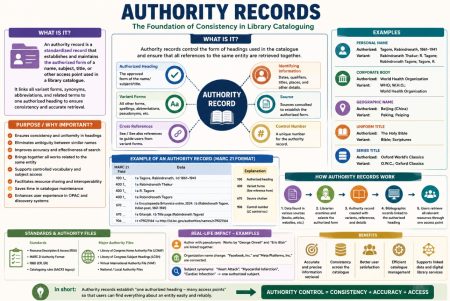
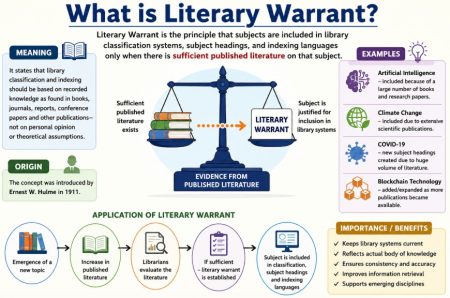
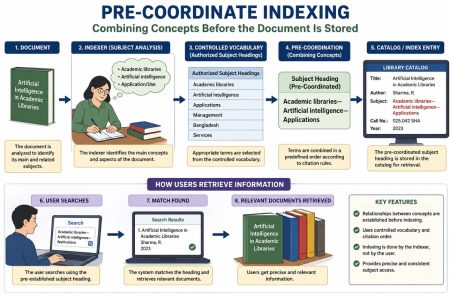
Once the subjects have been identified, appropriate controlled vocabulary terms must be selected from established subject heading lists, such as the Library of Congress Subject Headings (LCSH) or the Sears List of Subject Headings. Using these standardized subject headings ensures consistency in describing similar resources across different libraries and information systems. Subject analysis also aids in assigning classification numbers using schemes such as the Dewey Decimal Classification (DDC) or the Library of Congress Classification (LCC). This allows materials on similar topics to be grouped together on library shelves and within online catalogs. For example, books titled Computer Basics, Introduction to Computing, and Fundamentals of Information Technology may all be assigned the subject heading Computers, even though their titles use different terms.
Consider a practical example of subject analysis: a book titled Introduction to Artificial Intelligence in Healthcare discusses the application of artificial intelligence techniques in medical diagnosis, disease prediction, and healthcare management. Upon reviewing the contents, the cataloger determines that the primary subject is Artificial Intelligence, while Medical Informatics and Health Care-Technological Innovations are secondary subjects. These subject headings are then assigned to the bibliographic record, allowing a user searching for Artificial Intelligence, Medical Informatics, or Healthcare Technology to find the same book, regardless of the exact words used in the title.
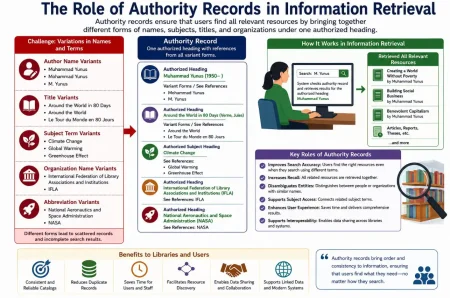
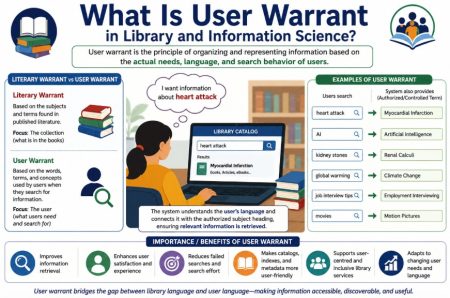
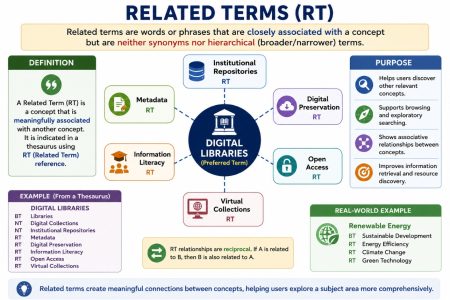
Subject analysis plays a crucial role in enhancing information retrieval by improving both the precision and recall of search results. Precision refers to retrieving only relevant documents, while recall refers to retrieving as many relevant documents as possible. By using standardized subject headings instead of relying solely on keywords, libraries can minimize issues caused by synonyms and variations in terminology. For example, a user searching for Heart Attack can still retrieve documents cataloged under the approved subject heading Myocardial Infarction because controlled vocabularies establish relationships between preferred and non-preferred terms. Similarly, books about Automobiles can be found, even if some authors use the term Cars.
Subject analysis plays a crucial role in various aspects of information organization. It supports authority control, enhances bibliographic consistency, facilitates knowledge organization, and improves the overall usability of library catalogs and digital information systems. Grouping materials on the same subject, even when different authors use different expressions, allows for easier navigation. For instance, books titled Global Warming, Climate Crisis, and Climate Change can be categorized under a uniform authorized subject heading, enabling users to find all related materials in one place.
However, subject analysis also faces several challenges. Many documents are interdisciplinary and encompass multiple topics, making it hard to identify the dominant subject. Emerging fields may lack established subject headings, and ambiguities in terminology or differences in catalogers’ interpretations can impact consistency. For example, a book titled Artificial Intelligence in Law could be classified under Artificial Intelligence, Law, or Legal Technology, depending on whether its primary focus is on technological methods, legal applications, or legal information systems. Such cases require professional judgment and a deep understanding of cataloging standards.
In today’s digital landscape, subject analysis remains essential for creating high-quality metadata in institutional repositories, digital libraries, and online databases. It supports semantic searching, linked data applications, and AI-powered discovery systems by providing structured and standardized descriptions of information resources. For example, digital repositories such as DSpace and institutional research databases depend on subject metadata to enhance the browsing, filtering, and retrieval of theses, dissertations, research articles, and conference papers.