What Is a Broader Term (BT)?
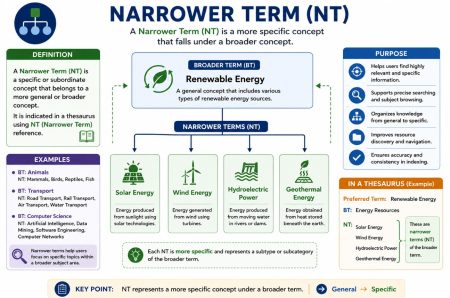
A broader term (BT) is a general or inclusive concept that encompasses one or more specific concepts within a hierarchical structure, such as a controlled vocabulary, thesaurus, subject heading list, taxonomy, or other knowledge organization system. It represents a higher level in the conceptual hierarchy and is used to organize related subjects based on their degree of generality. In a thesaurus, a broader term establishes a hierarchical relationship by linking a general concept to its more specific or subordinate concepts, known as narrower terms (NTs). This relationship helps information professionals and users understand how concepts are organized and interconnected within a particular field.
The primary purpose of a broader term is to provide a logical framework for organizing information from general to specific. Rather than treating every concept as an isolated subject, knowledge organization systems arrange concepts into hierarchical structures that reflect their natural relationships. For example, “Mammals” is a broader term for “Dogs,” “Cats,” and “Whales.” Similarly, “Computer Networks” is a broader term for “Local Area Networks (LAN),” “Wide Area Networks (WAN),” and “Wireless Networks.” In these examples, the broader term represents the general category, while the narrower terms identify more specific concepts within that category.
Broader terms are crucial for supporting systematic browsing and information retrieval. Users often start their searches with a specific topic but may later wish to explore a broader subject area for additional background information or related resources. For instance, a student researching “Renewable Energy” might use the broader term “Energy Resources” to find books and articles that discuss both renewable and non-renewable forms of energy. Likewise, someone looking for “Cybercrime” might navigate to the broader term “Criminology” to gain a wider understanding of crime-related studies and theories. By providing hierarchical navigation, broader terms assist users in expanding their searches and discovering information that might otherwise remain overlooked.
In a thesaurus, broader terms are indicated using the BT (Broader Term) reference. This reference accompanies a preferred term to indicate the more general concept it falls under. For example, the preferred term “E-books” may include the reference BT: Digital Publications, showing that e-books are a specific type of digital publication. Similarly, “Machine Learning” may include BT: Artificial Intelligence, indicating that machine learning is a specialized field within the broader discipline of artificial intelligence. These hierarchical references help users understand the conceptual structure of the vocabulary and facilitate efficient subject navigation.
Broader terms also promote consistency in indexing and metadata creation. Cataloguers and indexers utilize hierarchical relationships to assign accurate subject headings and classify resources appropriately. For instance, a book specifically about “Marine Biodiversity” might be indexed under that term while also being associated with the broader term “Marine Biology.” This hierarchical organization ensures that users searching either the specific topic or the broader discipline can locate relevant materials. Consequently, broader terms enhance the discoverability of resources across library catalogs, bibliographic databases, and digital repositories.
In addition to improving information retrieval, broader terms enhance the semantic structure of knowledge organization systems. They establish clear conceptual hierarchies that help both human users and computer systems interpret relationships among subjects. Modern digital libraries, discovery services, linked data applications, and semantic search engines rely on these hierarchical relationships to organize metadata, recommend related resources, and improve search accuracy. For example, a digital repository may categorize “Cloud Security” under the broader term “Cybersecurity,” enabling users to explore related research within the broader field while maintaining clear conceptual distinctions.
What Characteristics Define a Broader Term?
A broader term (BT) is distinguished by several characteristics that enable it to represent a more general concept within the hierarchical structure of a controlled vocabulary, thesaurus, subject heading list, or other knowledge organization system. Unlike preferred terms, which identify the authorized name for a concept, or related terms, which establish associative relationships, a broader term defines the parent concept under which one or more specific concepts are organized. These characteristics ensure that concepts are arranged systematically, making information easier to index, browse, and retrieve.
- One of the defining characteristics of a broader term is its higher level of generality. A broader term represents a wider concept that includes several more specific concepts within its scope. For example, “Birds” is a broader term because it includes narrower concepts such as “Eagles,” “Parrots,” “Penguins,” and “Owls.” Similarly, “Programming Languages” is a broader term that encompasses specific languages such as “Python,” “Java,” “C++,” and “JavaScript.” The broader term describes the overall category rather than any individual member of that category.
- Another important characteristic is that a broader term establishes a hierarchical relationship with narrower terms. This relationship follows a general-to-specific structure, where the broader term serves as the parent concept, and the narrower terms represent its subdivisions. For instance, “Natural Disasters” is a broader term for “Earthquakes,” “Floods,” “Volcanic Eruptions,” and “Tsunamis.” Each narrower term represents a specific type of natural disaster while remaining conceptually subordinate to the broader category.
- A broader term also represents an inclusive category rather than a single item or instance. It describes an entire class or group of related concepts instead of referring to an individual example. For example, “Musical Instruments” is a broader term because it includes categories such as “String Instruments,” “Wind Instruments,” and “Percussion Instruments.” It does not refer to one particular instrument but to the complete class of instruments.
- Another defining feature is that a broader term supports logical organization and navigation within a knowledge organization system. Hierarchical relationships help users move from highly specific subjects to broader areas of knowledge when expanding or refining their searches. For example, a user researching “Organic Chemistry” may navigate to the broader term “Chemistry” to explore foundational concepts or discover related branches such as “Analytical Chemistry” and “Physical Chemistry.” This hierarchical structure provides users with a clearer understanding of how subjects are interconnected.
- Broader terms are also characterized by their ability to improve consistency in indexing and classification. Information professionals use broader terms to position specific concepts correctly within a structured vocabulary, ensuring that similar resources are organized according to the same conceptual hierarchy. For example, documents about “Solar Power” may be indexed under that specific subject while also being linked to the broader term “Renewable Energy Technologies.” This consistent arrangement helps users retrieve both specialized and general resources on the topic.
- Another important characteristic is that a broader term may have multiple narrower terms, each representing a different aspect or subdivision of the broader concept. For example, the broader term “Transportation” may include narrower terms such as “Road Transportation,” “Rail Transportation,” “Air Transportation,” and “Water Transportation.” Although these narrower terms differ from one another, they all belong to the same broader conceptual category.
- Broader terms also possess semantic significance because they contribute to the conceptual structure of controlled vocabularies and thesauri. They help establish meaningful relationships between concepts, enabling both users and computer systems to interpret the organization of knowledge accurately. Modern library catalogues, digital repositories, linked data applications, and semantic search systems use broader term relationships to improve metadata quality, facilitate concept mapping, and generate more relevant search results.