What Is a Related Term (RT)?
 A related term (RT) is a word or phrase that represents a concept closely associated with, but not identical to, another concept in a controlled vocabulary, thesaurus, subject heading list, taxonomy, or other knowledge organization system. Unlike preferred terms, which denote the authorized term for a concept, and non-preferred terms, which serve as synonyms or alternative expressions directing users to the preferred term, related terms identify concepts that are linked through a meaningful association but do not share a hierarchical or synonymous relationship. They are connected using the RT (Related Term) reference, enabling users to explore additional topics that may be relevant to their information needs.
The primary purpose of related terms is to enhance information discovery by connecting subjects that are conceptually related. Often, users searching for one topic can benefit from exploring associated concepts. For instance, in a library thesaurus, the preferred term “Digital Libraries” may have related terms such as “Institutional Repositories,” “Metadata,” “Digital Preservation,” and “Open Access.” While these concepts are distinct, they are closely connected and frequently discussed together in academic literature. By providing RT references, the knowledge organization system encourages users to broaden their searches and discover additional relevant resources.
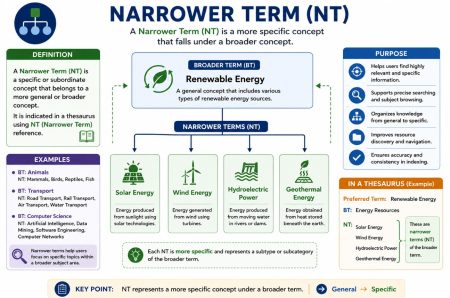
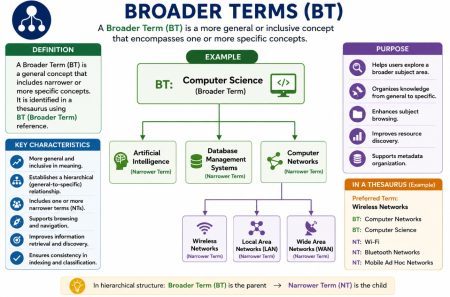
Related terms differ from broader terms (BT) and narrower terms (NT) because they do not represent hierarchical relationships. A broader term refers to a more general concept, while a narrower term represents a more specific concept. In contrast, related terms exist at a similar conceptual level but are meaningfully associated. For example, “Cataloguing” and “Classification” are related terms because both are core library technical services often performed together. However, one is neither a broader nor a narrower form of the other, nor are they synonyms. Similarly, “Information Literacy” and “Research Skills” are related terms because developing information literacy often supports research skills, yet each represents a distinct concept.
Related terms play a vital role in improving information retrieval and user navigation. When users search a library catalog, bibliographic database, or digital repository, they may initially focus on a single subject without realizing that other related concepts could provide valuable information. RT references encourage exploratory searching by guiding users to additional topics that enhance their original search. For example, a researcher interested in “Data Mining” may also discover related terms such as “Machine Learning,” “Big Data,” “Data Visualization,” and “Knowledge Discovery.” These connections help users conduct more comprehensive literature searches and identify resources they might otherwise overlook.
Another important function of related terms is to strengthen the semantic structure of controlled vocabularies. A well-designed thesaurus not only lists preferred terms but also records the relationships among concepts to reflect how knowledge is organized within a specific discipline. Related term references create semantic links between concepts that frequently occur together, making the vocabulary more useful for both human users and computer-based retrieval systems. For example, “Renewable Energy” may be linked to “Sustainable Development,” “Carbon Emissions,” and “Environmental Policy,” illustrating the interdisciplinary connections among these subjects without suggesting that one is broader, narrower, or synonymous with another.
In modern digital libraries, discovery systems, institutional repositories, and semantic search applications, related terms also enhance metadata quality and improve search performance. By linking associated concepts, RT references enable users to refine or expand their searches, improve recall, and gain a broader understanding of a subject area. They are widely used in internationally recognized knowledge organization systems, including thesauri, subject heading lists, and domain-specific vocabularies, to support effective browsing, linked data applications, and semantic information retrieval.
The Purpose of a Related Term in Knowledge Organization
A related term (RT) is essential in knowledge organization because it connects concepts that are closely related but not synonymous or hierarchical. In controlled vocabularies, thesauri, subject heading lists, and other knowledge organization systems, concepts do not exist in isolation. Many subjects have meaningful relationships with other topics that users may need to explore during their searches. Related terms help establish these associative relationships, enabling users to navigate between connected concepts while maintaining the vocabulary’s accuracy and consistency. By linking associated subjects, related terms create a richer and more interconnected representation of knowledge.
One of the primary purposes of related terms is to enhance information discovery. Users often start their search with a single topic, but relevant information might also be indexed under other closely related subjects. Related terms encourage users to expand their searches beyond the initial concept and uncover additional resources that may otherwise remain hidden. For example, a researcher searching for “Cybersecurity” may benefit from exploring related terms like “Network Security,” “Data Privacy,” “Cryptography,” and “Information Security.” Although these terms are distinct, they are closely connected and often discussed together in research and professional practice.
Related terms also improve the browsing experience by guiding users through conceptually linked subjects. Instead of confining users to one subject heading, a controlled vocabulary allows them to move seamlessly between related topics. For instance, a user studying “Urban Planning” may be directed to related terms such as “Smart Cities,” “Public Transportation,” “Housing Policy,” and “Sustainable Development.” These connections encourage broader exploration and help users develop a more comprehensive understanding of a subject area.
Another important purpose of related terms is to support semantic relationships within knowledge organization systems. A thesaurus is not just a list of authorized terms; it also represents how concepts are intellectually connected. Related terms record associative relationships that cannot be expressed through broader term (BT) or narrower term (NT) links. For example, “Blockchain” and “Digital Currency” are closely associated because blockchain technology underpins many digital currencies, yet neither term is broader, narrower, or synonymous with the other. Establishing an RT relationship accurately reflects this meaningful connection and enriches the structure of the vocabulary.
Related terms further contribute to more effective indexing and metadata creation. Information professionals use RT references to identify associated concepts that may be useful for assigning subject headings or keywords to information resources. This practice results in richer metadata, improves resource discoverability, and provides users with additional pathways to access relevant information. For instance, an article indexed under “Cloud Computing” may also lead users to related terms like “Edge Computing,” “Virtualization,” and “Distributed Systems,” allowing them to explore complementary technologies and research areas.
In digital libraries, online catalogs, discovery services, and institutional repositories, related terms significantly enhance information retrieval by expanding search options. Modern search systems often utilize associative relationships to recommend additional search terms or suggest related topics that align with users’ interests. For example, a user searching for “Renewable Agriculture” may receive recommendations for related concepts such as “Organic Farming,” “Soil Conservation,” “Sustainable Food Systems,” and “Agroecology.” These suggestions help users discover a broader range of relevant resources without requiring them to know every possible subject heading in advance. Moreover, related terms foster interdisciplinary research by highlighting connections between different fields of knowledge. Many contemporary research topics span multiple disciplines, making associative relationships increasingly valuable. For instance, “Artificial Intelligence in Healthcare” is closely related to concepts such as “Medical Imaging,” “Clinical Decision Support Systems,” “Health Informatics,” and “Machine Learning.” By linking these concepts through RT references, knowledge organization systems encourage users to explore related disciplines and gain a more holistic understanding of complex research topics.
How Is a Related Term Defined in a Thesaurus?
In a thesaurus, a related term (RT) refers to a concept that has a meaningful associative relationship with another concept but is neither a synonym nor part of a hierarchical relationship. Unlike preferred terms and non-preferred terms, which represent equivalent concepts, or broader terms (BT) and narrower terms (NT), which denote general-to-specific relationships, related terms connect subjects that are closely associated in meaning, usage, or context. These relationships are identified using the RT (Related Term) reference, allowing users to discover additional concepts that may be relevant to their information needs.
A thesaurus organizes knowledge by documenting various types of relationships among concepts. Every preferred term may include three principal types of references: Broad Term (BT), Narrower Term (NT), and Related Term (RT). While BT and NT describe hierarchical relationships, RT identifies associative relationships between concepts that often occur together or influence one another while remaining distinct. For example, the preferred term “Academic Libraries” may include related terms such as “Library Services,” “Information Literacy,” “Institutional Repositories,” and “Reference Services.” These terms are not broader, narrower, or synonymous with academic libraries, yet they are closely connected within the field of library and information science.
Related terms are established when two concepts share a logical or practical connection, which can assist users in searching and browsing. These associations may arise because the concepts are commonly studied together, share similar applications, belong to the same field, or have mutual influences. For instance, “Machine Translation” and “Natural Language Processing” are related terms because machine translation relies heavily on techniques from natural language processing. Similarly, “Digital Preservation” and “Digital Curation” are associated concepts that often appear together in digital library research, even though each represents a distinct professional activity.
An important characteristic of RT relationships is their reciprocity. If “Open Educational Resources” is listed as a related term for “Open Access Publishing,” then “Open Access Publishing” should also include “Open Educational Resources” as a related term. This reciprocal structure helps users easily navigate between connected subjects and ensures that associative relationships remain consistent throughout the thesaurus.
Related terms also enhance a thesaurus by supporting exploratory searching. Users frequently begin their search with one concept without realizing that other associated subjects could provide valuable information. RT references encourage users to broaden their searches and discover complementary topics. For example, someone researching “Disaster Management” may be directed to related terms such as “Emergency Response,” “Risk Assessment,” “Humanitarian Assistance,” and “Climate Resilience.” These suggestions enable users to locate additional resources that contribute to a comprehensive understanding of the subject.
For thesaurus developers and information professionals, assigning related terms requires careful judgment. RT relationships should be created only when a genuine conceptual association exists and when the connection is likely to improve information retrieval. Overusing related terms can create unnecessary links and confuse users, while having too few RT references may limit resource discovery. Therefore, thesaurus designers establish RT relationships based on the semantic connections between concepts, disciplinary practices, and the anticipated information needs of users.
In modern knowledge organization systems, related terms play a vital role in improving metadata quality, semantic searching, linked data applications, and information retrieval. They help users transition smoothly between associated concepts without implying equivalence or hierarchy, making searches more flexible and comprehensive. By defining meaningful associative relationships, RT references transform a thesaurus from just a simple list of terms into an interconnected network of knowledge. Consequently, related terms are an essential feature of thesauri, enhancing both the organization of information and the user’s ability to discover relevant resources across libraries, databases, and digital information systems.