Library classification is essential for helping users find resources quickly and efficiently by organizing library materials based on their subject content. Rather than simply arranging books in a random order or categorizing them only by title or author, classification schemes group materials on similar topics and assign unique class numbers or call numbers to each item. This systematic approach allows users to identify the exact location of a resource while also discovering related materials on the same subject. In this way, classification acts as a roadmap that guides users through the library collection, making information retrieval more effective.
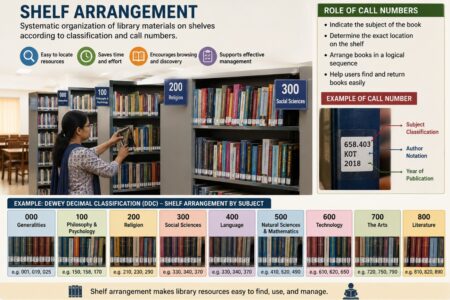
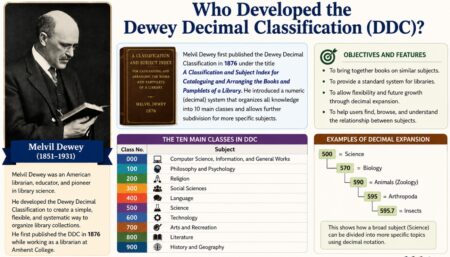
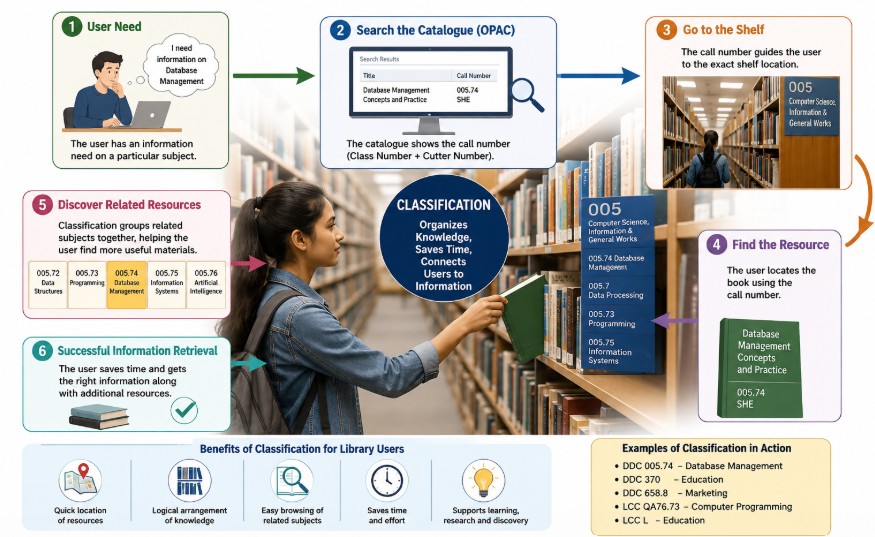
One primary way classification assists users is by providing a logical shelf arrangement. Books on similar subjects are placed close to one another, making it easier for users to browse a particular subject area. For instance, in the Dewey Decimal Classification (DDC) system, books on computer science are typically found in the 000 class, while those on education are located in the 370 class. If a student is searching for a book on database management classified as 005.74, they can go directly to that shelf location. While there, they may also discover books on related topics such as data processing, programming, and information systems. This arrangement not only helps users find a specific book but also exposes them to additional relevant resources they may not have initially considered.
Classification also enhances the efficiency of using the library catalog. When users search an Online Public Access Catalog (OPAC), the catalog displays the classification number or call number of the desired resource. For example, if a user searches for a book on marketing and finds that it is classified under 658.8, the classification number indicates precisely where the book is located on the shelves. Without these classification numbers, users would need to rely on staff assistance or search through shelves one by one, which would be time-consuming and inefficient. Thus, the classification system serves as a vital bridge between the catalog and the physical collection.
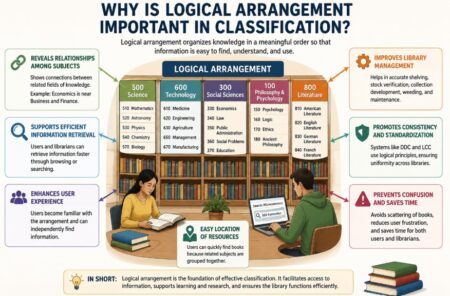
Another significant benefit of classification is that it facilitates subject browsing and information discovery. Users often enter a library searching for a general topic rather than a specific title. For instance, a researcher interested in artificial intelligence may locate one book on machine learning and then browse nearby shelves for books on neural networks, data mining, robotics, and expert systems. Because classification groups related subjects together, users can discover additional materials that support their research. This browsing process is particularly valuable for students and researchers needing comprehensive information on a topic.
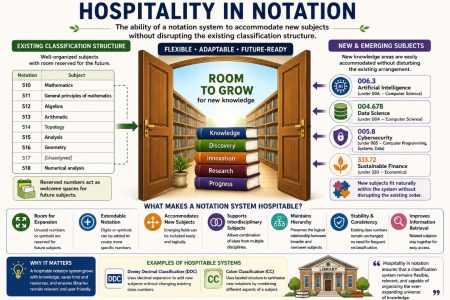
Classification is especially beneficial in large libraries containing hundreds of thousands of items. In a university library, for example, books on medicine, engineering, business, literature, and social sciences are organized into distinct subject areas. A medical student can go straight to the medicine section without having to sift through unrelated materials. Similarly, an engineering student can focus on the engineering shelves where relevant books are grouped together. This subject-based organization saves time and reduces confusion, particularly in libraries with extensive collections. Moreover, classification helps users understand the relationships between different fields of knowledge. Most classification schemes arrange subjects hierarchically, moving from broad topics to more specific ones. For example, in the DDC, the 500 class represents natural sciences, the 510 class represents mathematics, and the 516 class represents geometry. This hierarchy allows users to see how subjects are connected and enables them to transition from a general area of study to more specialized topics. A student exploring environmental science, for example, may start with general science resources and gradually narrow the search to books on ecology, climate change, or biodiversity.
In digital library environments, classification continues to support resource discovery. Many online catalogs, digital repositories, and databases organize materials using subject categories derived from classification principles. For instance, an institutional repository might allow users to browse collections under categories such as Education, Computer Science, Business Administration, or Engineering. A researcher searching for theses on library management can navigate directly to the relevant subject category instead of searching through all available documents. Thus, classification remains valuable even within electronic information systems.