
What Are Information Resources?
Information resources refer to the various materials, tools, and sources that provide data, knowledge, ideas, or evidence to meet users’ informational needs. These resources assist individuals in learning, conducting research, solving problems, making decisions, and developing new knowledge. Information resources can be found in both physical and digital forms and are commonly utilized in educational institutions, libraries, research organizations, businesses, and daily life. For example, a university student may use textbooks to study course materials, while a researcher might rely on scholarly journal articles for scientific investigations. Similarly, professionals may consult reports, manuals, and databases to support workplace decisions and problem-solving.
Traditionally, information resources included printed materials such as books, journals, newspapers, encyclopedias, dictionaries, reports, and maps. For instance, a medical student may refer to an anatomy textbook, while a historian might consult old newspapers or archival documents for historical research. Libraries also provide reference sources like atlases, handbooks, and yearbooks to assist users in quickly locating factual information. With the advancement of information and communication technology, electronic and online resources have become increasingly essential. Today, users can access e-books, e-journals, online databases, websites, digital repositories, and multimedia resources through the internet. For example, students and researchers often use databases like Scopus, Google Scholar, or JSTOR to search for academic literature. Educational videos, podcasts, and webinars are also widely used as digital information resources.
Information resources can be classified into three categories: primary, secondary, and tertiary sources. Primary sources contain original information or firsthand evidence, such as research articles reporting experimental findings, theses and dissertations, interviews, survey data, photographs, historical letters, and government documents. For example, a scientist publishing the results of a laboratory experiment in a journal article produces a primary source. Secondary sources interpret or analyze primary sources and include review articles, textbooks, biographies, and critical analyses. A literature review article summarizing previous research findings is an example of a secondary source. Tertiary sources compile or summarize information from primary and secondary sources and include encyclopedias, bibliographies, indexes, directories, and dictionaries. For instance, an encyclopedia article that provides an overview of climate change is classified as a tertiary source.
The quality of information resources is determined by characteristics such as accuracy, reliability, authority, relevance, currency, and accessibility. Users must evaluate information carefully to ensure that the source is trustworthy and suitable for their needs. For example, a peer-reviewed journal article written by experts is generally more reliable than an anonymous blog post. Additionally, current information is crucial in fields such as medicine and technology, where knowledge evolves rapidly. A medical student researching COVID-19 treatments should prioritize recently published articles over outdated sources. Evaluating an author’s qualifications, the publication source, the publication date, and supporting evidence can help users identify credible information resources.
Libraries and information centers play a significant role in organizing, preserving, and providing access to information resources. Modern libraries utilize digital technologies, online databases, and Online Public Access Catalog (OPAC) systems to help users efficiently locate books, journals, and other materials. For example, a student can search a library catalog to find the availability and location of a book or access electronic journals remotely through library subscriptions. Many academic libraries also provide access to institutional repositories that store theses, dissertations, and research papers in digital formats. In the digital era, information resources have become more accessible than ever, significantly contributing to education, research, professional development, and lifelong learning.
Why Are Information Resources Important in Education and Research?
Information resources play a crucial role in education and research by providing the knowledge, evidence, and data necessary for learning, teaching, and scholarly investigation. Students, teachers, researchers, and professionals rely on these resources to gain a deeper understanding of subjects, develop critical thinking skills, and create new knowledge. Without access to reliable information resources, the processes of education and research would be limited and ineffective. These resources support academic growth by helping learners explore concepts, verify facts, and enhance their analytical abilities.
In education, information resources enable students to acquire knowledge beyond what is presented in classroom lectures. Textbooks, reference books, scholarly journals, newspapers, audiovisual materials, and online resources offer detailed explanations and up-to-date information on various subjects. For example, a business student might use textbooks and case studies to understand marketing strategies, while an engineering student may refer to technical manuals and research articles to learn about new technologies. Digital resources, such as e-books, educational websites, and online learning platforms, have further expanded learning opportunities by allowing students to access information at any time and from anywhere. Databases like Google Scholar and Scopus help students and researchers discover relevant scholarly literature for their studies.
Information resources are equally important for teachers and educators, as they assist in preparing lectures, designing course materials, and staying updated on current knowledge. Teachers often consult academic journals, conference papers, reports, and multimedia resources to enrich classroom instruction and provide students with the most current information. For instance, a teacher discussing climate change might use recent scientific reports, charts, and documentaries to explain the topic more effectively. Access to quality information resources encourages innovative teaching methods and supports interactive learning environments.
In research, information resources are essential for identifying research problems, reviewing previous studies, collecting data, and backing arguments with evidence. Researchers use books, scholarly articles, theses, statistical reports, and databases to explore existing knowledge and identify gaps in research. For example, a medical researcher studying diabetes treatment may analyze previous clinical studies and experimental reports before conducting new research. Reliable information resources help researchers avoid duplicating work and ensure that their findings are backed by credible evidence. Citation databases and indexing services also assist researchers in tracking influential studies and measuring the impact of research publications.
Information resources also promote critical thinking and independent learning. By consulting various sources of information, students and researchers can compare ideas, evaluate evidence, and develop informed opinions. For example, a student writing a research paper on artificial intelligence might analyze journal articles, books, and expert opinions from multiple perspectives before drawing conclusions. This process enhances analytical skills and fosters intellectual curiosity. Furthermore, information resources contribute to lifelong learning and professional development. In today’s rapidly changing world, professionals must continuously update their knowledge and skills. Access to current information resources helps doctors learn about new treatments, librarians explore emerging technologies, and business professionals understand market trends. Online databases, webinars, digital libraries, and institutional repositories provide convenient access to updated information for ongoing education and skill development.
Libraries and information centers play a vital role in ensuring access to quality information resources for education and research. Modern libraries offer both printed and electronic resources, online catalogs, digital repositories, and remote access services to support users. Through these services, students and researchers can efficiently locate and utilize relevant information for academic and professional purposes. Therefore, information resources are considered the foundation of effective education, successful research, and the advancement of knowledge in society.
The Major Types of Information Resources
Information resources are the various materials and tools that provide knowledge, facts, data, and ideas to users. They play an essential role in education, research, teaching, learning, business, and decision-making. Students, teachers, researchers, professionals, and general users depend on information resources to gather accurate and reliable information for different purposes. In the modern information environment, information resources are generally classified into two major categories: Printed Information Resources and Electronic Information Resources. Each category contains several subtypes with unique characteristics and uses.
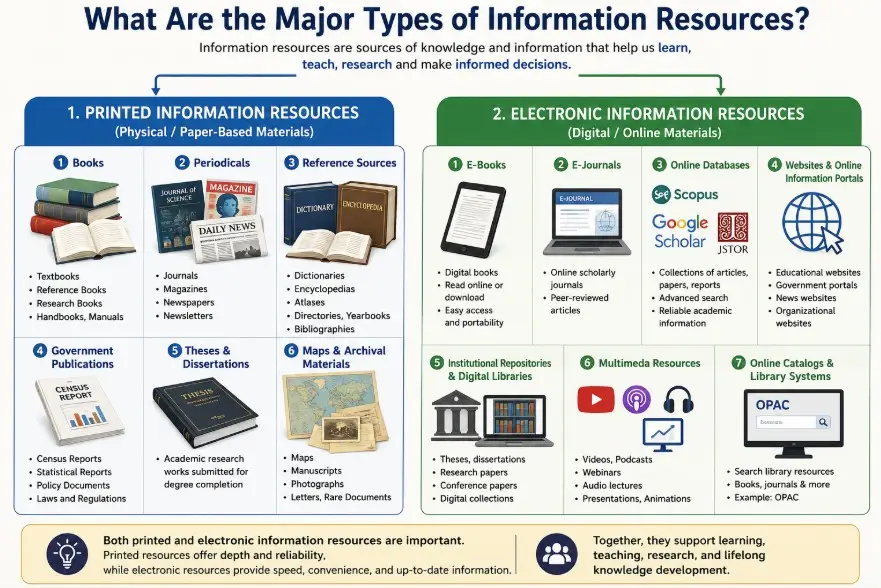
A. Printed Information Resources
Printed information resources are traditional information materials available in physical or paper form. These resources have been used for centuries and remain important in libraries, schools, universities, and research institutions.
- Books:Books are one of the most important and widely used printed information resources. They provide detailed and organized information on a specific subject or topic. Books may be academic, fictional, technical, or reference-based.
Examples of books include:- Textbooks
- Research books
- Storybooks
- Handbooks
- Manuals
- Periodicals:Periodicals are publications issued regularly at fixed intervals, such as daily, weekly, monthly, or quarterly. They provide current and updated information.
Major types of periodicals include:- Journals
- Magazines
- Newspapers
- Newsletters
Scholarly journals are especially important for research because they contain peer-reviewed research articles and scientific findings. Newspapers provide information about current events, politics, economics, sports, and social issues.
- Reference Sources:Reference sources provide concise and factual information for quick consultation rather than detailed reading. These resources are commonly used in libraries and educational institutions.
Examples of reference sources include:- Dictionaries
- Encyclopedias
- Atlases
- Directories
- Bibliographies
- Yearbooks
- Government Publications:Governments publish a large amount of information for public use, research, and policy development.
Examples include:- Census reports
- National budgets
- Policy documents
- Statistical reports
- Laws and regulations
Researchers and policymakers often use government publications for reliable statistical and demographic data.
- Theses and Dissertations;Theses and dissertations are academic research works prepared by students for degree completion. These resources contain original research findings and contribute significantly to knowledge creation.
For example, a master’s thesis on digital libraries may provide valuable insights for future researchers in library and information science. - Maps and Archival Materials:Maps provide geographical information, while archival materials preserve historical records and important documents.
Examples include:- Historical manuscripts
- Photographs
- Letters
- Rare documents
- Geographic maps
B. Electronic Information Resources
Electronic information resources are digital materials accessed through computers, smartphones, tablets, or internet-connected devices. These resources have become increasingly popular because they provide quick, remote, and convenient access to information.
- Electronic Books (E-books):E-books are digital versions of printed books that can be read online or downloaded to electronic devices.
Advantages of e-books include:- Easy accessibility
- Search functionality
- Portability
- Remote access
Students can access e-books from home without physically visiting the library.
- Electronic Journals (E-journals):E-journals are digital versions of scholarly journals available through online platforms and databases. They provide updated research information and are heavily used in academic research.
Researchers frequently use e-journals to access current studies, review articles, and scientific findings. - Online Databases:Online databases store and organize large collections of digital information, including scholarly articles, conference papers, reports, and research documents.
Examples of online databases include:- Scopus
- Google Scholar
- JSTOR
- PubMed
These databases help researchers quickly locate reliable academic materials.
- Websites and Online Information Portals:Websites are one of the most commonly used electronic information resources. Educational institutions, organizations, libraries, and governments provide information through websites and online portals.
Examples include:- University websites
- Government portals
- Educational websites
- News websites
- Digital libraries
For example, students may visit university websites to access academic notices, learning materials, and research resources.
- Institutional Repositories and Digital Libraries:Institutional repositories are digital collections maintained by universities and research organizations to preserve and share scholarly works.
These repositories may contain:- Research papers
- Theses and dissertations
- Conference papers
- Faculty publications
Digital libraries provide online access to books, journals, multimedia materials, and archives.
- Multimedia Resources:Multimedia resources combine text, audio, video, graphics, and animation to support interactive learning.
Examples include:- Educational videos
- Podcasts
- Webinars
- Audio lectures
- Online presentations
These resources make learning more engaging and easier to understand.
- Online Catalogs and Library Systems:Libraries use digital systems to help users search and locate information resources efficiently. One common example is the Online Public Access Catalog, which allows users to search for books, journals, and other library materials online.
Both printed and electronic information resources are important for education and research. Printed resources provide stable and reliable information and are often preferred for deep reading and archival purposes. Electronic resources offer speed, convenience, remote access, and updated information. Modern libraries and educational institutions usually provide both types of resources to meet the diverse needs of users.
The Main Characteristics of Reliable Information Resources?
Reliable information resources are sources that provide accurate, trustworthy, and useful information for learning, teaching, research, and decision-making. In today’s information-rich environment, users must carefully evaluate information before using it because not all sources are reliable or credible. Reliable information resources possess several important characteristics that help users identify trustworthy information.
- Accuracy:Accuracy is one of the most important characteristics of reliable information resources. Accurate information is correct, factual, and free from errors. Reliable sources provide information that has been verified through research, observation, or evidence. For example, scholarly journal articles and official government publications are generally considered accurate because they undergo careful review before publication. Users should compare information from multiple trusted sources to confirm accuracy.
- Authority:Authority refers to the credibility and qualifications of the author, publisher, or organization responsible for the information. Reliable information is usually created by experts, researchers, educational institutions, or recognized organizations. For example, a research article written by a university professor or a report published by an international organization is considered more authoritative than information from an unknown or anonymous source. Evaluating the author’s background and expertise helps determine the authority of the resource.
- Reliability and Trustworthiness:Reliable information resources consistently provide dependable and authentic information. Trustworthy sources support their statements with evidence, references, or citations. Academic books, peer-reviewed journals, and official publications are examples of trustworthy resources because they maintain high standards of quality and integrity. Reliable sources avoid spreading rumors, misleading claims, or unsupported opinions.
- Currency:Currency refers to how recent or up-to-date the information is. In rapidly changing fields such as medicine, science, and technology, current information is extremely important. Reliable resources usually mention publication dates and are updated regularly when necessary. For example, a researcher studying artificial intelligence should use recent journal articles and reports rather than outdated materials published many years ago.
- Relevance:Relevance means that the information is directly related to the user’s topic, purpose, or informational need. A reliable source should provide information suitable for the subject and academic level of the user. For example, a university student writing a research paper should use scholarly articles and academic books rather than unrelated websites or entertainment blogs. Relevant information improves the quality and effectiveness of learning and research.
- Objectivity:Reliable information resources present information fairly and without unnecessary bias. Objective sources focus on facts, evidence, and balanced discussion rather than emotional arguments or personal opinions. Scholarly publications often maintain objectivity by presenting multiple perspectives and evidence-based analysis. Users should be cautious of sources that strongly promote a single viewpoint without supporting evidence.
- Verifiability:Reliable information can be verified through other credible sources. Trustworthy resources usually provide references, citations, bibliographies, or supporting documents that allow users to confirm the information. For example, research articles often cite previous studies, enabling readers to trace the original sources of information. Verifiability increases the credibility and transparency of the resource.
- Peer Review and Editorial Control:Many reliable academic information resources go through peer review or editorial evaluation before publication. In the peer-review process, experts in the same field examine the quality, originality, and accuracy of the work. This process helps maintain academic standards and improves the reliability of the information. Scholarly journals indexed in databases such as Scopus are often considered reliable because they follow strict review and editorial procedures.
Reliable information resources are essential for quality education, effective research, and informed decision-making. Characteristics such as accuracy, authority, reliability, currency, relevance, objectivity, verifiability, and peer review help users evaluate the credibility of information sources. In the digital age, where misinformation and unverified content are common, understanding these characteristics is very important. By selecting reliable information resources, users can ensure that they use trustworthy and high-quality information for academic, professional, and personal purposes.
