What is a Library Catalogue?
A library catalogue is a systematic and organized record of all the information resources available in a library. It provides essential bibliographic information about each item in the collection, enabling users to identify, locate, and access materials efficiently. These resources may include books, journals, magazines, theses, audiovisual materials, and electronic resources such as e-books and online databases. Typically, a library catalogue includes important details such as the author’s name, title of the work, subject, publication information, edition, and call number. This structured information helps users understand what materials are available in the library and how they can be accessed.
The primary purpose of a library catalogue is to serve as a guide to the library’s collection. It allows users to search for materials through different access points, such as author, title, subject, or keyword. For example, if a student wants to find books written by Ranganathan, they can search for the author’s name in the catalogue. Similarly, if a user seeks information on library automation, they can search under the subject heading “Library Automation” to find related books and research materials. In this way, the catalogue helps users quickly discover relevant resources without the need to manually search every shelf.
A library catalogue also helps users determine whether a particular item is available in the library and where it is located. For instance, if a user searches for the book “Library and Information Science” by S. R. Ranganathan, the catalogue may display details such as the call number 020 RAN, the book’s location within the library, and its availability status. With this information, the user can easily locate the book on the appropriate shelf. Thus, the catalogue acts as a bridge between the library’s collection and its users by directing them to the exact location of the materials they need.
Historically, library catalogues have taken different forms, including book catalogues, card catalogues, and microform catalogues. The card catalogue was widely used in libraries for many years. In this system, bibliographic information was recorded on individual cards and arranged alphabetically in drawers by author, title, or subject. For instance, a library might have a separate card for the book “Introduction to Information Science,” arranged under either the author’s name or its subject. However, with advancements in information technology, most modern libraries now use Online Public Access Catalogues (OPAC). OPAC allows users to search the library’s collection electronically via computers or mobile devices. For example, a student in a university library can use the OPAC system to search for books on “digital libraries” and instantly see their availability and shelf location.
Types of Library Catalogues
A library catalogue is a systematic list of all the materials available in a library. It assists users in identifying, locating, and accessing resources such as books, journals, reports, and electronic materials. Library catalogues provide important bibliographic details, including the author, title, subject, publication information, and call number for each item. With this information, users can easily determine whether a specific resource is available in the library and where it can be found.
Over time, libraries have developed various types of catalogues to organize their collections efficiently and enhance information retrieval. These catalogues can generally be classified into two main categories: those based on physical form and those based on arrangement methods.

1. Types of Library Catalogues Based on Physical Form:
Catalogues based on physical form refer to the formats or mediums in which catalogue records are stored and presented. Over the years, libraries have utilized various physical formats to maintain their catalogues.
1.1 Book Catalogue:
A book catalogue is a type of library catalogue that is printed and published as a book or bound volume. In this format, all bibliographic records of the library’s collection are compiled and systematically arranged within a printed document. Entries in a book catalogue typically include important information such as the author’s name, the title of the work, the subject, publication details, and the call number. These entries are usually organized alphabetically by author, title, or subject, allowing users to search for materials in an orderly manner. Book catalogues were widely used in libraries before modern cataloguing systems were developed because they provided a comprehensive list of the library’s holdings at a specific point in time.
One advantage of a book catalogue is that it is easy to handle, portable, and convenient to distribute. Libraries can print multiple copies and place them in different sections, making it easy for users to consult them. However, book catalogues have some limitations. Since they are printed documents, they cannot be easily updated when new materials are added to the collection. Consequently, libraries must publish new editions of the catalogue to include newly acquired resources.
For example, a university library might publish a printed catalogue titled “Catalogue of Social Science Books in the University Library.” This catalogue would list all the books in the social sciences collection, arranged alphabetically by author, helping users identify the available titles in that subject area.
1.2 Card Catalogue:
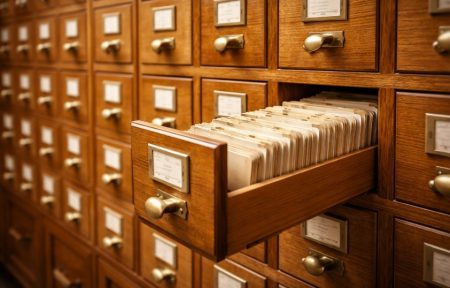
A card catalogue is a traditional type of library system in which bibliographic information about each item is recorded on separate cards. These cards are typically made of stiff paper and are stored in drawers within a catalogue cabinet. Each card represents a single item in the library’s collection and contains important details such as the author’s name, title of the work, subject, publication information, and call number. The cards are arranged systematically, usually in alphabetical order by author, title, or subject, making it easier for users to search for materials.
The card catalogue system was widely used in libraries for many decades because it allowed cataloguers to easily add, remove, or modify records. When a new book was added to the library, a new card could simply be inserted into the correct place in the drawer without needing to change the entire catalogue. Libraries often maintained separate sections for author catalogues, title catalogues, and subject catalogues, which helped users locate materials through different access points.
For example, a card for the book “Foundations of Library and Information Science” by Richard E. Rubin might include the author’s name, title, publisher, year of publication, and a call number such as 020 RUB. A user could search for the card by the author’s name or subject heading and then use the call number to find the book on the library shelves.
1.3 Microform Catalogue:
A microform catalogue is a type of library catalogue where bibliographic records are stored in a miniaturized photographic format, such as microfilm or microfiche. In this system, catalogue entries are reduced in size and recorded on photographic film, allowing a large number of records to be stored in a very small space. To read these records, users must use a microform reader, a special device that magnifies the images so that the information can be viewed clearly on a screen.
The microform catalogue was developed primarily to save storage space and preserve catalogue records. Large libraries often had thousands of catalogue entries, and maintaining them in card cabinets required significant physical space. By converting these records into microform, libraries could store vast amounts of bibliographic data in compact formats. However, while this system saved space, it was less convenient for users because it required special equipment to access the information.
For example, a national or research library may store older catalogue records on microfiche sheets, which contain hundreds of reduced images of catalogue entries. A user can place the microfiche sheet in a microform reader to view and search the catalogue records on the screen.
1.4 Online Public Access Catalogue (OPAC):
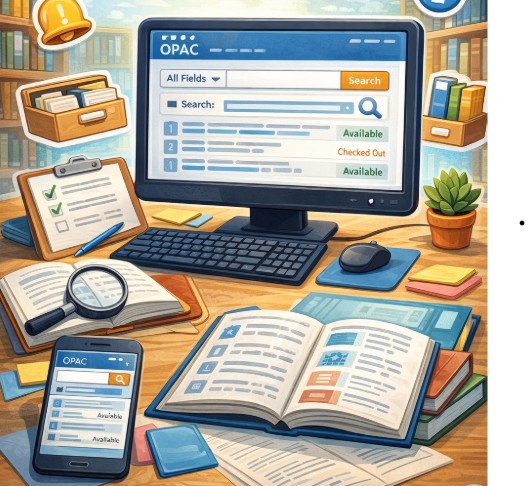
An Online Public Access Catalogue (OPAC) is a computerized library catalog that enables users to search the library’s collection electronically using computers or mobile devices. It is an online database that contains detailed bibliographic records of all materials available in the library, including books, journals, theses, multimedia resources, and electronic materials. Through OPAC, users can search for information using various access points such as author, title, subject, keyword, ISBN, or publication year. The system provides important information about each item, including its location within the library, call number, and whether it is currently available or checked out.
OPAC is a crucial component of modern library management systems because it offers quick and convenient access to library resources. Unlike traditional card catalogs, OPAC allows users to conduct searches instantly and refine their queries using multiple filters. In many libraries, OPAC can also be accessed remotely via the internet, enabling users to explore the library collection without needing to visit in person.
For example, a student searching the OPAC for the keyword “Digital Libraries” can quickly see a list of related books, such as “Digital Libraries: Principles and Practice.” The system will display the call number, shelf location, and availability status of each book, making it easier for the student to locate the materials in the library.
2. Types of Library Catalogues Based on Method of Arrangement:
Library catalogs can be categorized based on the arrangement of entries. This organization aids users in searching for information through various access points.
2.1 Author Catalogue:
An author catalogue is a type of library catalog that organizes entries alphabetically by the names of authors or creators of works. The main purpose of an author catalogue is to help users find materials written by a specific author. In this system, the author’s name serves as the primary access point, and all works by that author are collected under the same heading. Each entry typically includes bibliographic details such as the title of the work, publication information, edition, and call number, which assist users in identifying and locating the material within the library.
Author catalogs are particularly useful for readers and researchers who want to explore the works of a specific writer or scholar. By searching for the author’s name, users can easily discover all the books or materials by that individual available in the library’s collection. This type of catalog was commonly used in traditional cataloging systems, such as card catalogues, and it continues to be employed in modern systems like Online Public Access Catalogues (OPAC), where users can search directly by author name.
For example, if a user searches for “Ranganathan, S. R.” in the author catalog, the catalog may list several of his works, such as “The Five Laws of Library Science.” The entry will also provide the call number and location of the book, enabling the user to find it easily on the library shelves.
2.2 Title Catalogue:
A title catalogue is a type of library catalogue where all entries are arranged alphabetically according to the titles of the works. In this system, the title of a book, journal, or other library material serves as the primary access point. Each entry in the catalogue includes bibliographic details such as the author’s name, title of the work, publication information, edition, and call number. These details assist users in identifying and locating the item within the library collection.
The title catalogue is particularly useful for users who know the title of a book but do not remember the author’s name. By searching for the title alphabetically, users can quickly find the required item and obtain information about its location in the library. Title catalogues were commonly used in traditional catalogue systems, such as card catalogues. This principle is also applied in modern systems like Online Public Access Catalogues (OPAC), where users can search directly by title.
For example, if a user searches for the book “Introduction to Information Science” in a title catalogue, they can locate the entry under the letter “I.” The catalogue entry will provide the author’s name, publication details, and call number, enabling the user to easily find the book on the library shelves.
2.3 Subject Catalogue:
A subject catalogue is a type of library catalogue that organizes entries according to the subjects or topics of the materials. In this system, books and other resources are grouped under specific subject headings, allowing users to easily find materials related to a particular topic. Each entry in a subject catalogue typically includes bibliographic information such as the author’s name, the title of the work, publication details, and a call number, which helps users identify and locate the item within the library.
The primary purpose of a subject catalogue is to assist users in finding information on a specific subject, even if they do not know the author or title of a particular book. Libraries assign standardized subject headings to materials using controlled vocabularies, such as the Library of Congress Subject Headings (LCSH) or other subject classification systems. By searching under a subject heading, users can discover a list of resources related to that topic, making research or exploration of new areas of study much easier.
For example, if a user searches the subject catalogue under the heading “Digital Libraries,” the catalogue may display several books and journals related to that topic. Each entry will provide details such as the author’s name, the title of the work, and the call number, enabling the user to locate the materials on the library shelves.
2.4 Dictionary Catalogue:
A dictionary catalogue is a type of library catalogue where author, title, subject, and sometimes other entries are arranged together in a single alphabetical sequence. It is called a dictionary catalogue because the arrangement resembles how words are organized in a dictionary. Instead of having separate catalogues for authors, titles, and subjects, all entries are integrated into one alphabetical list, making it easier for users to find information.
In a dictionary catalogue, users can search for materials through various access points within the same alphabetical order. Each entry includes bibliographic details such as the author’s name, title of the work, publication information, and call number. This information helps users identify and locate items in the library collection. The system simplifies the search process because users do not need to check multiple catalogues to find the information they need.
Dictionary catalogues were commonly used in traditional card catalogue systems, where cards for authors, titles, and subjects were arranged together alphabetically in the same cabinet drawers. This organization made the catalogue more convenient and user-friendly for readers.
For example, in a dictionary catalogue, entries such as “Library Automation,” “Ranganathan, S. R.,” and “Reference Services” may all appear together in the same alphabetical sequence. A user searching under the letter R may find the author entry “Ranganathan, S. R.” alongside related subject entries like “Reference Services.” Each entry provides the necessary bibliographic details and call numbers to assist the user in locating the materials in the library.
Library catalogs have evolved over time to facilitate the efficient organization and retrieval of information. They can be classified based on their physical format, which includes book catalogs, card catalogs, microform catalogs, and Online Public Access Catalogs (OPAC). Additionally, they can be categorized by their method of arrangement, such as author catalogs, title catalogs, subject catalogs, and dictionary catalogs. Understanding these various types of catalogs helps library users and professionals search for information more effectively and ensures better access to the resources available in the library.