Uniform Title in Library Cataloguing
A uniform title in library cataloguing is a standardized and authoritative title assigned to a work to bring together all its manifestations, such as different editions, translations, adaptations, or formats, under a single, consistent heading in the library catalogue. It is used when a work appears under varying titles or in different forms, ensuring that users can easily locate and identify all related versions of the same intellectual or artistic creation. By providing a single, normalized title, the uniform title overcomes confusion caused by title variations and enhances the effectiveness of bibliographic control.
In traditional cataloguing practice, particularly under AACR2, the uniform title is applied when a work is known by multiple titles, published in more than one language, or exists in various versions over time. For example, a classic literary work may appear with slightly different titles in different editions, or a translated work may carry titles in multiple languages. Without a uniform title, these related records would be scattered across the catalogue, making comprehensive retrieval difficult for users. The uniform title serves as a unifying element that collocates all such records, regardless of the title found on the title page.
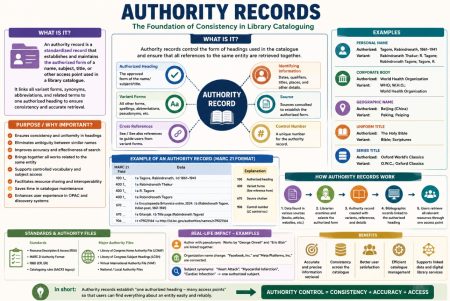
From the perspective of authority control, the uniform title plays a crucial role in maintaining consistency and accuracy in the catalogue. It ensures that cataloguers use the same authorized form of the title across all bibliographic records, which in turn improves the reliability of searching and browsing in OPACs and discovery systems. Users benefit from this consistency because they can retrieve all versions of a work through a single search, even if they are unaware of the exact title used in a specific edition.
In modern cataloguing standards such as RDA (Resource Description and Access), the concept of the uniform title has evolved into the idea of an authorized access point for a work or expression. Although the terminology has changed, the fundamental purpose remains the same: to identify and collocate related resources representing the same work. In both traditional and contemporary cataloguing environments, the uniform title continues to be an essential tool for organizing knowledge, supporting effective information retrieval, and enhancing user access to library collections.
Importance of Uniform Title as an Access Point in Bibliographic Control
The uniform title is considered an important access point in bibliographic control because it provides a standardized and consistent means of identifying and collocating all manifestations of a single work in the library catalogue. In bibliographic environments where the same intellectual or artistic work appears under different titles, languages, editions, or formats, relying only on the title proper can lead to fragmented records and incomplete retrieval. The uniform title addresses this issue by consolidating all related bibliographic records under a single authorized heading, thereby enhancing control over bibliographic data.
One of the primary reasons the uniform title is vital as an access point is its role in collocation. Bibliographic control aims to ensure that all versions of a work can be found together, regardless of how or where they were published. Uniform titles enable users to retrieve original texts, translations, adaptations, revised editions, and different formats (print, electronic, audio, etc.) of the same work through a single search. This is especially important for classical works, religious texts, musical compositions, and literary classics that exist in numerous versions across time and cultures.
The uniform title also supports authority control, which is a cornerstone of effective bibliographic management. By using an authorized form of a title consistently across all records, cataloguers maintain uniformity and prevent the proliferation of variant or conflicting titles. This consistency improves catalogue reliability, reduces ambiguity, and enhances user trust in the library system. For users, it means fewer missed results and more precise searching, even when they are unsure of the exact wording of a title.
From a user access perspective, the uniform title significantly improves information retrieval. Many users search by known works rather than by specific editions or exact titles. The uniform title serves as a bridge between the user’s search intent and the catalogue’s organization, enabling users to discover all relevant resources associated with a work in a logical and comprehensive manner. This is particularly beneficial in OPACs and discovery tools, where effective navigation and browsing depend on well-structured access points.
In the context of modern cataloguing standards such as RDA, the traditional uniform title concept has been refined into authorized access points for works and expressions, but its importance remains unchanged. The uniform title continues to play a central role in controlling bibliographic relationships, supporting linked data structures, and ensuring meaningful connections among related resources. Therefore, the uniform title is not merely a cataloguing convention; it is a fundamental access point that enhances bibliographic control, promotes consistency, and ensures efficient and user-friendly access to library collections.
Main Rules for Constructing a Uniform Title in Library Cataloguing
The uniform title is constructed according to established cataloguing rules to ensure consistency, clarity, and effective bibliographic control. These rules help collocate all versions, editions, and formats of a work under a single standardized heading. Below are the main rules for constructing a uniform title, explained in detail with practical examples.
1. Choose the Most Commonly Known or Original Title
The uniform title should be the original or most widely recognized title of the work. This ensures stability and familiarity in the catalogue.
Example:
-
-
A novel originally published as Pride and Prejudice, but later reissued under titles like First Impressions
→ Uniform title: Pride and Prejudice
-
2. Use the Authorized Form of the Title
Before assigning a uniform title, cataloguers must consult authority files and use the already established authorized form, if available.
Example:
-
-
If the authorized uniform title for Shakespeare’s play is established as Hamlet
→ All editions must use Hamlet, not variants such as The Tragedy of Hamlet, Prince of Denmark
-
3. Base the Uniform Title on the Work, Not the Manifestation
A uniform title represents the intellectual content of the work, not a particular edition, publisher, or format.
Example:
-
-
Introduction to Economics (3rd revised and enlarged edition)
→ Uniform title: Introduction to Economics
(Edition statements are excluded from the uniform title.)
-
4. Add Language of Expression When Necessary
When a work exists in multiple languages, the original title is used, and the language of the translation is added when needed.
Example:
-
-
Original work: Don Quixote (Spanish)
-
English translation
→ Uniform title: Don Quixote. English
-
This allows all translations to be grouped under the same work.
5. Include Qualifying Elements to Distinguish Similar Works
When two or more works have identical or very similar titles, qualifiers such as date, form, or medium are added.
Example:
-
-
Two books titled Introduction to Statistics ” were published in different years
→ Introduction to Statistics (1998)
→ Introduction to Statistics (2015)
-
6. Follow Standard Form and Structure
Uniform titles must follow a consistent structure, capitalization, and punctuation as prescribed by cataloguing standards.
Example:
-
-
Musical work: Beethoven’s Symphony no. 5
→ Uniform title: Symphonies, no. 5, op. 67, C minor
-
This standardized form ensures precise identification.
7. Apply Special Rules for Certain Types of Works
Some works require special treatment, including sacred texts, classical works, musical compositions, and anonymous works.
Example (Sacred text):
-
-
The Bible in English
→ Uniform title: Bible. English
-
Example (Anonymous classic):
-
-
Beowulf
→ Uniform title: Beowulf
-
8. Ensure Consistency through Authority Control
Once a uniform title is established, it must be applied consistently across all related records to maintain bibliographic control.
Example:
-
-
If The Republic by Plato is established as a uniform title
→ All editions, translations, and formats must use Republic as the uniform title.
-
9. Reflect RDA Practice in Modern Cataloguing
Under RDA, the concept of uniform title has evolved into authorized access points for works and expressions, but the principles remain the same.
Example:
-
-
Work: Hamlet
-
Expression: French translation
→ Authorized access point: Hamlet. French
-
The main rules for constructing a uniform title emphasize standardization, differentiation, and consistency. By selecting the original or most recognized title, adding language and qualifiers where needed, and maintaining strict authority control, uniform titles ensure effective bibliographic control and improved user access. With proper application of these rules, library catalogues can accurately represent works and provide seamless access to all their versions and expressions.