Authority Control in Library and Information Science
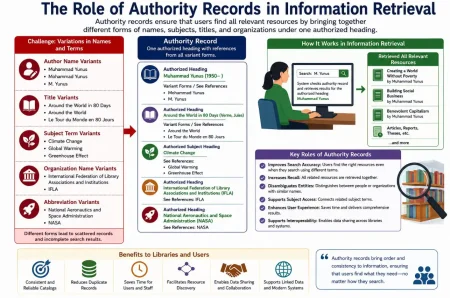
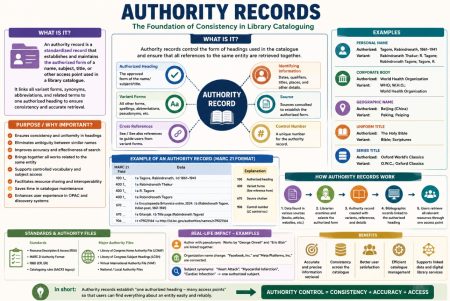
Authority control is the process of establishing and maintaining consistent, standardized forms of names, subjects, titles, and other access points in library catalogs or information retrieval systems. Its primary purpose is to ensure that each person, organization, subject, or work is represented by a single authorized heading, even when multiple names, spellings, abbreviations, or language variations exist. By controlling these variations through authority records, libraries enable users to retrieve all relevant resources using one consistent access point, thus improving the accuracy, reliability, and efficiency of information retrieval.
For example, the well-known American writer Mark Twain published under the pen name Mark Twain, while his real name was Samuel Langhorne Clemens. In a library catalog, Mark Twain is established as the authorized heading, and Samuel Langhorne Clemens is recorded as a variant name that directs users to the authorized form. As a result, whether a user searches for Mark Twain or Samuel Clemens, the catalog retrieves all works by the same author. Similarly, the Nobel Prize-winning writer Rabindranath Tagore may also be found in publications as Rabindranath Thakur, but authority control ensures that all records are linked under one standardized heading.
In Library and Information Science (LIS), authority control is a fundamental component of cataloging and metadata management. Librarians create authority records that specify the authorized form of a heading and include references from alternative or non-preferred forms such as pseudonyms, maiden names, abbreviations, acronyms, and spelling variations. For instance, the organization World Health Organization may also be referred to as WHO in publications. Instead of creating separate catalog entries, authority control establishes one authorized heading and links the abbreviation as a variant form. Similarly, the subject Artificial Intelligence may have related terms such as AI, but the catalog uses a single standardized subject heading to maintain consistency and improve retrieval.
Authority control is also widely used to standardize titles of works. For example, different editions of Shakespeare’s Hamlet may contain varying titles such as Hamlet, The Tragedy of Hamlet, or translations in other languages. Through authority control, these variations are connected to a uniform title, enabling users to locate all editions and translations of the same work in a single search.
International cataloging standards and authority files support this process. Libraries use resources such as the Library of Congress Name Authority File (LCNAF), Library of Congress Subject Headings (LCSH), the MARC Authority Format, and Resource Description and Access (RDA) to establish and maintain consistent authority records. These standards ensure that catalogs remain accurate and interoperable across different library systems worldwide.
Authority control plays a vital role in enhancing the quality and usability of library catalogs, Online Public Access Catalogs (OPACs), institutional repositories, and digital libraries. It eliminates ambiguity, reduces duplicate entries, and helps users discover all resources associated with a particular author, subject, or organization, regardless of the search term initially used. For example, if one book is cataloged under J.K. Rowling and another under Joanne Rowling, users might mistakenly believe they are written by different authors. Authority control prevents this confusion by linking both names to a single authorized heading.
As libraries increasingly adopt linked data technologies and Semantic Web applications, authority control has become even more important for enabling interoperability, data sharing, and accurate resource discovery across multiple information systems. Consequently, authority control remains one of the most essential practices for organizing knowledge, improving search precision, and ensuring effective access to information in modern libraries.
Objectives of Maintaining Authority Records
Authority records are essential for ensuring consistency, accuracy, and reliability in library catalogs and other information retrieval systems. They establish standardized forms for names, subjects, titles, and other access points, allowing users to efficiently locate information even when multiple variations of the same name or term exist. The main objectives of maintaining authority records are as follows:
- Ensure Consistency in Cataloging: The primary goal of authority records is to maintain uniformity in bibliographic records. Each name, subject, or title has a single authorized form that is used consistently throughout the catalog, preventing inconsistent entries. For instance, all works by Mark Twain are cataloged under the authorized heading “Mark Twain,” rather than being split between “Mark Twain” and “Samuel Langhorne Clemens.”
- Eliminate Ambiguity: Many authors and organizations have identical or similar names. Authority records help distinguish one entity from another by including additional identifying information such as birth and death dates, occupations, or affiliations. For example, authority records can differentiate Michael Jordan (the basketball player) from Michael Jordan (the computer scientist).
- Improve Information Retrieval: Authority records assist users in retrieving all relevant resources with a single search, regardless of the name or term they use. If a user searches for WHO, the catalog can automatically redirect them to the authorized heading World Health Organization, ensuring comprehensive search results.
- Control Variant Forms of Names and Terms: Authors, organizations, and subjects may appear under various forms due to abbreviations, pseudonyms, initials, spelling variations, language differences, or name changes. Authority records link these variant forms to a single authorized heading. For example, J.K. Rowling, Joanne Rowling, and Robert Galbraith can all be connected through appropriate authority records.
- Reduce Duplicate Entries: Without authority control, the same person or subject might be entered multiple times under different names, resulting in duplicate records and user confusion. Authority records prevent such duplication by ensuring that all related bibliographic records use the same authorized access point.
- Support Accurate Catalog Maintenance: Authority records simplify the maintenance and updating of library catalogs. When an authorized heading changes—such as when an organization’s name changes—it can be updated once in the authority record, and this change will be reflected consistently throughout the catalog.
- Promote Standardization Across Libraries: Libraries worldwide adhere to internationally recognized standards, such as Resource Description and Access (RDA), the MARC Authority Format, the Library of Congress Name Authority File (LCNAF), and the Library of Congress Subject Headings (LCSH). Authority records ensure that cataloging practices remain standardized and compatible across various library systems.
The primary objective of maintaining authority records is to ensure that library catalogs remain consistent, accurate, and user-friendly. By standardizing names, subjects, titles, and other access points, authority records eliminate ambiguity, enhance search precision, reduce duplication, and support efficient information retrieval. They also promote interoperability among library systems and provide the foundation for modern cataloging practices, digital libraries, and linked data environments.