
Library classification is a fundamental function in library and information management. As libraries continue to collect and provide access to an increasing volume of books, journals, reports, digital resources, and other materials, the need for a systematic organization method becomes more important. Without a well-structured classification system, locating specific resources within a large collection would be challenging and time-consuming for both users and staff. For example, in a university library with hundreds of thousands of books, finding a particular title on data science or medieval history would be nearly impossible if the materials were arranged randomly. Library classification addresses this challenge by organizing materials by subject and establishing a logical order that facilitates efficient access and retrieval.
The primary purpose of library classification is not just to place books on shelves but to organize knowledge in a meaningful and systematic way. By grouping related subjects together and separating unrelated topics, classification helps users discover relevant resources, explore broader subject areas, and identify connections between different fields of knowledge. For instance, a student searching for books on artificial intelligence may also find nearby materials on machine learning, data mining, and robotics, as these subjects are closely related. Similarly, books on medicine are typically placed together, while books on literature are arranged in a separate section, making subject-based browsing easier and more effective.
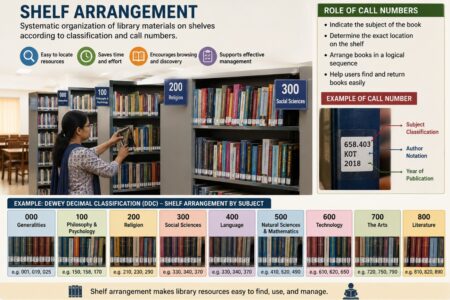
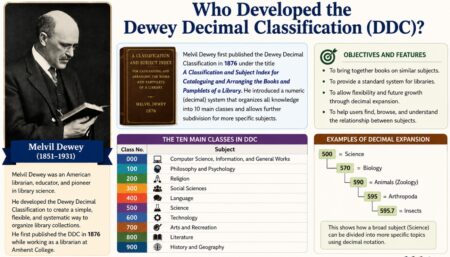
Library classification also plays a vital role in various library operations, including cataloging, shelving, collection management, stock verification, and information retrieval. Each resource is assigned a unique classification number that indicates its location within the collection. For example, under the Dewey Decimal Classification (DDC) system, books on computer science are generally found in the 000s, while books on history are located in the 900s. This systematic arrangement enables library staff to shelve and retrieve materials efficiently and assists users in locating resources independently.
In today’s information-rich environment, the importance of library classification extends beyond physical libraries to digital repositories, online catalogs, and knowledge management systems. Digital libraries and institutional repositories also apply classification principles to organize electronic resources and improve searchability. For example, when a researcher searches an online catalog for renewable energy resources, classification and subject organization enhance the accuracy of retrieving related books, articles, and reports. Thus, effective classification increases the discoverability, accessibility, and utilization of information resources across both physical and digital environments.
Understanding the objectives of library classification is essential for appreciating its role in supporting teaching, learning, research, and lifelong information access. Whether helping a student find a textbook, enabling a researcher to discover related literature, or assisting library staff in managing large collections, classification serves as the foundation of organized library services. This article explores the major objectives of library classification and highlights its ongoing significance in modern libraries and information centers.
Why Library Classification is Necessary?
Library classification is essential because libraries contain vast and continuously growing collections of information resources covering numerous subjects and disciplines. Without a systematic arrangement, finding a specific book or resource within a large collection would be difficult, time-consuming, and frustrating for users. Classification provides a logical framework for organizing materials according to their subject content, ensuring that resources can be easily identified, located, and retrieved. For example, in a university library with thousands of books, a student searching for materials on economics can quickly find relevant resources because they are grouped together in a designated subject area, rather than being scattered randomly throughout the library.
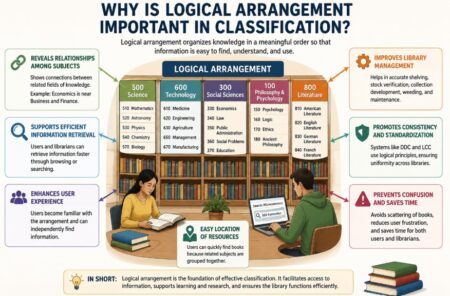
Another important reason for library classification is that it brings related subjects together while separating unrelated ones. This arrangement not only helps users find a specific item but also enables them to discover additional resources on the same or closely related topics. For instance, a researcher looking for books on environmental science may also encounter materials on climate change, sustainability, and natural resource management located nearby on the shelves. Such subject-based organization promotes browsing, supports interdisciplinary learning, and encourages deeper exploration of a topic.
Library classification is also crucial for the efficient management of library collections. It assigns every item a unique class number that indicates its subject and physical location within the library. This facilitates shelving, reshelving, stock verification, inventory control, and collection maintenance. For example, when a returned book is assigned a classification number, library staff can quickly determine its correct place on the shelf, reducing the chances of misplacement and improving operational efficiency. Additionally, classification enhances information retrieval by supporting library catalogs and discovery systems. Modern Online Public Access Catalogs (OPACs), digital libraries, and institutional repositories often use classification data to improve search results and subject access. When users search for information on a particular topic, classification helps retrieve not only the exact resource requested but also other relevant materials within the same subject area, making information searching more accurate and comprehensive.
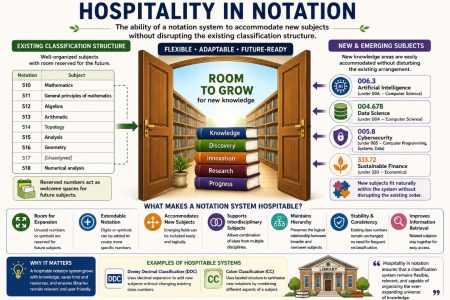
Furthermore, library classification helps accommodate the continuous expansion of knowledge. As new disciplines and interdisciplinary fields emerge, classification systems provide mechanisms for incorporating new subjects into the existing structure without disrupting the overall organization of the collection. For example, emerging fields such as artificial intelligence, data science, and cybersecurity can be integrated into modern classification schemes while maintaining logical relationships with related subjects.
Therefore, library classification is necessary because it ensures the systematic organization of knowledge, facilitates efficient access and retrieval, supports library management, promotes subject browsing, and enables libraries to adapt to the ever-expanding world of information. It serves as the foundation upon which effective library services and information access are built.
Objectives of Library Classification
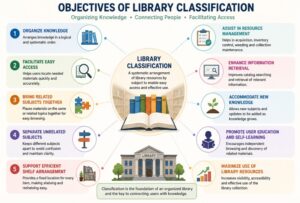 Library classification is a systematic process for organizing library materials based on their subjects and relationships. It serves as the foundation for effective library management and information retrieval by providing a logical arrangement of knowledge. The primary purpose of classification is not only to assign call numbers to books but also to make information easily accessible and usable for library users. As libraries continue to expand their collections in both physical and digital formats, the goals of library classification remain essential for ensuring efficient access to knowledge. The major objectives of library classification are outlined below.
- To Organize Knowledge Systematically: One of the key objectives of library classification is to organize knowledge in a logical and systematic manner. Human knowledge is vast and diverse, comprising numerous disciplines and sub-disciplines. Classification systems divide this knowledge into broad classes and further categorize it into more specific topics, creating a structured arrangement of information resources. For example, in the Dewey Decimal Classification (DDC) system, books on computer science are grouped under the 000 class, while books on social sciences are placed in the 300 class. This systematic arrangement helps maintain order within the library and enables users to understand the relationships between different subjects.
- To Facilitate Easy Location of Resources: Classification helps users and library staff locate materials quickly and accurately. Each document is assigned a unique classification number that indicates its subject and location on the shelf. This reduces confusion and minimizes the time required to find resources. For instance, a student searching for books on marketing can go directly to the designated section instead of searching throughout the library. Similarly, library staff can easily retrieve, shelve, and reshelve materials based on their classification numbers.
- To Bring Related Subjects Together: A significant objective of library classification is to group materials on similar or related topics. This arrangement allows users to browse a subject area and discover additional resources that may be relevant to their needs. For example, books on artificial intelligence, machine learning, data mining, and robotics are often located near one another because these subjects are closely related. A researcher looking for information on machine learning may thus uncover valuable resources on related technologies without needing to conduct separate searches.
- To Separate Unrelated Subjects: While classification groups related materials together, it also separates unrelated subjects to avoid confusion. This clear distinction enables users to navigate collections more effectively and locate information within a specific discipline. For example, books on medicine are placed separately from books on literature, while engineering resources are organized independently from works on philosophy. Such separation ensures a logical structure that supports efficient information retrieval.
- To Support Efficient Shelf Arrangement: Classification provides a designated location for every item in the library, facilitating orderly shelving and maintaining consistency within the collection. Without classification, it would be challenging to arrange books and even more difficult to locate them after they have been returned. For example, when a borrowed book is returned to the library, staff can easily identify its correct location using the classification number. This process minimizes misplacement and ensures that materials remain accessible to users.
- Enhancing Information Retrieval: Modern library catalogs and discovery systems rely heavily on classification data to improve information retrieval. Classification numbers serve as subject identifiers that assist users in locating relevant materials through catalogs and databases. For instance, when a researcher searches an online catalog for resources on environmental sustainability, classification data can help retrieve books, journals, and reports related to environmental science, climate change, and conservation. This approach enhances both the precision and comprehensiveness of search results.
- Promoting Subject Browsing and Self-Learning: Library classification encourages users to browse collections independently. By organizing related resources together, classification enables users to explore a subject beyond their initial search requirements. For example, a student looking for a textbook on accounting might discover additional books on auditing, taxation, financial management, and business ethics located nearby. This promotes self-directed learning and broadens the user’s understanding of the subject.
- Assisting in Collection Management: Classification is an essential tool for managing library collections. It helps librarians analyze subject strengths and weaknesses, identify collection gaps, and make informed decisions regarding acquisitions, weeding, and preservation. For instance, if a library observes that a particular subject area contains outdated materials or lacks recent publications, librarians can use classification-based collection analysis to prioritize future acquisitions in that area.
- Accommodating the Growth of Knowledge: Knowledge is constantly evolving, and new disciplines continue to emerge. Library classification systems are designed to accommodate this growth by allowing new subjects and subtopics to be integrated within existing structures. For example, emerging fields such as data science, cybersecurity, and renewable energy have been incorporated into modern classification schemes. This flexibility ensures that libraries can effectively organize new knowledge while maintaining a coherent structure.
- Maximizing the Use of Library Resources: Ultimately, the goal of library classification is to ensure that library resources are used effectively. When materials are well-organized and easily accessible, users are more likely to discover and utilize them. For instance, a well-classified library collection allows students, researchers, and faculty members to quickly locate resources, leading to increased circulation, greater user satisfaction, and enhanced support for teaching, learning, and research activities.
Library classification is much more than a method of arranging books on shelves; it is a powerful tool for organizing knowledge, facilitating access to information, supporting information retrieval, and improving the overall efficiency of library operations. By grouping related subjects, separating unrelated topics, promoting subject browsing, and accommodating the continuous growth of knowledge, classification plays a vital role in connecting users with the information they need. Whether in traditional or digital library environments, the objectives of library classification remain fundamental to the effective organization and dissemination of knowledge.
Reference Articles:
- KRISHAN KUMAR. Theory of classification. 1993. Vikas Publishing; New Delhi. p1.
- SHARMA (C D). Use of libraries: A guide to better use of libraries and their resources. 1978. Metropolitan Book; New Delhi. p-120.
- SHARMA (C D). Op. cit., p 121.
- KRISHAN KUMAR. Op. cit., p 4.
- INDIRA GANDHI NATIONAL OPEN UNIVERSITY (IGNOU). Unit 2: Needand purpose of library classification. IGNOU; New Delhi. p 26.
- DUTTA (Dwijendranath). Library classification: Theory and practice. 1962. The Western Book Depot; Nagpur. p 48.
- RAJU (Addepali Appala Narasimha). Dewey decimal classification (DDC 20): Theory and practice: A practical and self instructional manual. 1995. T.R. Publications; Madras. p 4.
- CHOWDHURY (G G). Introduction to modern information retrieval. Ed. 3. 2004. Facet Publishing; London. p 89.


11 Comments
This is very useful information. I have known about all the classification briefly,i.e.colon classification, ddc. thank u.
I am very happy to know that this article help you. Thank you for your inspiring comment.
The document or article is really useful and helpful. Am glad to know about all which is included, Actually it is brief, clear and attractive as well.
Thanks to Md Ashikuzzanman
eeeertwytwsf
You have giving me awesome help as I was opportuned to answer my assignment easily.
God bless you
You have giving me an awesome help as I was opportuned to answer my assignment easily.
God bless you
Pewdiepie will take over T-Series! Hail Pewdiepie
The main objective of library classification is to arrange the library documents in afiliatory sequence for the convenience of both the readers and the staff in the library. Infact, According to Dr. S.R. Ranganathan, library classification mechanizes the correctre placement of library documents after use, fixes the most helpful place for a newly added document or a book amongst the other books available in the library on a similar subject and files the most helpful place for the first document on such other already existing subjects which are related to it. For this purpose, the class number must be coextensive with the subject of a document and easy subject must be individualized to the extent that no other subject must share the same class number.library classification
It brings like books together: Classification arranges books in an order most convenient to the readers and the librarians. Readers should find all the related books together and librarians should minimum time and energy in locating the documents. Classification brings together all the books on the same subject. Not only that, books on different branches of the subjects are also collated in a way that their mutual relationship is clearly displayed.
It saves time: Classification is a great time saving device for readers, as well as librarians and thus fulfils the demand of the fourth law of library science. The arrangement by subject, a natural consequence of library classification, saves a lot of time of readers as well as of staff, by bringing together all the related documents.
It reveals the weakness and strengthof the collection: As classification arranges books on shelf by subject, it clearly shows which subjects have a good collection, and which subjects require more attention. In this way, it facilitates the book selection process and helps in developing all round collection of the library. Similarly, it assists the librarians in making up their collection, for the departmental or branch libraries or lending centers, from the central stock.
It helps in bibliographic research: Classification is of value in bibliographic research as it helps in the compilation of bibliographies, catalogues and union catalogues.
It helps in stock verification: Classification plays a significant role in the stock taking procedure. Generally, verification of stock is done through a shelf list, which is arranged in classified order. Books on the shelf are also arranged in the same order. In the stock taking procedure, a person on the shelf goes on calling the call number of the books while the other person, holding the shelf list goes on pushing the relevant cards forward. Thus, the process of stock taking is completed within a relatively short time.
Library classification assists the librarian to make available the requisite book to the reader in the shortest possible time. The purpose of any library classification scheme is to allow libraries to arrange the documents in a sequence that will be of immense help to the readers. The library classification scheme offers the leaders a basis for organizing books and other reading material so that these can be used by the readers as and when they desire. A variety of classification schemes have been developed in various countries throughout the world to maintain the library collections in the most helpful manner possible.
The article is more than help … Thanks for this simple and helpfully article
its a great work for us the librarians
This is great it has really helped