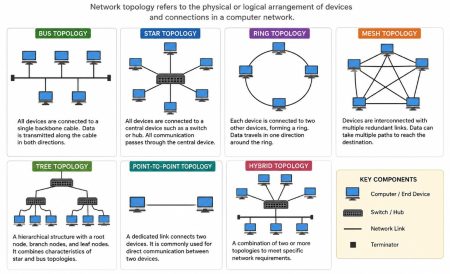
Network topology refers to the arrangement or layout of different elements (links, nodes, etc.) in a computer network. It dictates how devices are connected and how data flows between them. Understanding network topology is crucial because it impacts the efficiency, scalability, security, and management of a network. Network topologies can be classified into several types, such as bus, star, ring, mesh, tree, and hybrid, each offering unique advantages and drawbacks based on specific networking requirements.
For example, bus topology, which uses a single central cable (the bus), is cost-effective for small networks but may suffer from data collision and performance issues as the network grows. This topology is often found in older networking systems. Star topology, on the other hand, is common in modern networks, such as those in office environments. In this setup, all devices are connected to a central hub or switch, making it easy to manage and troubleshoot the network.
Ring topology forms a circular data path where each device connects to two other devices, creating a loop. This is commonly used in token-ring networks, where data travels in a specific direction, and the device with the “token” can send data, reducing collisions. Mesh topology, which involves every device being interconnected, is often used in critical systems, such as data centers or large-scale enterprise networks, because of its redundancy and fault tolerance. A tree topology is a hybrid structure that combines characteristics of both star and bus topologies and is typically used in large organizational networks that need hierarchical organization and scalability.
The choice of topology depends on factors like the size of the network, the number of devices, and the level of fault tolerance required. For example, star topology is known for its simplicity and ease of troubleshooting, while mesh topology offers high redundancy and resilience but is more complex and costly to implement. Ultimately, selecting the right network topology is vital for ensuring optimal performance, minimizing network downtime, and meeting specific organizational needs.
What is Network Topology?
Network topology refers to the physical or logical arrangement of devices, nodes, and connections within a computer network. It describes how different network components, such as computers, routers, switches, and servers, are connected and how data flows between them. The structure of a network topology significantly influences the network’s performance, scalability, and resilience. Various topologies are designed to meet the specific needs of different networking environments, whether for small local area networks (LANs) or large, complex wide-area networks (WANs).
There are several types of network topologies, each with its own strengths and limitations. Common examples include bus topology, where all devices share a single communication line; star topology, where all devices are connected to a central hub or switch; ring topology, where each device is connected to two others, forming a loop; and mesh topology, where every device is interconnected, providing multiple paths for data transmission. Hybrid topologies combine elements of multiple topologies to create flexible, scalable network designs. The choice of topology is driven by factors such as the size of the network, the need for fault tolerance, budget constraints, and the level of complexity the network can handle.
Understanding network topology is crucial for network administrators and engineers, as it helps determine how a network will handle data traffic, adapt to growth, and recover from failures. Each topology has its own impact on network efficiency, maintenance, and troubleshooting, and selecting the appropriate one can significantly enhance the overall network performance.
Importance of Network Topology
Network topology refers to the arrangement of elements (such as nodes, devices, and connections) in a computer network. It plays a pivotal role in determining the efficiency, performance, scalability, security, and reliability of a network. Choosing the appropriate network topology for an organization is crucial for ensuring seamless communication, optimal data flow, and minimal network downtime. Let’s explore the importance of network topology, emphasizing its impact on performance, scalability, fault tolerance, cost, and network management.
- Performance Optimization: The performance of a network is directly influenced by its topology. Topologies determine how devices are connected and how data flows between them, which can significantly affect network efficiency. For instance, in a star topology, all devices are connected to a central hub or switch. This centralized setup makes it easier to manage traffic and resolve issues, ensuring that the network operates efficiently. In contrast, bus topology, which relies on a single shared communication line, can cause congestion and data collisions as the network grows, limiting performance. Thus, a well-designed topology can enhance network speed, reduce bottlenecks, and ensure smooth data transmission, which is essential for high-performing networks.
- Scalability and Future Growth: As organizations grow, their network requirements expand, necessitating a scalable network structure. Star topology is particularly suited for scalable networks because adding new devices is straightforward—each device simply needs to be connected to the central hub. Similarly, tree topology, which is a hierarchical extension of the star topology, allows for easy network expansion and is ideal for large networks that require branching subnets. The modular nature of these topologies ensures that new devices can be integrated without major disruptions to the network, making them highly adaptable to future growth. On the other hand, mesh topology, although more complex and costly, is highly scalable and is often used in networks requiring extensive redundancy and fault tolerance.
- Reliability and Fault Tolerance: One of the most crucial aspects of network design is ensuring reliability and fault tolerance, especially in mission-critical networks where downtime is not acceptable. Mesh topology excels in this area, as each device is connected to every other device in the network, providing multiple paths for data to travel. If one path fails, the data can be rerouted through another path, ensuring continuous operation. This high level of redundancy makes mesh topology the ideal choice for data centers and critical infrastructure where uptime is essential. In contrast, bus topology lacks redundancy, and a failure in the central bus can disrupt the entire network. Choosing a topology that provides adequate fault tolerance is key to ensuring that a network remains operational even in the event of hardware failures.
- Cost-Effectiveness: While mesh topology offers high reliability, it comes with a higher initial cost due to the large number of connections required. On the other hand, bus topology is more cost-effective for smaller networks because it uses fewer cables and devices. However, the low cost of bus topology is offset by its limitations in scalability and performance, making it less suitable for larger or more complex networks. Star topology is a good middle ground for many organizations. Though it requires more hardware (such as a hub or switch), it is relatively inexpensive to set up and maintain while still offering better performance and scalability than bus topology. Therefore, while cost is an important consideration, the network’s size, complexity, and reliability requirements must also be factored into the decision.
- Network Security: Security is another critical factor influenced by network topology. Star topology offers enhanced security since all traffic passes through a central hub, which allows for easier monitoring and control of data traffic. This centralized structure simplifies the implementation of security measures such as firewalls and intrusion detection systems, making it easier to detect and prevent potential security breaches. In contrast, mesh topology, while offering redundancy and fault tolerance, presents more challenges in terms of security. With multiple interconnections between devices, each point in the network becomes a potential security vulnerability. Therefore, mesh networks require more sophisticated security strategies to ensure that all communication paths are protected.
- Ease of Maintenance and Troubleshooting: A well-designed network topology can make maintenance and troubleshooting much simpler. In star topology, for example, if one device fails, only that device is affected, and the rest of the network remains operational. This makes it easier to diagnose issues and perform repairs without affecting the entire network. Furthermore, centralizing traffic in a hub or switch allows for efficient network monitoring. In contrast, ring topology and mesh topology can be more challenging to troubleshoot due to the interconnected nature of the devices. In ring topology, if one device fails, it can disrupt the entire network unless a backup path is implemented, while mesh topology may require complex diagnostics to pinpoint the source of network failures.
- Choosing the Right Topology for Your Network: The importance of network topology cannot be overstated, as it affects every aspect of network performance, from speed and scalability to reliability and security. When choosing a topology, network administrators must consider several factors, including the size of the network, the number of devices, the level of fault tolerance required, and the available budget. For smaller networks, bus topology or star topology may be appropriate, while larger, more complex networks may benefit from mesh topology or tree topology. Each topology has its advantages and drawbacks, and selecting the right one depends on the specific needs of the organization.
Network topology is a critical element in the design and operation of any computer network. It determines how devices are interconnected, how data is transmitted, and how the network responds to failures. By carefully considering factors such as performance, scalability, cost, and fault tolerance, organizations can choose the most appropriate topology for their needs. A well-designed network topology ensures optimal performance, minimizes downtime, and provides a solid foundation for future network growth and security. Understanding the importance of network topology is essential for anyone involved in network design and management, as it has a profound impact on the network’s overall efficiency and reliability.
Most Common Type of Network Topology
Network topology refers to the physical or logical layout of devices, connections, and communication paths in a computer network. The choice of network topology has a significant impact on the performance, scalability, cost, and reliability of the network. Various topologies are used to suit different networking needs, and each has its unique advantages and limitations. Below are some of the most common types of network topologies, each with unique characteristics and benefits:
1. Bus Topology
Bus topology is one of the simplest and most cost-effective network topologies. In this layout, all devices are connected to a single central cable or “bus,” which serves as the backbone for data transmission. Data travels along the bus, and each device checks if the data is intended for it. This setup is commonly used in small networks due to its simplicity and low cost.
-
- Advantages:
- Easy to implement and set up
- Requires less cabling compared to other topologies
- Cost-effective for small networks
- Disadvantages:
- Performance degrades as the network grows, with increased chances of data collisions
- A failure in the central bus can bring down the entire network
- Difficult to troubleshoot due to the shared communication line
- Advantages:
Typical Use Case: Bus topology is often found in small office or home networks where a limited number of devices need to be connected.
2. Star Topology
Star topology is one of the most widely used network topologies, especially in modern office environments. In a star topology, all devices are connected to a central hub or switch. The central device serves as the intermediary through which data is transmitted to other devices on the network. This setup simplifies network management and troubleshooting, as problems are often isolated to individual devices or connections.
-
- Advantages:
- Easy to add or remove devices without disrupting the network
- Centralized management makes it easier to monitor and troubleshoot
- A failure in one device does not affect the rest of the network
- Disadvantages:
- The central hub or switch is a single point of failure; if it fails, the entire network is impacted
- Requires more cabling and hardware than bus topology
- Advantages:
Typical Use Case: Star topology is commonly used in office networks, data centers, and home networks where central management and ease of troubleshooting are essential.
3. Ring Topology
In ring topology, each device is connected to two other devices, forming a circular or ring-like structure. Data travels in one direction around the ring until it reaches its destination. If the network uses a dual ring, data can travel in both directions, providing redundancy.
-
- Advantages:
- Data flows in a predictable manner, which can help reduce collisions
- Efficient for smaller networks with predictable traffic patterns
- Can be more cost-effective than star topology in certain cases
- Disadvantages:
- A failure in one device or connection can disrupt the entire network, unless redundancy is implemented
- Troubleshooting can be difficult due to the interconnected nature of devices
- Advantages:
Typical Use Case: Ring topology was commonly used in early local area networks (LANs), particularly in token-ring networks, but is less popular today due to its vulnerability to network failures.
4. Mesh Topology
Mesh topology is characterized by each device being directly connected to every other device in the network. This setup creates multiple paths for data to travel, providing a high level of redundancy and fault tolerance. Mesh networks are highly reliable because if one path fails, data can still be transmitted via alternative routes.
-
- Advantages:
- Very reliable and fault-tolerant due to multiple paths for data
- High performance with reduced risk of congestion or data loss
- Disadvantages:
- Expensive to implement due to the large number of cables and devices required
- Complex to set up and maintain, especially for larger networks
- Advantages:
Typical Use Case: Mesh topology is commonly used in large-scale networks that require high reliability, such as data centers, mission-critical systems, and large enterprise networks.
5. Tree Topology
Tree topology is a hierarchical topology that combines aspects of both star and bus topologies. It consists of multiple star networks connected to a central backbone bus. The hierarchical nature of tree topology allows for scalable network expansion, as new branches can be added to the central structure without major disruption.
-
- Advantages:
- Scalable and flexible, ideal for growing organizations
- Can support large networks with a hierarchical structure
- Easier to manage and expand compared to bus topology
- Disadvantages:
- The central backbone is a potential point of failure
- Requires more cabling and hardware compared to simpler topologies
- Advantages:
Typical Use Case: Tree topology is often used in large enterprise networks, educational campuses, and organizations with multiple departments or locations.
6. Hybrid Topology
A hybrid topology combines two or more different network topologies to create a more complex yet adaptable structure. By integrating the benefits of multiple topologies, hybrid networks can be tailored to meet specific needs, such as combining star and mesh topologies to achieve both centralized management and fault tolerance.
-
-
- Advantages:
- Flexible and customizable to meet various network requirements
- Can combine the strengths of different topologies to optimize performance, reliability, and cost-efficiency
- Disadvantages:
- Complex to design and maintain
- Higher initial setup cost due to the use of multiple topologies
-
Typical Use Case: Hybrid topologies are often used in large, complex networks such as those in universities, multinational corporations, and data centers, where different areas of the network require different topological designs.
Each type of network topology has its own strengths and weaknesses, making them suitable for different applications. Bus topology is ideal for small, cost-sensitive networks, while star topology is a versatile option for larger networks that require centralized control. Ring topology works well in smaller, simpler environments, but mesh topology is preferred in scenarios requiring high reliability and redundancy. Tree topology offers scalability for large networks, and hybrid topologies combine the best features of multiple topologies to meet specific needs.
The choice of network topology depends on factors like the size of the network, cost considerations, performance requirements, and desired fault tolerance. Understanding the advantages and limitations of each topology helps organizations make informed decisions about the structure of their networks, ensuring efficiency, reliability, and scalability for both present and future needs.
Factors to Consider When Choosing a Network Topology for an Organization
Choosing the right network topology for an organization is crucial for ensuring optimal performance, scalability, security, and manageability. The network topology determines how devices are connected, how data flows between them, and how the network responds to failures or changes. Selecting the wrong topology can lead to performance issues, high maintenance costs, or even system downtime. Several key factors should be considered when deciding on the most appropriate network topology for an organization. These include the size of the network, budget, required level of redundancy, scalability, ease of management, security, and the type of traffic the network will handle.
- Network Size: The size of the network is one of the first considerations when selecting a network topology. Smaller networks typically benefit from simpler topologies, such as bus or star topology, due to their low cost and easy implementation. These topologies are ideal for smaller offices or home environments where the number of devices and users is limited.
As the network grows, however, the needs and requirements change. For larger organizations or networks with a high volume of data traffic, topologies like mesh or tree topology may be more suitable. These topologies can handle higher traffic volumes, offer better fault tolerance, and provide redundancy, which is important in larger-scale systems. Understanding the number of devices, users, and data traffic will help determine whether a simpler or more complex topology is needed. - Budget and Cost: Cost is always a critical factor in network design. The upfront cost of implementing a network topology can vary greatly depending on the complexity of the design. Bus topology, for example, is one of the most cost-effective solutions, especially for small networks. It requires minimal cabling and devices, making it an attractive option for businesses with limited budgets.
On the other hand, more complex topologies like mesh topology come with a higher initial investment because they require more cabling, switches, and routers to interconnect devices. While the mesh topology offers high fault tolerance and redundancy, which is beneficial for critical applications, the cost of implementation and maintenance can be a significant factor. For businesses with large budgets and high reliability requirements, investing in a more robust topology like mesh might make sense. However, businesses on tighter budgets may opt for a less expensive, simpler topology, such as a star or tree topology. - Scalability and Future Growth: As organizations expand, their network requirements will inevitably grow. A scalable network topology allows the system to easily accommodate more devices, users, and locations. Choosing a topology that is adaptable to future growth is essential to avoid costly and disruptive upgrades later.
Star topology and tree topology are excellent options for scalable networks because adding new devices to these networks is straightforward. In a star topology, additional devices can be easily connected to the central hub or switch. Similarly, in a tree topology, more branches can be added to accommodate new locations or departments. In contrast, more complex topologies like mesh require extensive planning for scalability, as they involve creating multiple connections between devices, which can make expansion challenging.
When selecting a topology, it’s crucial to assess not only current needs but also the organization’s future growth projections. Ensuring that the chosen topology can scale with the organization’s expansion will save both time and money in the long term. - Redundancy and Fault Tolerance: Network reliability is paramount, especially for organizations where continuous operation is critical. Redundancy and fault tolerance determine how resilient the network will be in the event of a device failure or other issues. A network with built-in redundancy ensures that data can continue to flow through alternative paths if one connection fails.
Mesh topology is known for its high level of redundancy, as every device is connected to every other device in the network, creating multiple paths for data. If one link fails, the data can be routed through another path, minimizing downtime and ensuring reliability. While mesh topology provides the most redundancy, it is also more complex and costly to implement.
For smaller or less critical networks, topologies like a star or a tree can provide sufficient reliability. In a star topology, a failure in one device only affects that device, and the rest of the network remains operational. However, the central hub or switch in a star topology is a single point of failure, so it’s essential to ensure the central device is reliable and may even need backup solutions to improve fault tolerance. - Ease of Management and Maintenance: The ease of managing and maintaining a network is an important consideration when choosing a topology. Some topologies are easier to manage due to their simplicity and centralized control, while others require more complex management due to the large number of interconnections.
Star topology is relatively easy to manage because all traffic passes through a central hub or switch, which makes monitoring and troubleshooting simpler. If there is an issue, it’s easier to pinpoint the device causing the problem. However, this ease of management comes with the drawback of the central hub being a single point of failure.
On the other hand, mesh topology is more complex to manage due to the multiple connections between devices. Identifying and resolving issues may take longer, as network administrators need to track down which link or device is causing the problem. This complexity may require specialized network management tools and a team of skilled IT professionals. - Security Requirements: Security is a critical concern for all organizations, especially in today’s digital world where cyber threats are prevalent. The chosen network topology can affect how easily the network can be secured. In a star topology, for example, security can be centralized and managed through the central hub or switch, allowing for easier implementation of security measures like firewalls, intrusion detection systems, and data encryption.
In contrast, mesh topology introduces more points of vulnerability, as each device is interconnected. While it offers high redundancy, it can be more challenging to secure due to the larger number of communication paths. To secure a mesh network, businesses will need to implement sophisticated security measures to protect each connection.
When choosing a topology, organizations must assess their security needs and ensure that the topology can support the necessary security infrastructure. - Type of Network Traffic: The type of data traffic that flows through the network is another important factor when selecting a network topology. Networks with high-volume traffic or mission-critical applications may require topologies that can handle large amounts of data efficiently.
Mesh topology is suitable for networks that handle significant amounts of traffic because it provides multiple data paths, reducing the risk of congestion. However, for organizations with lower traffic demands, simpler topologies like a star or tree topology may suffice. These topologies provide an adequate level of performance without the added complexity and cost of more advanced configurations.
Choosing the right network topology for an organization requires a careful evaluation of various factors, including the network size, budget, scalability, redundancy, ease of management, security, and traffic requirements. There is no one-size-fits-all solution, as each topology has its strengths and weaknesses. By carefully considering these factors, organizations can select a topology that meets their current needs and allows for future growth. Ultimately, the goal is to create a network that is reliable, secure, and adaptable to the organization’s changing demands.