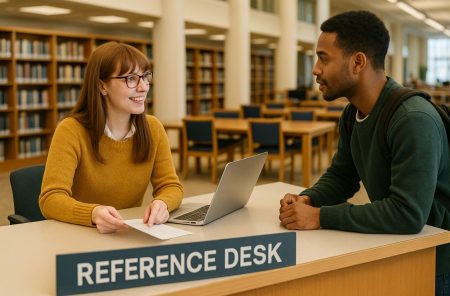
The reference desk plays a crucial role in helping library users identify credible and scholarly information sources. As a central point for guidance, it connects students and researchers with experienced reference librarians who provide personalized help in evaluating the quality and reliability of information. Many users, particularly first-year students, often struggle to distinguish between popular web articles and peer-reviewed research. For instance, a student working on a term paper might rely heavily on blogs or general news sites, unaware that academic assignments typically require scholarly journal articles.
Through one-on-one consultations, the reference desk assists users in evaluating key indicators of credibility, including authorship, publication type, citations, and research methodology. Librarians often demonstrate how to compare a peer-reviewed journal article from databases like Scopus or Taylor & Francis with non-academic sources found through a simple Google search. They may also guide users in utilizing tools like Google Scholar’s “Cited by” feature or journal ranking systems to better understand the academic influence of a source. Additionally, the reference desk provides hands-on examples of effective search strategies and teaches users how to use filters such as “peer-reviewed,” “scholarly journals,” or “publication year” in library databases. For instance, a librarian may demonstrate to a student how selecting “Advanced Search” and applying subject keywords yields more accurate and credible results compared to searching with a single broad term.
Why the Reference Desk Is Important for Improving Users’ Information Literacy Skills
Information literacy, the ability to find, evaluate, and use information effectively, is a foundational skill for academic success. In today’s rapidly evolving information landscape, students and researchers encounter an overwhelming amount of content, ranging from peer-reviewed journal articles to misleading online posts. In this context, the library’s reference desk serves as a critical support point, guiding users toward credible, relevant, and scholarly sources. By providing personalized, hands-on assistance, the reference desk plays a central role in developing strong information literacy skills among users.
- A Central Hub of Expert Guidance: The reference desk acts as the frontline of academic support, staffed by trained reference librarians who specialize in research assistance and information evaluation. Many users, especially new students, face difficulties navigating databases, distinguishing between different types of information, or selecting appropriate keywords. At the reference desk, librarians offer individualized support to address such challenges.
Example: A first-year undergraduate searching for “climate change solutions” may feel overwhelmed by thousands of search results. A reference librarian can teach students how to refine their search using Boolean operators, subject terms, and database filters, thereby turning a broad search into a manageable and academically relevant one. - Teaching Users to Evaluate Credible and Scholarly Sources: One of the most valuable contributions of the reference desk is its role in helping users distinguish credible academic sources from unreliable or non-scholarly materials. Many students rely on general Google search results without recognizing the importance of peer-reviewed literature.
Reference librarians guide users through criteria such as authorship, publisher reputation, citations, research methodology, and objectivity. They also demonstrate how to compare scholarly articles with popular content.
Example: A librarian can demonstrate how a blog post on “healthy eating” differs from a peer-reviewed nutrition study in Elsevier’s ScienceDirect database by examining the evidence, citations, and academic rigor. - Improving Search Strategies and Database Literacy: Effective searching goes far beyond typing keywords into a search bar. The reference desk helps users develop strategic search techniques and skills that form the foundation of strong information literacy.
Librarians teach users how to perform advanced searches, use controlled vocabularies, apply filters, and access specialized subject-specific databases.
Example: A business student struggling to find market data may learn how to use database tools in Emerald Insight or Scopus, discovering industry reports and scholarly research they could not locate through general web searching. - Encouraging Critical Thinking and Information Evaluation: The reference desk fosters critical thinking by teaching users to question the accuracy, purpose, and relevance of the information they encounter. This guidance helps students become more analytical researchers who do not accept information at face value.
Librarians often explain how bias, outdated data, or unreliable sources can mislead users.
Example: During a research consultation, a librarian may help a student compare two articles on the same topic, one from a credible academic journal and another from a commercial website, to illustrate differences in bias, objectivity, and evidence. - Providing Hands-On Learning and Personalized Instruction: Unlike traditional classroom instruction, assistance at the reference desk is tailored to meet the individual needs of each user. Students and researchers can ask specific questions, request demonstrations, or work through problems at their own pace.
This personalized attention makes information literacy learning more effective and memorable.
Example: A student confused about APA citation formats may receive step-by-step guidance from a reference librarian, who also demonstrates tools like Zotero or Mendeley to manage references more efficiently. - Reducing Library Anxiety and Inspiring Confidence: Many students, particularly those new to academic research, experience anxiety or hesitation when approaching research tasks in the library. The reference desk creates a welcoming environment where users feel comfortable asking questions, regardless of their level of experience.
As students gain confidence in navigating databases, evaluating sources, and building search strategies, their overall academic performance improves.
Example: A hesitant student unsure how to begin a literature review may leave the reference desk with a clear search plan, recommended databases, and tips for evaluating sources, transforming confusion into confidence. - Supporting Lifelong Research and Digital Literacy Skills: The benefits of reference desk guidance extend far beyond a single assignment. By learning how to locate, evaluate, and use information responsibly, users develop essential lifelong skills relevant to academic study, professional work, and informed citizenship.
Reference librarians help users become independent researchers capable of navigating both digital and traditional information landscapes.
The reference desk is more than just a place to ask questions; it is a key driver of information literacy development. Through expert guidance, personalized instruction, and practical demonstrations, reference librarians empower users to recognize credible sources, build effective search strategies, think critically, and approach research with confidence. As academic environments continue to evolve, the reference desk remains a vital resource for helping students and researchers navigate the complex world of information and develop the skills necessary for academic and professional success.
How the Reference Desk Helps Users Learn to Identify Credible and Scholarly Information Sources
The reference desk plays a crucial role in helping users learn to identify credible and scholarly information sources, especially in an age where vast amounts of information, both reliable and misleading, are easily accessible online. Reference librarians provide expert guidance by teaching users how to evaluate the credibility of sources through factors such as authorship, publication type, research methodology, citations, and the reputation of publishers. For example, when a student brings an article from a random website, a librarian can demonstrate how to verify the author’s background, determine whether the content is peer-reviewed, and compare it with more reliable materials from academic databases such as Scopus or Taylor & Francis. The reference desk also helps users understand the difference between scholarly and popular sources by offering practical comparisons. A librarian may, for instance, show how a newspaper article on climate change differs from a peer-reviewed scientific study in terms of structure, evidence, tone, and academic rigor.
The reference desk also teaches users how to effectively use academic databases. Rather than relying solely on simple Google searches, students learn to utilize advanced search tools, subject filters, and peer-reviewed options on platforms such as JSTOR, EBSCOhost, and Emerald Insight to find reliable information. Through these interactions, reference librarians promote critical thinking by assisting users in analyzing potential biases, identifying unsupported claims, and determining whether a source is suitable for academic purposes. This guidance is often provided through personalized, hands-on instruction, enabling users to receive immediate feedback tailored to their specific research topics. For instance, if a student brings several potential sources for an assignment, the librarian can guide them step-by-step in evaluating the reliability and academic value of each source.
The reference desk plays a crucial role in helping users understand academic integrity and proper citation practices, which enhances their ability to identify credible sources. Librarians can demonstrate how to trace citations, utilize tools like Google Scholar’s “Cited by” feature, and manage references with software such as Zotero. Over time, these interactions build users’ confidence and independence, allowing them to navigate information resources more skillfully and with greater assurance. Ultimately, the reference desk serves as an essential educational hub, empowering users to become informed, critical, and capable researchers who can confidently select credible scholarly information for their academic and professional needs.
How Reference Librarians Guide Users in Developing Effective Search Strategies
Developing effective search strategies is one of the most essential components of information literacy, yet it is also one of the areas where users struggle the most. Reference librarians play a critical role in supporting students and researchers by helping them navigate complex databases, refine their search approaches, and retrieve relevant, high-quality information efficiently. Through personalized guidance, practical demonstrations, and expert instruction, reference librarians empower users to search more effectively, leading to more accurate and meaningful research outcomes.
Reference librarians begin by helping users understand how to formulate clear, focused research questions. Many students approach the reference desk with broad or unclear topics, making it difficult to retrieve useful information. Librarians guide users in narrowing down their ideas, identifying key concepts, and determining appropriate keywords or subject terms. For example, a student researching “education” may be assisted in breaking the topic into more specific elements, such as “online learning in higher education” or “student engagement in digital classrooms,” which leads to more precise search results.
A major part of this guidance involves teaching users how to construct effective keyword combinations. Librarians explain how to use Boolean operators such as AND, OR, and NOT to connect ideas, expand topics, or exclude irrelevant information. They also introduce techniques such as phrase searching, truncation, and wildcard symbols to refine and broaden searches when necessary. For instance, a librarian may demonstrate to a user that searching for “climate change” AND “Bangladesh” yields more relevant results than searching for each term separately.
Reference librarians also instruct users on how to navigate academic databases, which often appear intimidating to new researchers. By demonstrating advanced search features, filters, subject terms, and indexing systems, librarians make these tools more approachable. They show users how to limit results by publication year, peer-reviewed status, research methodology, or specific disciplines, allowing users to retrieve sources that closely match their academic needs. A librarian assisting a psychology student, for example, might demonstrate how to use subject headings in PsycINFO to access research more efficiently than through basic keyword searching. Furthermore, reference librarians teach users how to evaluate their search results and adjust strategies when needed. Users often assume that the first search attempt must produce the perfect set of results, but librarians help them understand searching as an iterative process. They encourage users to analyze which keywords were effective and which weren’t, and how results can be improved by modifying phrases, exploring related terms, or switching databases entirely. This approach not only improves immediate search outcomes but also helps users become more flexible and independent researchers.
In addition to technical skills, reference librarians emphasize critical thinking by encouraging users to question the relevance and reliability of the sources they retrieve. They explain how to identify scholarly materials, recognize credible publishers, and differentiate between primary and secondary sources. These lessons enhance users’ ability to determine whether search results effectively support their research questions.
Through these varied forms of support, reference librarians play a transformative role in helping users develop strong, effective search strategies. Their guidance not only improves search accuracy but also enhances users’ confidence in navigating digital information landscapes. As a result, users become more capable, independent researchers who can approach academic work with clarity, efficiency, and critical understanding.