Why is Notation Important in a Library Classification System?
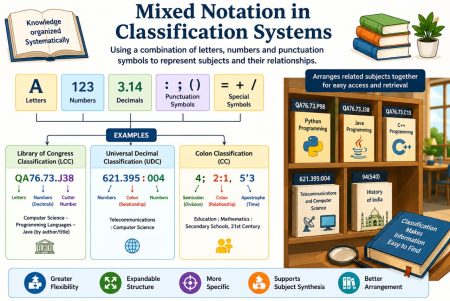
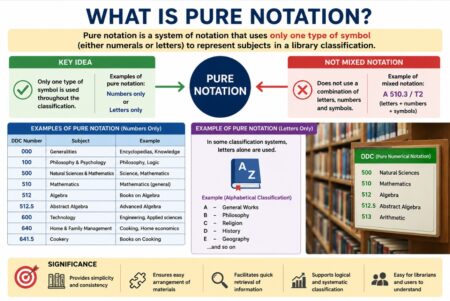
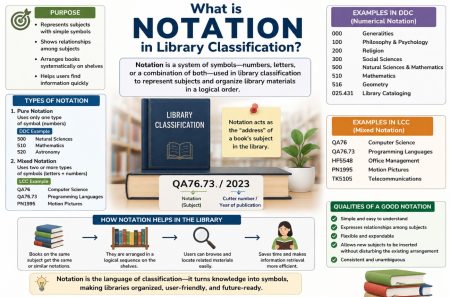
Notation is a fundamental component of a library classification system because it provides a concise and systematic way to represent subjects using symbols such as numbers, letters, or a combination of both. It acts as the symbolic language of classification, enabling librarians to organize knowledge efficiently and users to locate information quickly. Instead of writing lengthy subject names on book labels and catalog records, notation translates subjects into short, standardized codes. For example, in the Dewey Decimal Classification (DDC) system, 510 represents Mathematics, while 530 represents Physics. Similarly, in the Library of Congress Classification (LCC) system, QA76 represents Computer Science. These symbols make it possible to classify and arrange large collections of materials in a consistent and manageable manner.
One of the most important functions of notation is that it facilitates the systematic arrangement of library materials. Resources on similar or related subjects are assigned similar notations and are shelved together. For instance, books classified under 510 Mathematics, 512 Algebra, and 516 Geometry are placed near one another because their notations indicate a close subject relationship. This arrangement helps users browse related materials easily and discover additional resources on the same topic. Notation also reflects the hierarchical structure of knowledge by showing relationships between broader and narrower subjects. For example, in DDC, 500 represents Natural Sciences and Mathematics, 510 represents Mathematics, and 516 represents Geometry, clearly indicating how each subject fits within a broader classification framework.
Notation is equally important for information retrieval. By assigning a unique symbol to each subject, it allows users to locate relevant resources quickly in both physical and digital library environments. A user searching for books on cataloging, for example, can identify materials classified under 025.431, while someone looking for programming resources may browse books classified as QA76.73 in LCC. This standardization improves search efficiency and ensures consistency across library collections. Furthermore, notation saves time and space in cataloging, supports shelf management, and allows new subjects to be incorporated into the classification system without disrupting existing arrangements. As knowledge continues to expand, notation provides the flexibility needed to accommodate emerging disciplines and interdisciplinary fields.