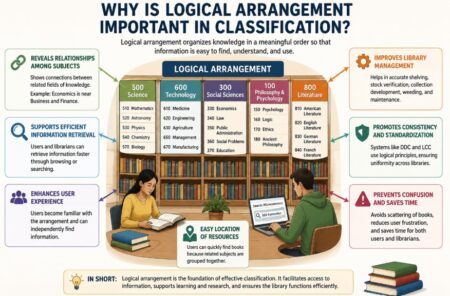
The Library of Congress Classification (LCC) and the Dewey Decimal Classification (DDC) are two of the most widely used systems for organizing library collections, but they differ significantly in terms of subject coverage and intended use. DDC, developed in the 19th century, provides a broad and generalized subject arrangement, making it simple and effective for small to medium-sized libraries, especially public and school libraries with collections that cater to general readers. For example, in DDC, all works on law are placed under the single number 340, which can become overcrowded in large research libraries. In contrast, LCC, developed by the Library of Congress in the United States, was specifically designed to manage vast and complex research collections. It offers a much more detailed breakdown of subjects, such as assigning K for law and dividing it further into specialized subclasses like KF for U.S. law or KD for British law. Similarly, while DDC places all works on medicine under 610, LCC divides medicine into R (general medicine), RC (internal medicine), RD (surgery), and many more, allowing for a more precise classification. Its alphanumeric system thus provides greater flexibility and depth, accommodating the continuous growth of scholarly disciplines. For this reason, academic and research libraries often find LCC more suitable, as it ensures a more nuanced organization of subjects, facilitates accurate shelving, and supports the diverse needs of advanced researchers and scholars working in specialized fields.
Why Do Some Libraries Prefer LCC over DDC?
Libraries around the world adopt different classification systems to organize their collections, with the Library of Congress Classification (LCC) and the Dewey Decimal Classification (DDC) being the two most widely used. While both systems serve the fundamental purpose of arranging books and materials systematically, many academic and research libraries prefer LCC over DDC. This preference arises mainly from differences in subject coverage, structural flexibility, and suitability for large, specialized collections.
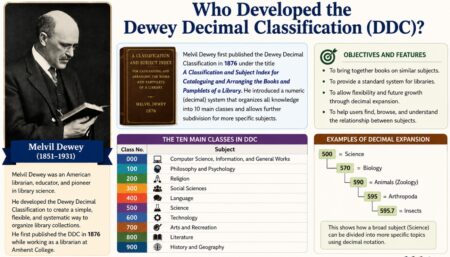
DDC, created in the 19th century, uses a purely numerical scheme that divides knowledge into ten main classes. Its structure is simple and practical, which makes it well-suited for public and school libraries with general collections. However, this numeric arrangement often compresses vast subject areas into narrow ranges, causing difficulties for large and specialized collections. For example, all legal studies in DDC are grouped under the number 340, which makes it challenging to distinguish between different legal systems or specializations in research libraries. LCC, on the other hand, offers broader subject coverage through an alphanumeric scheme. Law is classified under the letter K and further divided into detailed subclasses such as KF for U.S. law and KD for British law, allowing for a much more precise organization.
This flexibility is even more evident in specialized academic disciplines. While DDC places all works on medicine under the general number 610, LCC provides a refined classification by separating medicine into categories like R for general medicine, RC for internal medicine, and RD for surgery. Such detail is crucial in research libraries, where scholars depend on access to narrowly defined resources. The alphanumeric design of LCC also allows it to expand continually, accommodating the emergence of new fields such as data science, artificial intelligence, or environmental law more smoothly than DDC.
LCC is also considered more practical for large academic collections. Since it was designed by the Library of Congress, the world’s largest library, it naturally suits institutions managing millions of items across many disciplines. By dividing knowledge into 21 broad classes instead of DDC’s 10, LCC reduces overcrowding and ensures a more logical distribution of resources. For instance, a university library with large collections in science, engineering, and technology can easily shelve items under LCC’s Q for science, T for technology, and QA for mathematics, without the limitations that occur in DDC’s compressed structure.
Another reason for preferring LCC is its wide international adoption, especially in research institutions. Since scholarly publishing, indexing services, and library catalogues often align with LCC, academic libraries benefit from consistency and ease of information sharing across institutions. Moreover, LCC provides practical advantages for shelving and browsing. Students and researchers can locate related works more intuitively, as subjects are grouped into well-defined subclasses. For example, sociology falls under HM and anthropology under GN, allowing users to move seamlessly between related disciplines.