Reference services are a core and indispensable function of libraries, designed to connect users with the information they need in an efficient, accurate, and meaningful way. Through reference services, libraries go beyond merely housing information resources and actively assist users in identifying, locating, evaluating, and using information to meet their specific academic, professional, or personal needs. For example, a student seeking articles for a term paper may receive guidance on selecting appropriate academic databases, refining search keywords, and accessing full-text resources, while a faculty member may consult a reference librarian for assistance with advanced literature reviews or impact factor analysis of journals. These interactions demonstrate how reference services transform raw information resources into usable knowledge through professional mediation.
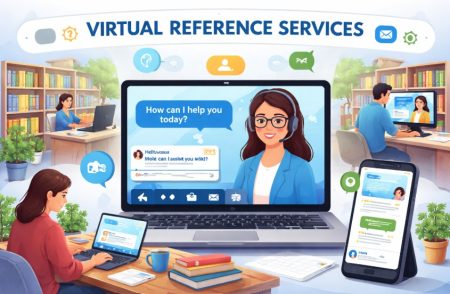
In the contemporary information landscape, reference services have expanded significantly in scope and format, encompassing face-to-face assistance, email and chat-based reference, virtual consultations, and support through digital platforms. For instance, users may receive real-time help through online reference chat services when searching electronic journals, or obtain step-by-step guidance via email on using citation management tools such as Zotero or Mendeley. As information sources continue to grow in volume and complexity, users increasingly require expert guidance to evaluate the credibility of online content, avoid predatory journals, and apply information ethically by following proper citation practices. In this way, reference services function not only as a problem-solving activity but also as an educational process that promotes information literacy, critical thinking, and independent research skills, reinforcing the library’s role as a trusted academic and learning support institution.
Why Are Reference Services Considered a Core Function of Libraries?
Reference services are widely regarded as a core function of libraries because they represent the most direct and meaningful way in which libraries fulfill their mission of supporting learning, research, and informed decision-making. While libraries provide access to extensive collections of print and digital resources, the mere availability of information does not guarantee effective use. Reference services bridge this gap by offering personalized assistance that helps users identify their information needs, locate appropriate sources, and apply information accurately and ethically. Through this professional mediation, libraries move beyond being passive repositories and become active partners in knowledge creation and use.
At the heart of reference services is the role of trained librarians who possess expertise in information organization, search strategies, and user behavior. These professionals assist users with a wide range of inquiries, from simple factual questions to complex research problems. For example, a student working on an academic assignment may receive guidance on selecting suitable databases and refining search terms, while a researcher may seek support in conducting systematic literature reviews or assessing the credibility of journals. Such interactions highlight how reference services transform complex information systems into accessible and user-friendly environments.
Reference services are also essential because they address the diverse and evolving needs of library users. Libraries serve individuals with varying levels of information literacy, academic backgrounds, and research experience. Reference services provide tailored support that ensures equitable access to information for all users, including first-time library users, postgraduate researchers, and faculty members. By adapting assistance to individual needs, reference services promote inclusivity and ensure that no user is disadvantaged due to lack of information-seeking skills.
In the contemporary digital environment, reference services play a critical educational role by promoting information literacy and critical thinking. Users today face an overwhelming volume of information, much of which may be unreliable or misleading. Reference librarians guide users in evaluating the quality and credibility of sources, understanding scholarly communication, and applying information ethically through proper citation practices. This guidance is particularly important in academic settings, where issues such as plagiarism, predatory publishing, and misinformation can undermine the quality of research and learning.
Despite the widespread availability of search engines and advanced technologies, reference services remain highly relevant. While digital tools can retrieve large quantities of information quickly, they cannot replace the analytical judgment and contextual understanding provided by professional librarians. Reference services help users navigate subscription-based academic resources, interpret search results effectively, and use digital tools such as citation managers with confidence. The expansion of virtual and online reference services further ensures that users can receive expert support regardless of time or location.
Ultimately, reference services enhance the overall user experience and strengthen trust in libraries as reliable academic and social institutions. When users receive accurate, timely, and personalized assistance, they are more likely to engage with library resources and services on a regular basis. This ongoing engagement reinforces the library’s central role in education and research. For these reasons, reference services are rightly considered a core function of libraries, as they lie at the intersection of information access, user support, and knowledge development in an increasingly complex information landscape.