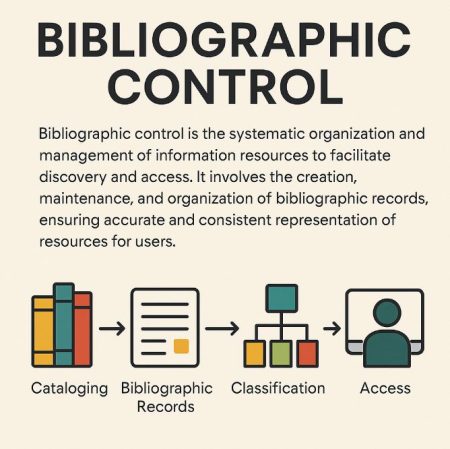
Universal Bibliographic Control (UBC) refers to the global effort to standardize the cataloguing of bibliographic information across libraries and institutions worldwide. The primary goal of UBC is to ensure consistency, accessibility, and interoperability of bibliographic records, allowing library users to discover resources efficiently, regardless of their location. By adhering to internationally recognized cataloguing standards, such as the International Standard Bibliographic Description (ISBD), MARC (Machine-Readable Cataloging), and Resource Description and Access (RDA), UBC facilitates seamless resource sharing, accurate information retrieval, and global cooperation in library systems. It plays a crucial role in the management of library collections, as it helps avoid duplication of efforts by allowing libraries to share bibliographic records and avoid the need for cataloguing resources independently. As libraries increasingly transition to digital and online platforms, UBC’s importance continues to grow, ensuring that bibliographic data remains standardized, interoperable, and accessible across various systems and formats.
What is Universal Bibliographic Control (UBC)?
Universal Bibliographic Control (UBC) is a global initiative aimed at standardizing the cataloguing of bibliographic records across libraries and information centres worldwide. The primary goal of UBC is to create a consistent and interoperable system for managing bibliographic information, ensuring that records for library materials are uniformly described and easily accessible across different countries and institutions. By adhering to internationally recognized cataloguing standards such as the International Standard Bibliographic Description (ISBD), MARC (Machine-Readable Cataloging), and Resource Description and Access (RDA), UBC facilitates the accurate exchange of bibliographic data between libraries, allowing for better resource discovery, interlibrary loans, and research collaboration.
UBC also plays a crucial role in reducing redundancy in cataloguing efforts, as libraries can share bibliographic records instead of duplicating work. This is particularly important in an increasingly digital world where resources are often available globally and accessible through a variety of platforms. The use of standardized systems also ensures that bibliographic data remains compatible across different cataloguing systems and formats, making it easier for users to access materials from diverse institutions. As a result, UBC is vital for maintaining a unified and efficient global library infrastructure, promoting easier access to knowledge, and enhancing international cooperation in the library and information science field.
How UBC Helps in the Standardization of Bibliographic Records Across Different Countries
Universal Bibliographic Control (UBC) plays a crucial role in the standardization of bibliographic records across different countries, facilitating international cooperation and ensuring consistency in library cataloguing practices worldwide. By promoting the adoption of internationally recognized cataloguing standards such as the International Standard Bibliographic Description (ISBD), MARC (Machine-Readable Cataloging), and Resource Description and Access (RDA), UBC provides a unified framework for describing and classifying library resources. This consistency ensures that bibliographic records for materials, whether in the United States or Japan, contain the same essential descriptive information, making it easier for libraries around the world to share and exchange data. The standardization of records is particularly important for large-scale global library catalogues, such as OCLC WorldCat, where libraries from different regions contribute to a centralized system. By ensuring that bibliographic data adheres to the same structure, UBC makes it easier for libraries to discover, borrow, and share materials, regardless of location.
UBC also enhances interoperability among library systems by allowing libraries to integrate their catalogues with ease. Standardized bibliographic records mean that users can search multiple library systems simultaneously and retrieve relevant information without encountering discrepancies in data format or language. This is especially beneficial for international cooperation on interlibrary loan systems, shared digital archives, and other global initiatives. Furthermore, as libraries increasingly embrace digital resources, UBC’s guidelines ensure that new types of materials, such as e-books and multimedia content, are catalogued in a consistent manner that aligns with traditional physical resources. This flexibility enables libraries to maintain a coherent global bibliographic network despite the growing diversity of formats and digital technologies.
In addition to enhancing consistency and accessibility, UBC supports cultural and linguistic inclusivity. While standardization ensures uniformity, UBC allows libraries to incorporate multilingual and culturally specific metadata, ensuring that bibliographic records remain relevant to users across different countries and linguistic groups. By adhering to standards like ISBD and MARC, libraries can adapt cataloguing practices to reflect local languages and naming conventions while still maintaining compatibility with global systems. This ensures that users, regardless of their country, can search for materials in their own language or script while benefiting from an interconnected global library system.
Key International Standards Promoted by Universal Bibliographic Control (UBC) for Cataloging and Metadata
Universal Bibliographic Control (UBC) is founded on the premise of standardizing bibliographic records to ensure consistency and interoperability across global library systems. The success of UBC in achieving these goals largely depends on the adoption and promotion of key international standards that guide cataloguing and metadata practices. These standards help libraries describe, organize, and share bibliographic data in a uniform manner, making it easier to access resources and collaborate internationally. Below are the key international standards that UBC promotes for cataloguing and metadata:
- International Standard Bibliographic Description (ISBD): The International Standard Bibliographic Description (ISBD) is one of the foundational standards for bibliographic cataloguing. Developed by the International Federation of Library Associations and Institutions (IFLA), ISBD provides a set of guidelines for describing bibliographic items in a consistent and standardized way. These guidelines cover a variety of resource types, including books, journals, sound recordings, and digital materials. ISBD’s purpose is to ensure that bibliographic records are structured in a uniform format, making it easier for users to identify and locate resources across different libraries and countries. The standardization of data fields such as titles, authors, publishers, and publication dates under ISBD ensures that bibliographic information is clearly communicated and globally accessible.
- MARC (Machine-Readable Cataloging): The MARC (Machine-Readable Cataloging) format is another critical standard promoted by UBC. MARC is a coding system used for representing bibliographic data in a machine-readable format, enabling libraries to store, share, and retrieve bibliographic records electronically. First developed by the Library of Congress in the 1960s, MARC allows bibliographic records to be exchanged between libraries and integrated into digital systems. By encoding bibliographic data in a standardized format, MARC ensures that systems across different countries and regions can interpret and process bibliographic information in the same way. The widespread adoption of MARC has greatly enhanced the efficiency of cataloguing and resource sharing, supporting global initiatives like interlibrary loan systems and centralized catalogues such as OCLC WorldCat.
- Resource Description and Access (RDA): Resource Description and Access (RDA) is a cataloguing standard that focuses on resource description in the digital age. RDA was developed as a successor to the Anglo-American Cataloguing Rules (AACR2) and is designed to address the evolving needs of libraries and information systems, particularly with regard to digital and online resources. RDA builds upon the principles of FRBR (Functional Requirements for Bibliographic Records) and FRAD (Functional Requirements for Authority Data), which emphasize the relationships between resources, their creators, and users. RDA provides a flexible framework for cataloguing a wide variety of resources, including books, e-books, audiovisual materials, and digital objects. Its emphasis on descriptive accuracy and user-friendly metadata ensures that library catalogues remain relevant and accessible in the modern information landscape. RDA is increasingly adopted by libraries around the world, allowing for greater consistency in cataloguing practices and facilitating global information sharing.
- International Standard Identifier for Libraries and Related Organizations (ISIL): The International Standard Identifier for Libraries and Related Organizations (ISIL) is another key standard that helps promote bibliographic consistency within UBC. ISIL provides a unique identifier for libraries, archives, and other information institutions worldwide, making it easier to identify and locate institutions involved in cataloguing and information management. ISIL ensures that organizations can be accurately represented in bibliographic records, contributing to the creation of a global network of library and information resources. By providing a standardized identifier for institutions, ISIL enhances the interoperability of library catalogues and supports international cooperation.
- ISO 25964 (Thesaurus for Information Retrieval): ISO 25964 is an international standard for the creation and management of thesauri used in information retrieval. This standard plays a vital role in ensuring the consistency and effectiveness of subject indexing in bibliographic records. A thesaurus is a controlled vocabulary that helps classify and organize information based on subject terms, ensuring that users can find relevant materials using consistent terminology. By promoting the use of standardized subject headings and controlled vocabularies, ISO 25964 supports more accurate resource discovery across global library systems. This standard is essential for enhancing the accessibility of bibliographic data in subject-based searches, ensuring that users can locate resources regardless of their location or the specific library catalogue they are using.
- Open Metadata Standards (e.g., Dublin Core): In the digital age, open metadata standards like Dublin Core have become increasingly important in the cataloguing and description of online resources. Dublin Core is a set of vocabulary terms used for describing a wide range of resources, including web pages, e-books, digital documents, and multimedia content. Unlike traditional cataloguing standards, Dublin Core is designed to be simple, flexible, and interoperable with various digital platforms. It provides a standardized set of elements such as title, creator, subject, and date, which can be easily understood and used by systems worldwide. Dublin Core is particularly useful for cataloguing web-based resources and digital archives, ensuring that these materials are accessible and discoverable in global library networks.
The key international standards promoted by Universal Bibliographic Control (UBC) – including ISBD, MARC, RDA, ISIL, ISO 25964, and open metadata standards like Dublin Core – are essential for ensuring the uniformity, accessibility, and interoperability of bibliographic records across global library systems. These standards provide libraries with the tools needed to catalogue resources consistently and share bibliographic data effectively with institutions around the world. As the global information landscape becomes increasingly digital, the adoption of these standards enables libraries to stay relevant, ensuring that bibliographic data is accurate, discoverable, and compatible with modern technologies.
The Role of International Organizations like IFLA and ISO in the Development of Universal Bibliographic Control (UBC)
International organizations such as the International Federation of Library Associations and Institutions (IFLA) and the International Organization for Standardization (ISO) play a pivotal role in the development and promotion of Universal Bibliographic Control (UBC). IFLA, through its Universal Bibliographic Control and International MARC (UBCIM) program, has been instrumental in developing essential cataloguing guidelines and fostering international cooperation among libraries. IFLA has contributed significantly to the creation and adoption of cataloguing standards such as the International Standard Bibliographic Description (ISBD) and Resource Description and Access (RDA), both of which are fundamental to UBC. By providing a platform for libraries worldwide to share best practices, IFLA ensures that UBC reflects the diverse needs of libraries globally while maintaining consistent bibliographic practices. ISO, on the other hand, focuses on the technical side of UBC, developing standards like ISO 2709, which defines the MARC (Machine-Readable Cataloging) format, and ISO 25964, which addresses thesauri and subject indexing. These technical standards facilitate the exchange and sharing of bibliographic data across systems and borders, enhancing global interoperability. ISO’s work also includes the creation of frameworks for new cataloguing and metadata standards, allowing UBC to adapt to emerging technologies, such as digital resources and linked data. Both IFLA and ISO often collaborate to ensure that the standards they develop meet the practical needs of the global library community. Their combined efforts help foster an interconnected, efficient global library network where resources can be shared seamlessly and information is accessible to users worldwide. Through these organizations, UBC ensures that cataloguing practices are standardized, machine-readable, and inclusive of linguistic and cultural diversity, making global resource sharing more effective.
How UBC Enhances the Discoverability of Library Resources for Researchers and Users Worldwide
Universal Bibliographic Control (UBC) significantly enhances the discoverability of library resources by standardizing the cataloguing, recording, and sharing of bibliographic data, making it easier for researchers and users worldwide to access and find materials. By promoting internationally recognized cataloguing standards such as the International Standard Bibliographic Description (ISBD), MARC (Machine-Readable Cataloging), and Resource Description and Access (RDA), UBC ensures that bibliographic records are consistently structured, enabling interoperability between different library systems. This consistency allows users to search multiple catalogues and databases globally and retrieve accurate results, regardless of the cataloguing practices used by individual libraries. The adoption of machine-readable formats like MARC further enhances discoverability by enabling the creation of large-scale centralized databases, such as OCLC WorldCat, which aggregate bibliographic records from libraries around the world. These global databases provide a single point of access to millions of resources, saving researchers time and effort when locating materials from distant or foreign institutions.
UBC also facilitates resource sharing and interlibrary loans by ensuring that bibliographic records are compatible across different systems. This allows libraries to easily share materials, enabling researchers to request and borrow resources from libraries worldwide, thus improving access to scholarly content that may not be available locally. Furthermore, UBC plays a crucial role in the inclusion of digital resources, such as e-books, online journals, and multimedia content, within library catalogues. By ensuring that these materials are described and indexed using the same standardized cataloguing practices as traditional print materials, UBC makes it possible for researchers to locate both physical and digital content through a unified search process. Additionally, UBC enhances access for diverse global audiences by supporting multilingual and culturally inclusive cataloguing, ensuring that materials are discoverable regardless of language or region.
How Centralized Systems Like OCLC WorldCat Contribute to the Effectiveness of Universal Bibliographic Control (UBC) in Cataloging and Resource Management
Universal Bibliographic Control (UBC) has revolutionized how libraries and institutions manage, catalogue, and share bibliographic records worldwide. At the core of UBC’s effectiveness lies the ability to standardize bibliographic data, allowing resources to be easily discovered, shared, and accessed globally. Centralized systems, such as OCLC WorldCat, play an instrumental role in amplifying the benefits of UBC by providing a unified platform for bibliographic records, thereby streamlining cataloging practices, improving resource management, and facilitating international collaboration among libraries.
- Centralized Access to Global Bibliographic Records: OCLC WorldCat, one of the largest and most widely used centralized bibliographic databases, aggregates bibliographic records from libraries around the world. It houses records from thousands of libraries in multiple countries, creating a comprehensive global catalogue that can be accessed by researchers, librarians, and users worldwide. The presence of a centralized system like WorldCat ensures that bibliographic data, whether it pertains to books, journals, multimedia materials, or digital resources, is uniformly catalogued and standardized. This central repository of records enhances UBC by making it possible for users to search a single catalogue and locate resources from various institutions, improving discoverability and accessibility.
By consolidating records into one platform, WorldCat makes it easier for libraries to share and exchange bibliographic data. This reduces the need for individual libraries to independently catalogue resources that may already be documented in other institutions’ databases. As a result, WorldCat eliminates duplication of effort and encourages the efficient use of resources, while enabling libraries to focus on other aspects of their collections. - Standardization of Bibliographic Data Across Institutions: One of the cornerstones of UBC is the standardization of bibliographic data to ensure consistency across global library systems. WorldCat enhances this principle by adhering to international cataloguing standards like MARC (Machine-Readable Cataloging) and ISBD (International Standard Bibliographic Description), which are fundamental components of UBC. By incorporating these standards, WorldCat ensures that bibliographic records are uniformly structured, regardless of the library or country of origin. This uniformity makes it easier for libraries worldwide to collaborate and share data without worrying about discrepancies in how records are formatted.
The centralized system of WorldCat acts as a repository that can be accessed by different library systems, allowing users to search bibliographic data using consistent metadata. This standardization not only benefits cataloguing within individual libraries but also supports resource discovery on a global scale, making it possible for researchers to find relevant materials without encountering barriers related to differences in cataloguing systems or formats. - Enhancing Resource Sharing and Interlibrary Loans: Centralized systems like WorldCat are essential for the success of resource sharing and interlibrary loan programs, which are key components of UBC’s goal of improving global access to library materials. WorldCat allows libraries to list their holdings in a single, easily accessible catalogue, making it possible for other institutions to quickly identify materials available for loan. Researchers and students can use WorldCat to locate items in libraries around the world, request loans, and access materials they would otherwise have difficulty obtaining.
WorldCat’s centralized approach also supports more efficient resource management by enabling libraries to track the availability of materials in real time. This means that library staff can easily determine whether an item is available for loan, identify its location, and manage the borrowing process seamlessly. The widespread use of WorldCat for interlibrary loans enhances the reach of library resources, making it easier for libraries to support global research and knowledge-sharing efforts. - Integration with Digital Resources and Modern Technologies: As the information landscape evolves, libraries increasingly rely on digital resources, e-books, and multimedia content. WorldCat plays a vital role in incorporating these digital resources into global catalogues by using UBC standards to ensure they are easily discoverable and accessible. WorldCat’s integration with digital libraries and repositories helps facilitate access to a wide range of online content, making it an indispensable tool for users seeking e-books, journals, and multimedia materials.
Additionally, WorldCat’s compatibility with emerging technologies, such as linked data and open metadata standards, ensures that bibliographic records are adaptable to future innovations in resource management. As libraries transition to more digital-first environments, the flexibility of centralized systems like WorldCat ensures that UBC remains effective, even in the face of new technologies. This adaptability is vital for ensuring the continued accessibility and discoverability of resources as the library landscape continues to evolve. - Promoting Collaboration and Global Research Networks: Centralized systems like WorldCat foster international collaboration by connecting libraries and researchers from around the world. Through the shared use of standardized bibliographic data, libraries in different countries can collaborate more effectively on research projects, resource sharing, and academic initiatives. WorldCat enables libraries to contribute records to a centralized global database, allowing for greater cooperation in providing access to resources that might otherwise be difficult to obtain. This global interconnectedness enhances research opportunities, supporting scholars in accessing materials from different parts of the world. Furthermore, WorldCat’s integration with other global systems and databases supports the creation of collaborative research networks, where libraries can work together to curate collections, develop digital archives, and engage in joint projects. These networks improve access to knowledge, promote the efficient use of resources, and contribute to the overall success of UBC’s goals.
Centralized systems like OCLC WorldCat play a pivotal role in enhancing the effectiveness of Universal Bibliographic Control (UBC) by providing a global platform for bibliographic records, ensuring standardization, improving resource sharing, and promoting international collaboration. By consolidating bibliographic data into a single, accessible database, WorldCat supports the efficient management and discovery of resources across libraries worldwide. The use of internationally recognized cataloguing standards ensures that records are consistently formatted and easy to search, while integration with digital resources and emerging technologies ensures that UBC remains relevant in the digital age. Ultimately, WorldCat contributes to a more interconnected and accessible global library system, advancing UBC’s goal of making library resources discoverable and shareable on a global scale.
Reference Articles:
- | UIA Yearbook Profile | Union of International Associations. (n.d.). Retrieved May 24, 2025, from https://uia.org/s/or/en/1100052681
- About the ISBD. (n.d.). IFLA. Retrieved May 24, 2025, from https://www.ifla.org/g/isbd-rg/international-standard-bibliographic-description/
- Digitalna zbirka. (n.d.). Filozofski fakultet Sveucilišta u Zagrebu. Retrieved May 24, 2025, from http://www.ffzg.unizg.hr/infoz/dzs/text/UBC.htm
- Guerrini, M. (2022). Universal bibliographic control in the digital ecosystem: Opportunities and challenges. JLIS : Italian Journal of Library, Archives and Information Science = Rivista italiana di biblioteconomia, archivistica e scienza dell’informazione : 13, 1, 2022, 12–18. https://doi.org/10.4403/jlis.it-12742
- International Standard Identifier for Libraries and Related Organizations. (2024). In Wikipedia. https://en.wikipedia.org/w/index.php?title=International_Standard_Identifier_for_Libraries_and_Related_Organizations&oldid=1265674812
- ISO 2709:2008. (n.d.). ISO. Retrieved May 24, 2025, from https://www.iso.org/standard/41319.html
- ISO 15511:2011. (n.d.-a). ISO. Retrieved May 24, 2025, from https://www.iso.org/standard/57332.html
- ISO 15511:2019. (n.d.-b). ISO. Retrieved May 24, 2025, from https://www.iso.org/standard/77849.html
- ISO 25964 – the international standard for thesauri and interoperability with other vocabularies | NISO website. (n.d.). Retrieved May 24, 2025, from https://www.niso.org/schemas/iso25964
- ISO 25964-1:2011. (n.d.). ISO. Retrieved May 24, 2025, from https://www.iso.org/standard/53657.html
- ISO 25964-1:2011(en), Information and documentation—Thesauri and interoperability with other vocabularies—Part 1: Thesauri for information retrieval. (n.d.). Retrieved May 24, 2025, from https://www.iso.org/obp/ui/en/#iso:std:iso:25964:-1:ed-1:v1:en
- Kent, A. (1984). Encyclopedia of Library and Information Science: Volume 37 – Supplement 2: Alabama. University of Alabama Graduate School of Library Science to Universal Bibliographic Control. CRC Press.
- Kuku, D. (2023). Universal Bibliographic Control: Understanding the Mechanism of Interntional standard book Number ISBN. https://doi.org/10.14293/111.000/000068.v1
- Riva, P. (n.d.). UBC, Background and Future Perspectives.
- [Solved] Universal Bibliographic Control and International MARC (UBCI. (n.d.). Testbook. Retrieved May 24, 2025, from https://testbook.com/question-answer/universal-bibliographic-control-and-international–65a02a75b4433c9a0c978ab1
- Testing Resource Description and Access (RDA) – Announcement | IFLA Bibliography Section Blog. (2011, June 15). https://blogs.ifla.org/bibliography/2011/06/15/testing-resource-description-and-access-rda-announcement/
- The Universal Bibliographic Control and International MARC Programme (UBCIM)—Winston D. Roberts, 1990. (n.d.). Retrieved May 24, 2025, from https://journals.sagepub.com/doi/abs/10.1177/034003529001600211
- Tosaka, Y., & Park, J. (2013). RDA: Resource description & access—a survey of the current state of the art. Journal of the American Society for Information Science and Technology, 64. https://doi.org/10.1002/asi.22825
- Universal Bibliographic Control. (n.d.). Retrieved May 24, 2025, from https://www.wikidata.org/wiki/Q28402222
- Universal Bibliographic Control. (2025). In Wikipedia. https://en.wikipedia.org/w/index.php?title=Universal_Bibliographic_Control&oldid=1270317223