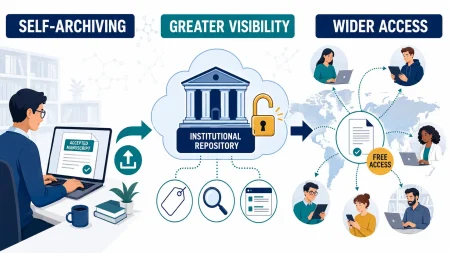
An Institutional Repository (IR) is a digital archive established by academic or research institutions to collect, manage, preserve, and disseminate the intellectual and scholarly outputs of the institution. These outputs typically include theses, dissertations, faculty publications, research data sets, conference proceedings, teaching materials, and administrative documents. The core purpose of an IR is to provide open, long-term, and organized access to the institution’s knowledge assets, ensuring that they are easily discoverable and preserved for future use. By facilitating the centralization and visibility of institutional research, IRs play a crucial role in supporting scholarly communication, knowledge sharing, and academic reputation-building.
Institutional Repositories significantly enhance library services by expanding the scope, reach, and efficiency of information access. Through open access policies, IRs allow libraries to remove the barriers imposed by commercial journal subscriptions, enabling users, both within the institution and globally, to freely access scholarly content. This promotes equity in information access, especially for users in underfunded or remote settings. Additionally, IRs are equipped with standardized metadata and interoperable systems that improve the discoverability of research outputs through platforms like Google Scholar, CORE, and BASE, thus increasing citation potential and institutional visibility. They also support digital preservation, ensuring that valuable academic resources remain intact and accessible over time. Libraries benefit from integrating IRs with research tools such as ORCID, DOI services, and altmetric tracking, offering value-added support to researchers.
What is an Institutional Repository?
An Institutional Repository (IR) is a digital platform established by academic, research, or scholarly institutions to collect, preserve, and provide open access to the intellectual and creative output of the institution’s community. These repositories serve as centralized databases where materials such as research papers, theses and dissertations, conference proceedings, datasets, technical reports, and teaching resources are systematically archived. The primary purpose of an IR is to ensure the long-term preservation and global dissemination of scholarly work produced by faculty members, researchers, and students. By making these materials freely available online, institutional repositories support open access principles, enhance academic visibility, and foster greater knowledge sharing. Unlike traditional library systems that rely heavily on commercial publishers, IRs empower institutions to manage their own scholarly communication channels, improve citation impact, and support the broader academic mission. They also provide a reliable digital preservation infrastructure, helping safeguard institutional knowledge against data loss or obsolescence over time. Through these functions, institutional repositories have become vital components of the modern academic information ecosystem.
The Role of Institutional Repository in Library for Providing Better Services to Users
In the rapidly evolving landscape of academia, libraries are no longer just repositories for physical books and journals. With the advancement of digital technologies, academic libraries have increasingly turned to Institutional Repositories (IRs) to enhance their services, facilitate access to scholarly content, and improve the overall user experience. An Institutional Repository (IR) is a digital archive that stores, preserves, and disseminates the intellectual output of an institution’s community. These repositories house a range of materials such as research articles, theses, dissertations, conference papers, teaching resources, and institutional reports. By enabling the secure and open access to these materials, IRs play a crucial role in advancing the mission of academic libraries and providing better services to users.
- Facilitating Open Access to Scholarly Content: One of the primary roles of an Institutional Repository is to provide open access to scholarly materials. Traditionally, academic content such as journal articles, research papers, and conference proceedings has been locked behind costly subscription models, restricting access to only those who can afford to pay. This limited access hinders the free flow of knowledge and creates barriers for researchers, students, and academics, especially in less well-funded institutions. Institutional repositories, however, break down these barriers by making research available for free to anyone with an internet connection.
- Ensuring Long-Term Preservation of Scholarly Work: In addition to promoting open access, Institutional Repositories serve as vital tools for digital preservation. With the growing reliance on digital formats, there is an increasing risk of data loss or obsolescence due to changing technologies. IRs are designed to preserve academic content in stable, standardized formats to ensure that it remains accessible for future generations. This preservation function is essential for maintaining the institutional memory of universities, colleges, and research organizations.
For instance, an academic institution might use an IR to archive a collection of historical research, making it available to future scholars who may want to analyze past research trends or use the data for new studies. This long-term preservation helps mitigate the risk of losing valuable intellectual property and ensures that knowledge produced today is not lost to future generations. By integrating robust data management strategies, IRs provide a reliable infrastructure for preserving a wide range of academic outputs, from research articles to multimedia materials. - Increasing Visibility and Impact of Research: Institutional Repositories also play a significant role in increasing the visibility and impact of academic research. The more discoverable research is, the higher the likelihood that it will be read, cited, and used by other researchers. IRs facilitate this by indexing content in academic databases and search engines such as Google Scholar, CORE, and BASE. Through this increased visibility, research hosted in an IR is more likely to be found and cited by other scholars, which can contribute to higher citation counts and greater academic recognition.
In many cases, research that is stored in an IR also receives more attention than research that is locked behind subscription-based journals. For example, faculty members and graduate students whose work is hosted in an institutional repository may find that their research is accessed by a larger audience, leading to higher recognition and, potentially, more collaboration opportunities. This increased visibility not only enhances the academic reputation of individual researchers but also elevates the institution’s standing in the global academic community. - Supporting Institutional Accountability and Assessment: IRs also support institutional accountability by providing evidence of research output. Having a centralized and easily accessible repository of scholarly work allows institutions to track their academic productivity and demonstrate their research impact. This information can be crucial during performance evaluations, funding applications, and accreditation processes, where institutions are often required to provide evidence of their research contributions. For example, data from an IR can be used to illustrate the breadth and depth of research conducted within the institution, strengthening its case for continued funding and recognition.
- Supporting Research Collaboration and Networking: Institutional Repositories facilitate research collaboration and networking by providing a centralized platform where researchers can discover each other’s work. By browsing the repository, a researcher can easily identify other individuals working on similar topics, leading to potential collaborations that might not have occurred otherwise. This capability is particularly valuable in interdisciplinary research, where scholars from different fields can connect and share ideas.
For example, a researcher in the social sciences may come across research in the IR from a colleague in the natural sciences, leading to cross-disciplinary collaboration that might yield innovative solutions to complex problems. In addition, many IRs support integration with researcher profiles such as ORCID, which allows users to manage their academic identity and maintain a consistent record of their research activities. This integration fosters networking and collaboration across institutions, further strengthening the global academic community. - Promoting Academic Integrity and Citation Practices: Another critical role of Institutional Repositories is their support for academic integrity. By providing a secure, stable repository for research materials, IRs ensure that authorship is clearly established and that proper attribution is given to researchers. Each piece of content uploaded to the repository is assigned a Digital Object Identifier (DOI) or a permanent link, which makes it easily citable by other researchers. This reduces the likelihood of plagiarism and ensures that original authors are credited for their work. Moreover, by offering citation analytics and usage statistics, IRs provide authors with valuable insights into how their work is being used and cited. This can help researchers track the impact of their work and understand its reach within the academic community.
- Supporting the Research Lifecycle: Institutional Repositories also play an integral role in supporting the entire research lifecycle. Libraries are no longer just facilitators of access to books and journals; they have evolved into research hubs that provide comprehensive services for the academic community. IRs are central to this transformation. By providing services such as publication support, copyright clearance, and citation management, libraries help researchers navigate the complexities of the research process. Additionally, IRs allow libraries to offer services such as data management, assisting researchers in managing and archiving research data sets. This comprehensive support ensures that researchers have the tools they need to succeed, from initial research to publication and preservation.
- Facilitating Sustainable Publishing Models: Institutional repositories offer an alternative to traditional commercial publishing models. By providing a platform for researchers to self-archive their work, IRs reduce the reliance on expensive commercial publishers. This shift encourages the development of more sustainable publishing models that are aligned with the principles of open access and scholarly collaboration. In this way, IRs contribute to the movement toward more equitable academic publishing practices, where knowledge is shared and disseminated in a way that benefits all stakeholders, not just those with the financial resources to access paywalled content.
Institutional Repositories have revolutionized the role of libraries in supporting academic research and knowledge dissemination. By promoting open access, ensuring long-term preservation, enhancing research visibility, fostering collaboration, supporting academic integrity, and offering comprehensive research lifecycle services, IRs significantly improve the services libraries provide to users. These repositories are not just digital storage systems; they are dynamic, interactive platforms that empower researchers, enhance scholarly communication, and strengthen the academic mission of institutions worldwide. As digital scholarship continues to grow, Institutional Repositories will undoubtedly remain central to the evolving landscape of academic libraries.