Introduction: A library’s collection becomes useful when people can discover and access the resources they need. However, locating a particular book, finding materials on a subject, or identifying the correct edition of a publication can be difficult without an organized retrieval tool. A library catalog addresses this need by providing structured information about resources held or made accessible by a library or a group of libraries. It serves as a guide that connects users’ information needs with relevant materials.
A library catalog contains records describing resources such as books, journals, maps, audiovisual materials, and electronic publications. These records provide information such as titles, authors, editions, publication details, and subjects, helping users identify and select suitable resources. Associated location and access information helps users obtain the materials they have selected. Catalogs have developed from printed lists and card files into online public access catalogs (OPACs), allowing users to search collections through multiple access points and, where supported, check availability or follow links to electronic resources.
For students and teachers of Library and Information Science (LIS), understanding the library catalog provides a foundation for studying cataloging, classification, bibliographic description, and information retrieval. It also demonstrates how decisions about describing and organizing resources affect users’ ability to find them.
What is a Library Catalog?
A library catalog is an organized collection of records describing the information resources held by or made accessible through a library or a group of libraries. It helps users discover, identify, select, and locate resources through access points such as author, title, subject, and identifiers. For example, a university library’s catalog may include records for printed textbooks, journals, theses, maps, audiovisual materials, and electronic books.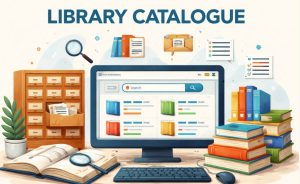
Each catalog record provides information about a particular resource, including its title, author or creator, edition, publisher, publication date, physical description, and subjects. These details help users recognize and evaluate the resource. For instance, a record for The Five Laws of Library Science would identify the title and its author, S. R. Ranganathan. When a catalog contains records for several editions of a textbook, the edition statement and publication year help a student select the version required for a course.
Users can approach the catalog with different information needs:
| Search approach | Example | How it helps |
|---|---|---|
| Title | Search for The Five Laws of Library Science. | Helps locate a known publication. |
| Author | Search for S. R. Ranganathan. | Helps discover resources associated with that author. |
| Subject | Search under the subject heading “Library science.” | Helps locate resources assigned that subject. |
| Keyword | Enter “library automation.” | Helps discover potentially relevant records containing those terms in searchable fields. |
| ISBN | Enter the ISBN printed on a textbook. | Helps locate the record associated with that identifier. |
Associated holdings and item information help users obtain the resources they select. For example, an online catalog might show that a book is located in the Central Library, display its call number, and indicate that one copy is available while another is on loan. The call number guides the user to the appropriate shelf location. An electronic book’s record may instead provide an access link, sometimes requiring institutional authentication.
The process of creating and maintaining these records is called cataloging. For example, when a librarian describes a newly acquired book, assigns appropriate access points and subjects, and adds its location information, the librarian is performing cataloging. The resulting record becomes part of the library catalog that users consult.
Components of a Traditional Library Catalog
A traditional library catalog represents resources through systematically arranged entries. In a card catalog, these entries appear on separate cards, allowing readers to approach the same resource through different access points. Its components include main entries, added entries, bibliographic descriptions, call numbers, cross-references, and tracings.
1. Main Entry: The main entry provides the complete catalog record for a resource. Its heading is selected according to the cataloging rules being followed. This may be a personal author, a corporate body, or a title.
For example, an author main entry for The Five Laws of Library Science would be filed under Ranganathan’s established name heading. Beneath that heading, the card would contain the title and other descriptive information about the particular edition.
2. Added Entries: Added entries provide additional approaches to a resource beyond its main entry. Separate cards may be prepared under titles, subjects, other contributors, and series headings. Their purpose is to help readers locate a resource using the information they already know.
| Added entry | Purpose | Example |
|---|---|---|
| Title entry | Provides access through the resource’s title. | A reader searches for The Five Laws of Library Science without knowing its author. |
| Subject entry | Provides access through an assigned subject heading. | A student searches under “Library science” for relevant books. |
| Contributor entry | Provides access through another person associated with the resource. | A reader searches under a translator’s name. |
| Series entry | Provides access through an established series heading. | A reader looks for other publications belonging to the same series. |
3. Bibliographic Description: The bibliographic description identifies the resource and distinguishes it from similar publications. It records information taken from the resource, following the applicable descriptive cataloging rules. Common elements include the following.
| Element | Information provided | Illustrative example |
|---|---|---|
| Title and statement of responsibility | The resource’s name and the people or bodies responsible for it. | A book’s title followed by its author’s name. |
| Edition statement | The edition being described. | “2nd ed.” |
| Publication information | Place of publication, publisher, and publication date. | The publisher and year printed in the book. |
| Physical description | Extent, illustrations, and dimensions. | “250 p. : ill. ; 24 cm.” |
| Series statement | The series to which the publication belongs. | A numbered textbook series. |
| Notes | Additional information useful for identification or selection. | “Includes bibliographical references and index.” |
| Standard number | An identifier associated with the publication. | ISBN, where applicable. |
4. Call Number and Location Information: The call number connects the catalog entry with the resource’s shelf arrangement. In many classified collections, it includes a classification number and a book number or author mark. It helps bring together materials on related subjects while distinguishing individual resources.
For example, after identifying a suitable book, a student copies its call number from the card and uses it to locate the book on the shelf. A location designation such as “Reference” may indicate the collection in which it is kept.
5. Cross-References: Cross-references guide readers between headings. A “See” reference directs them from an unused form to the heading adopted by the catalog. A “See also” reference connects an established heading with other relevant headings.
A simplified name reference is:
Clemens, Samuel Langhorne — See Twain, Mark.
This directs someone searching under the author’s birth name to the heading used for his works. Similarly, a subject reference may direct readers from a broad topic to related or more specific topics.
6. Tracings: Tracings record the headings under which added entries have been prepared. They commonly appear near the bottom of the main entry card and help librarians maintain the associated cards.
For example, a tracing may indicate that subject and title entries exist for a book. If the book is withdrawn, the librarian can use this information to locate and remove those additional cards.
7. Filing Arrangement and Guide Cards: Consistent filing rules make entries retrievable. In a dictionary catalog, author, title, and subject entries share an alphabetical sequence. A classified catalog arranges subject entries according to a classification scheme and uses an alphabetical subject index to support access.
Guide cards and drawer labels help readers navigate the files. For example, a drawer label showing an alphabetical range directs the reader to the appropriate section before examining individual entries.
Reference Articles:
- Chambers, S. (2013). Catalogue 2.0: The Future of the Library Catalogue. Facet Publishing.
- Khochar, R. S. (1999). Modern Cataloguing, (Systems And Practices). Discovery Publishing House.
- Library Catalog—An overview | ScienceDirect Topics. (n.d.). Retrieved March 10, 2025, from https://www.sciencedirect.com/topics/computer-science/library-catalog
- Library Catalogue – Knowledge Organization and Processing –Cataloguing. (n.d.). Retrieved March 10, 2025, from https://ebooks.inflibnet.ac.in/lisp3/chapter/library-catalogue/
- Ramalingam, M. S. (2000). Library Cataloguing and Classification Systems. Gyan Publishing House.
- Wheatley, H. B. (2010). How to Catalogue a Library. Cambridge University Press.
Catlog library information
This is awesome it helped as library is introduced newly to my state school. Thanks buddy for the write up.
Thanks for your inspiration.
definition for cataloguing ,catalogue & cataloguer
Thanks for your information I like it
Thanks for your information I like it
How do I catalog a book…an easy way to catalog a book please
You can follow this link attached: http://www.lisbdnet.com/library-cataloguing-practical-catalogue/
thank for upfating library students of ATBU Bauchi
Thank you. Please discuss the types of catalogue in details.
Definition need purpose of library catalogue seminar topic note . today plzz
Thanks for your contribution
Thanks
Thanks for this information
Thanks for ur information,it helped me
Alot.
This really helped me when I was preparing for an orientation during my attachment
thanks you for the updated
That’s nice update it really help users to retrieve of choice resource. thanks God bless
Thanks because this really helps me it’s edifying indeed!