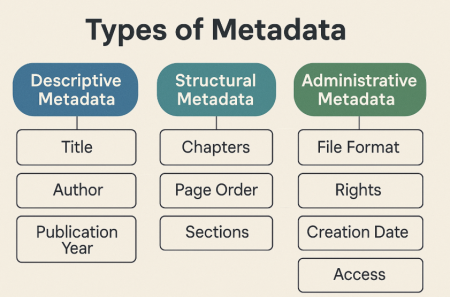
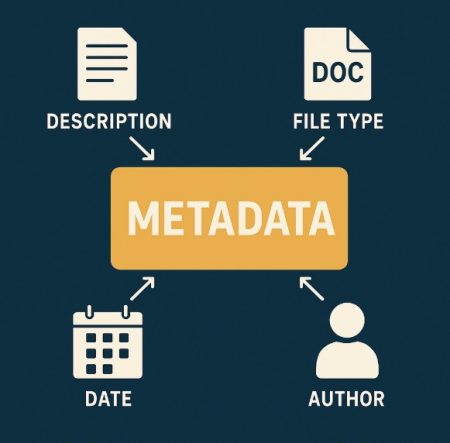
Metadata refers to the structured details that describe and give meaning to books, articles, and digital resources. In libraries and digital platforms, it plays a vital role in organizing knowledge by recording key information such as the title, author, subject, publication year, and format of each resource. For example, when a student searches for “climate change adaptation in Bangladesh” in the library’s online catalogue (OPAC), it is the metadata subject headings, keywords, and abstracts that ensure the right books and articles appear in the results. Similarly, in digital repositories like DSpace, metadata elements such as author names, thesis titles, and submission dates make research papers easily searchable. Without metadata, locating a specific article in databases like JSTOR or a particular e-book in platforms like SpringerLink would be extremely difficult. By standardizing cataloging through schemes such as MARC or Dublin Core, metadata ensures accuracy in searches and allows resources to be visible not just in a single library system but also in global platforms like Google Scholar. In this way, metadata acts as a bridge, connecting vast collections of knowledge with the users who need them, making information both accessible and discoverable.
How Metadata Improves the Discoverability of Books, Articles, and Digital Resources
In today’s information-driven world, libraries and digital platforms are filled with countless books, scholarly articles, and digital resources. Without proper organization, however, these materials would remain hidden and difficult for users to find. Metadata provides the solution by describing the essential details of each resource and acting as a bridge that connects users with the information they seek. It is not simply a technical cataloging tool but a powerful mechanism that enhances access, visibility, and usability across physical and digital collections.
Metadata consists of structured information that records characteristics such as a resource’s title, author, subject, publication date, edition, keywords, and format. In libraries, these details are visible in catalogue entries that allow users to identify and locate materials on the shelves or online. On digital platforms, metadata provides the descriptive record that makes research papers, e-books, or datasets searchable through keywords and browsing functions. For instance, when a student searches for “machine learning applications in education” in an online catalogue, it is the subject headings, abstracts, and keywords within the metadata that ensure relevant results appear. Similarly, in repositories such as DSpace or in databases like JSTOR and Scopus, metadata determines how academic works are indexed, retrieved, and linked to related materials.
The role of metadata in enhancing discoverability is multifaceted. It enables efficient search and retrieval by allowing users to search specific fields such as author, subject, or keyword rather than sifting through unstructured content. It also ensures consistency and standardization, as seen in the use of cataloging formats such as MARC and Dublin Core, which make it possible to retrieve information uniformly across systems. Metadata further improves interoperability by allowing resources stored in one system to be visible in others; for example, a thesis deposited in an institutional repository can also appear in Google Scholar or WorldCat thanks to its standardized metadata. In addition, metadata contextualizes information by linking related works together, such as an article connected to other papers by the same author, to the journal’s website, or to works that cite it.
Examples from practice make this even clearer. In library catalogs, subject headings such as those in the Library of Congress Classification system group related books together, helping readers explore an area of study. In digital repositories like those being used at NSU Library, descriptive elements such as thesis title, supervisor, department, and year of submission will allow students and researchers to find relevant works more easily. On large-scale platforms such as Scopus and Google Scholar, metadata like abstracts, keywords, and citations are essential for making millions of articles searchable worldwide.
The greatest benefit of metadata is that it makes information truly accessible. Whether a student is looking for a textbook, a researcher is seeking recent scholarly work, or a reader is browsing e-books, metadata allows them to find the right resources quickly and accurately. It also supports advanced search features such as filtering by date, author, or publication type, which further enhances the user experience. At the same time, creating and maintaining high-quality metadata comes with challenges. Inconsistencies, missing details, or a lack of adherence to standards can reduce discoverability. For this reason, libraries and digital platforms are increasingly adopting international standards, investing in professional training, and using automated tools to improve metadata quality. Emerging trends such as linked open data and artificial intelligence-driven enrichment offer even more opportunities to strengthen resource discoverability.
Ultimately, metadata is the foundation of information discovery in libraries and digital environments. By offering structured descriptions, ensuring consistency, and enabling interoperability, it transforms vast collections into accessible systems of knowledge. For students, researchers, and readers alike, metadata is the invisible key that unlocks access to books, articles, and digital resources, ensuring that the right information is discoverable at the right time.
How Metadata Standards Contribute to Interoperability and Wider Discoverability
In today’s digital age, libraries, repositories, and information platforms hold enormous collections of books, articles, and digital resources. Yet, without a shared framework for describing these resources, each system would remain isolated, limiting access and making it difficult for users to search across collections. Metadata standards such as MARC, Dublin Core, and MODS address this challenge by providing consistent rules and structures for describing resources, ensuring that they can be exchanged, shared, and discovered across diverse platforms. These standards play a pivotal role in promoting interoperability and enhancing the global visibility of information.
MARC, or Machine-Readable Cataloguing, has been one of the most influential standards in library history. Introduced in the 1960s, it transformed library catalogues by allowing bibliographic records to be encoded in a machine-readable format. This not only enabled libraries to move from traditional card catalogues to online systems but also facilitated large-scale sharing of records through union catalogs such as WorldCat, where a book catalogued in one library can be discovered by users worldwide. While MARC is highly detailed and robust, its structure is sometimes considered complex for digital environments, which paved the way for other standards.
Dublin Core was designed as a simpler and more flexible schema tailored for digital resources. With just 15 core elements, including title, creator, subject, and date, Dublin Core makes it easy to describe a wide range of materials, from scholarly articles and theses to multimedia and web pages. Its simplicity has led to widespread adoption in institutional repositories, digital libraries, and open-access platforms. Moreover, its compatibility with the semantic web means that resources described in Dublin Core can be linked and indexed by global search engines such as Google Scholar, making them far more discoverable beyond their original platforms.
MODS, or Metadata Object Description Schema, developed by the Library of Congress, offers a middle ground between MARC’s complexity and Dublin Core’s simplicity. It is XML-based, making it ideal for digital environments, and provides richer descriptive fields than Dublin Core while remaining more adaptable than MARC. This makes MODS particularly useful in digital libraries and archives that require detailed bibliographic description but also need compatibility with modern systems. Its flexibility ensures that resources can be both thoroughly described and easily shared across platforms.
By using these metadata standards, libraries and repositories create records that can be understood and integrated across different systems, making interoperability possible. For example, a thesis stored in a university repository using Dublin Core can be harvested by global services such as OpenAIRE, making it visible to international researchers. Similarly, a book cataloged in MARC in a local library becomes part of WorldCat’s massive union catalog, extending its discoverability beyond national boundaries. MODS, with its XML structure, allows digital resources to be exchanged between archives and online platforms without losing important descriptive detail.