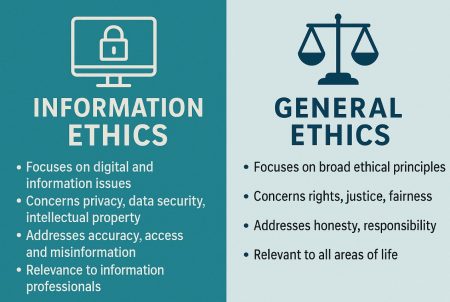
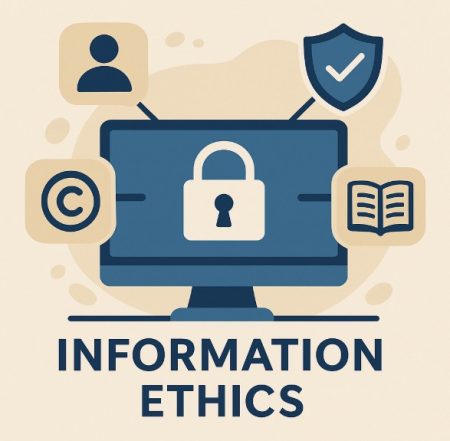
Information ethics is a field of study that examines the moral principles and values that guide the creation, organization, storage, use, and sharing of information across physical and digital environments. In today’s world, where people constantly interact with online platforms, libraries, social media, and AI systems, ethical considerations have become increasingly essential. Information ethics addresses key issues such as privacy (e.g., protecting users’ personal browsing data on a library’s computer system), accuracy (e.g., ensuring that academic databases and news platforms provide verified and reliable information), and intellectual property (e.g., respecting copyright when using digital articles or multimedia content). It also emphasizes equitable access to information, such as offering accessible digital resources for users with disabilities or providing free access to educational materials through open-access platforms. As technologies such as AI chatbots, data analytics, and cloud-based library systems continue to evolve, information professionals must strike a balance between openness and security, ensuring that information practices respect user rights.
How Information Ethics Relates to Privacy, Accuracy, and Accessibility
Information ethics plays a central role in guiding how individuals, organizations, and information systems handle data in a responsible manner. As the world becomes increasingly digital, people interact with information through various platforms, including social media, academic databases, library systems, AI technologies, and everyday online services. This rapid growth has created new opportunities for sharing knowledge, but it has also raised critical ethical concerns. Among these concerns, privacy, accuracy, and accessibility stand out as three interconnected pillars that shape the ethical landscape of modern information management. Understanding how information ethics links these principles is essential for ensuring fairness, trust, and responsible information practices in any environment, particularly in libraries, educational institutions, and online communities.
- Information Ethics and Privacy: Privacy is a foundational element of information ethics because users have the right to control their personal information. Information ethics emphasizes protecting individuals from unauthorized access, surveillance, or misuse of their data. For example, a library must ensure that borrowing records remain confidential and are not disclosed without permission. Similarly, online platforms that collect user data for service improvement are expected to obtain informed consent and store data securely. Ethical dilemmas often arise when organizations balance user tracking (to improve services) with individuals’ rights to privacy. In such cases, information ethics provides principles for minimizing data collection, ensuring transparency, and respecting personal autonomy. By following these ethical guidelines, institutions build trust and protect users from risks such as identity theft, data breaches, or misuse of sensitive information.
- Information Ethics and Accuracy: Accuracy is another crucial dimension of information ethics, particularly in an age where misinformation can spread rapidly. Ethical information practices require that information professionals, researchers, content creators, and digital platforms ensure the information they provide is reliable, verifiable, and free from manipulation. For instance, academic libraries carefully select high-quality journals and databases to prevent the spread of false or misleading academic materials. Similarly, news organizations must verify facts before publication, especially during elections or public health crises. Inaccurate information not only misleads users but can also cause significant harm, such as influencing poor health decisions or spreading fear. Information ethics promotes transparency regarding information sources, responsible fact-checking, and the correction of errors when they occur. In digital environments, this may include labeling AI-generated content or updates that help users identify trustworthy information. By prioritizing accuracy, organizations uphold integrity and foster informed decision-making.
- Information Ethics and Accessibility: Accessibility refers to the ethical obligation to ensure that all individuals—regardless of disability, socioeconomic background, or location- can access the information they need. Information ethics strongly supports the principle of equitable access as a fundamental human right. In libraries, this may involve providing ramps, elevators, screen-reading software, and Braille materials to support persons with disabilities. It may also include offering remote access to digital resources through institutional platforms such as OpenAthens, ensuring that users can obtain academic materials from anywhere. Ethical challenges arise when information is locked behind expensive paywalls or when digital divides prevent certain groups from accessing online content. To address these issues, information ethics promotes open access publishing, community internet initiatives, and user-friendly digital interfaces designed for inclusivity. Accessibility ensures not only fairness but also promotes informed and empowered communities.
- The Interconnection Among Privacy, Accuracy, and Accessibility: Although privacy, accuracy, and accessibility may appear as separate concerns, they are deeply interconnected within the framework of information ethics. For example, improving accessibility through digital services requires collecting user data, which introduces privacy considerations. Ensuring accuracy may involve reviewing user-generated content, which raises ethical questions about surveillance and data monitoring. Similarly, efforts to protect privacy, such as encryption, can sometimes limit accessibility or affect verification processes. Information ethics helps professionals navigate these tensions by promoting balanced decision-making based on fairness, transparency, and respect for user rights. Instead of treating these principles as competing interests, ethical frameworks emphasize their harmonious integration to support responsible information ecosystems.
Information ethics provides an essential foundation for navigating today’s complex digital environments. By addressing privacy, accuracy, and accessibility, it ensures that information is managed in ways that protect users, promote trust, and support equitable access. For institutions such as libraries and academic organizations, adhering to ethical principles strengthens user confidence and enhances the quality of services. As technologies continue to evolve, the importance of responsible information practices will only increase.
Information Ethics and the Protection of Privacy in the Digital Age
Information ethics defines and protects an individual’s right to privacy by establishing moral principles that govern how personal information is collected, stored, accessed, and shared in an increasingly digital world. As individuals use online platforms, library systems, mobile applications, and social networks, they leave behind digital footprints that contain sensitive data, including search histories, location details, academic records, and personal preferences. Information ethics emphasizes that individuals have the right to control this information and to decide how it is used. For example, ethical standards require websites and digital services to obtain informed consent before collecting user data, clearly explain how the data will be used, and give users the ability to opt out of tracking. In libraries, borrowing records and user search histories must remain confidential to protect intellectual freedom and prevent misuse. Information ethics also promotes practices such as data minimization, strong encryption, secure storage systems, and transparent privacy policies to safeguard users from identity theft, surveillance, or unauthorized data sharing. By promoting fairness, respect, and user autonomy, information ethics ensures that privacy is upheld as a fundamental human right, even in an era where digital information flows rapidly and is often difficult to control.
Accuracy as a Core Principle of Information Ethics in Academic and Digital Environments
Accuracy is considered a core principle of information ethics because it ensures that individuals, institutions, and societies make decisions based on truthful, reliable, and verifiable information. In academic and digital environments, where vast amounts of data circulate rapidly, the consequences of inaccurate or misleading information can be significant. For example, students and researchers depend on accurate scholarly articles, datasets, and bibliographic information to produce credible work. If these sources contain errors, the quality of research declines, and academic integrity is compromised. In digital spaces, misinformation spreads quickly across social media, blogs, and unverified websites, often leading to confusion, public harm, or biased thinking. Information ethics emphasizes that information creators, publishers, and digital platforms have a moral obligation to verify facts, cite credible sources, and correct mistakes promptly. AI-generated content and algorithms further underscore the importance of accuracy, as ethical systems necessitate transparency regarding how information is produced and reviewed. By upholding accuracy, information ethics fosters trust, promotes intellectual honesty, and safeguards users from falsehoods that could impact public health decisions, academic outcomes, or societal beliefs.
Information Ethics and the Promotion of Equal and Fair Access to Information
Information ethics promotes equal and fair access to information by emphasizing that every individual, regardless of ability, socioeconomic status, or location, has the right to obtain the information they need to learn, work, and participate in society. This ethical principle is grounded in the belief that information is a public good, and denying access creates inequality, limits opportunities, and widens the digital divide. In practice, information ethics encourages libraries, educational institutions, and digital platforms to design systems and services that are inclusive and user-friendly. For example, libraries provide resources such as screen-reading software, Braille materials, and wheelchair-accessible facilities to support people with disabilities. They also offer open-access digital repositories, free Wi-Fi, and remote login options, allowing users from diverse backgrounds to access academic materials without financial or physical barriers. Information ethics also challenges restrictive practices, such as excessive paywalls, biased licensing agreements, or platforms that require expensive devices, which can exclude disadvantaged groups. By promoting transparency, affordability, and inclusiveness, information ethics ensures that information flows freely and fairly, enabling all users to benefit equally from knowledge and opportunities in both physical and digital environments.