How Does the Call Number Guide Users to the Correct Subject Area?
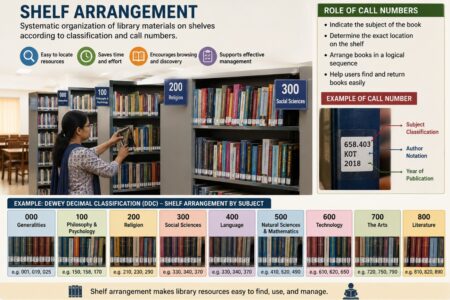
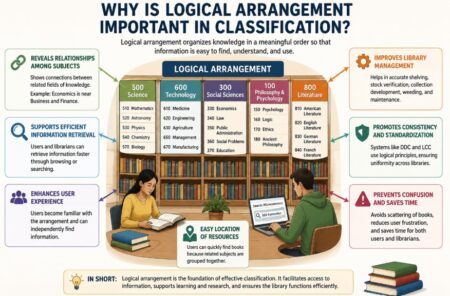
A call number guides users to the correct subject area by encoding the subject classification of a book into a standardized alphanumeric system that directly corresponds to how materials are arranged on library shelves. The first part of the call number represents a broad discipline, allowing users to identify which section of the library houses materials on a particular subject. Because libraries organize shelves according to these classification ranges, users can move confidently to the relevant subject zone before searching for a specific title.
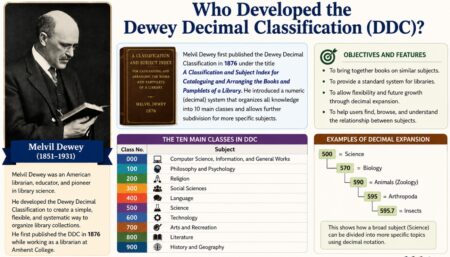
For example, in the Dewey Decimal Classification (DDC) system, numbers in the 000 range cover general works and computer science, while the 300 range represents social sciences. A book with a call number beginning with 025 immediately signals that it belongs to library science, directing users to that subject section. Similarly, in the Library of Congress Classification (LCC) system, the initial letter indicates the main subject area, such as Q for science or Z for library and information science, helping users identify the correct shelves at a glance.
Once users reach the appropriate subject area, the remaining parts of the call number further refine the topic and arrange books in an exact order. This subject-based structure ensures that related materials are grouped together, enabling both efficient retrieval and meaningful browsing. In this way, the call number acts as a subject map of the library, guiding users step by step from a broad academic field to a specific book within that field.

How Does a Call Number Represent the Subject of a Book in a Library Classification System?
A call number represents the subject of a book by encoding its intellectual content into a structured classification scheme that reflects a recognized body of knowledge. The first part of the call number is always subject-based and is derived from an established library classification system, such as the Dewey Decimal Classification (DDC) or the Library of Congress Classification (LCC). This subject component determines where the book belongs within the overall organization of the library and ensures that materials on similar topics are grouped together.
In the Dewey Decimal Classification system, subjects are represented numerically. Each main class covers a broad discipline, and additional digits and decimals refine the topic. For example, a book with the call number 025.3 is classified under library science, with the decimal .3 specifying cataloging. This numeric structure allows the subject to be expressed with increasing specificity, moving from general to highly focused topics.
In the Library of Congress Classification system, subjects are represented using letters followed by numbers. The initial letter indicates a broad subject area, while the numbers that follow narrow it down. For instance, a call number beginning with Z represents library and information science, and Z678 further specifies library automation. Through this combination of letters and numbers, the subject of the book is clearly embedded within the call number itself.
By representing subject content in this systematic way, call numbers not only help users locate a book physically but also communicate what the book is about before it is even taken off the shelf. This subject-based representation supports logical shelving, efficient retrieval, and meaningful browsing, making the call number a fundamental tool for organizing and accessing knowledge in libraries.