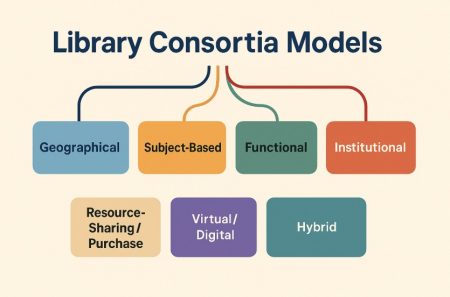
Library consortia are collaborative networks where multiple libraries join forces to share resources, reduce costs, and enhance access to information. For example, the UDL (University Digital Library) Consortium in Bangladesh allows member institutions to access a wide range of e-resources that would be too expensive for a single library to subscribe to individually. In contrast, individual library initiatives refer to independent efforts undertaken by a single institution to develop services, collections, or technological innovations based on its own priorities and capacities. A good example is the North South University (NSU) Library’s initiative to establish its own Institutional Repository, which archives and showcases the university’s scholarly works.
In today’s digital age, where information resources are vast but often costly, and where user demands are increasingly complex, understanding the distinction between these two approaches has become essential. Consortia represent the power of collective strength and cooperation, enabling libraries to achieve goals that would be difficult individually, while individual initiatives reflect the unique identity, autonomy, and tailored services of a single library. Comparing these models is important because it helps us recognize how collaboration and independence each play vital roles in sustaining libraries in a resource-sharing environment. The purpose of this article is to explore the differences between library consortia and individual library initiatives, focusing on their scope, benefits, challenges, and long-term impact on the academic and research landscape.
Concept of Library Consortia
A library consortium refers to a cooperative arrangement among multiple libraries that come together to achieve common goals such as resource sharing, joint subscription to expensive databases, collective bargaining with publishers, and professional development of staff. The central idea behind a consortium is that libraries can accomplish more collectively than they can individually, especially in terms of reducing costs and expanding access to information. For instance, through regional or national consortia, member libraries can negotiate bulk licensing agreements for e-journals, e-books, and databases, giving their users access to a much wider range of scholarly resources than any single library could afford on its own. An example of this is the Research4Life program, which provides developing countries with access to scientific and scholarly content at reduced or no cost through collaborative partnerships. Similarly, in Bangladesh, consortia like the UDL Consortia and LiCoB (Library Consortium of Bangladesh) enable universities to pool resources for the benefit of students, faculty, and researchers across multiple institutions.
Beyond resource sharing, library consortia also foster collaboration in areas such as staff training, technology implementation, and interlibrary loan services. They create a platform for libraries to exchange expertise, standardize practices, and keep pace with global developments in information services. While each library retains its independence, participation in a consortium strengthens its collective capacity to meet the growing demands of users in the digital age. Thus, library consortia represent a strategic approach to overcoming financial, technological, and infrastructural barriers, ensuring that libraries remain vital gateways to knowledge in a highly competitive academic and research environment.
Concept of Individual Library Initiatives
Individual library initiatives refer to the independent projects, programs, and innovations undertaken by a single library to meet the unique needs of its users and strengthen its role as an information hub. Unlike consortia, which thrive on collaboration among multiple institutions, these initiatives are developed and implemented solely by one library, reflecting its vision, priorities, and available resources. Such initiatives often aim to enhance user experience, expand access to knowledge, or integrate modern technology into library services. For example, the North South University (NSU) Library has developed its own Institutional Repository (IR) using DSpace to archive theses, dissertations, and faculty research outputs, ensuring the long-term preservation and visibility of its academic contributions. Similarly, some university libraries implement RFID-based self-checkout systems or establish specialized sections such as a Rare Book Collection, which demonstrate independent efforts to modernize and diversify services.
These initiatives allow libraries to maintain autonomy in decision-making, experiment with innovative ideas, and customize services according to the demands of their academic or community environment. While such efforts may be limited by budget constraints and the institution’s capacity, they carry the advantage of flexibility, speed of implementation, and tailored solutions for local needs. Individual initiatives also highlight the library’s identity and role within its institution, making it a distinctive contributor to academic growth, research support, and community engagement. In this sense, individual library initiatives complement the broader collaborative advantages of consortia, showing that innovation at the single-library level is equally vital in shaping the modern library landscape.
How Do Library Consortia Differ from Individual Library Initiatives?
Libraries around the world have always sought to maximize their ability to provide knowledge, information, and resources to their users. However, with the rising cost of academic databases, the rapid shift toward digital resources, and the diverse expectations of modern users, libraries must constantly explore strategies to remain effective. Two important approaches have emerged in this context: library consortia and individual library initiatives. Both are vital for the advancement of library services, but they differ in scope, financial structures, governance, innovation, and long-term impact.
- Scope and Collaboration: Library consortia are broad, collaborative networks formed by multiple libraries that share common goals. Their scope often extends across regions, countries, or even globally. For example, the OCLC (Online Computer Library Center) is a worldwide consortium that connects thousands of libraries to share bibliographic records, interlibrary loans, and cataloging services. Similarly, INFLIBNET (Information and Library Network Centre) in India coordinates a national consortium called e-ShodhSindhu, which provides universities and colleges with collective access to expensive e-journals and databases. These consortia highlight the power of collaboration to achieve large-scale objectives that no single library could afford or manage alone.
By contrast, individual library initiatives focus on the independent efforts of a single institution. Their scope is narrower but often more specialized. For instance, the British Library’s Endangered Archives Programme digitizes rare and at-risk collections from around the world, showcasing a unique initiative led by one institution. Similarly, Harvard University Library’s open-access digital repository DASH (Digital Access to Scholarship at Harvard) was developed as a university-led project to preserve and disseminate its scholarly works. These initiatives reflect the autonomy of a single library to innovate and tailor services to its immediate academic or community needs. - Funding and Cost-Effectiveness: A key difference between consortia and individual initiatives lies in financial management. Consortia reduce costs by pooling funds from multiple libraries and negotiating bulk subscriptions with publishers. For example, the Bangladesh INASP-PERI Consortium (BIPC) successfully provided access to international journals at a fraction of the cost by uniting academic institutions under a shared licensing agreement. This collective purchasing power ensures that even smaller or resource-constrained libraries can offer their users access to world-class scholarly materials.
On the other hand, individual initiatives depend solely on the budget and priorities of a single library. This can be a strength in cases where an institution is well-funded and wants to invest in projects tailored to its needs. For example, MIT’s OpenCourseWare project, though not a consortium initiative, reflects a university library-driven effort to make course materials freely available worldwide. However, for smaller libraries with limited budgets, launching ambitious initiatives independently may not be feasible. - Access to Resources: Consortia generally provide broader and more diverse access to resources. By combining efforts, they allow users across institutions to benefit from a much wider pool of journals, databases, and e-books. For example, HINARI, a part of Research4Life, is a global health research consortium that provides free or low-cost access to biomedical and health literature in developing countries. This level of access would be nearly impossible for a single library to achieve on its own.
In contrast, individual initiatives are limited to what one library can provide. Yet, they often focus on unique resources that consortia cannot replicate. For example, the National Library of Scotland’s Digital Gallery showcases digitized Scottish history, literature, and culture, reflecting the institution’s specific focus. Such initiatives may not provide the global breadth of resources that consortia offer, but they deliver depth and uniqueness tailored to the institution’s mission. - Governance and Decision-Making: Consortia operate under collective governance structures, where decisions are made jointly by representatives of member libraries. This democratic structure ensures inclusivity and fairness but may sometimes slow down decision-making due to bureaucratic processes and the need to balance diverse institutional interests.
Individual initiatives, in contrast, benefit from faster decision-making and greater autonomy. The library or its parent institution has full control over planning, funding, and implementation. For example, the New York Public Library’s Digital Collections project, which has made more than one million items freely available online, was able to move forward quickly because it was led by one institution rather than requiring broad consensus. - Innovation and Customization: Individual initiatives often take the lead in innovation and experimentation. Since they are not bound by collective agreements, single libraries can adopt cutting-edge technologies or design services that specifically address their users’ needs. For example, the Qatar National Library developed a state-of-the-art digital library platform to support its country’s vision of becoming a knowledge-based society.
Consortia, however, focus more on standardization and shared solutions. While this may limit customization, it ensures that all member institutions benefit equally. For example, the Council of Australian University Librarians (CAUL) negotiates licensing agreements for all member universities, ensuring consistent access across the country, though individual libraries cannot customize subscriptions according to their unique research priorities. - Sustainability and Long-Term Impact: Consortia often demonstrate greater sustainability, as they are supported by the collective strength of multiple institutions. Even if one library faces financial or administrative difficulties, the consortium continues to function. This ensures continuity of access and services for member institutions.
Individual initiatives, however, are more vulnerable to changes in funding, leadership, or institutional priorities. For example, a university may start a digitization project but abandon it midway if budgets are cut. Yet, when successful, such initiatives can leave a lasting legacy by highlighting a library’s distinctive identity, such as Stanford University Libraries’ Special Collections digitization program, which preserves rare manuscripts and archives for future generations.
Library consortia and individual initiatives differ in many ways, but both are essential in strengthening the modern information landscape. Consortia emphasize collaboration, cost-effectiveness, and expanded access to global resources, making them indispensable for academic and research libraries worldwide. Individual initiatives highlight independence, innovation, and customization, allowing libraries to address local needs and showcase their unique contributions. Ultimately, the future of libraries depends on striking a balance between these two models—leveraging the power of collaboration while fostering the creativity and identity of individual institutions.