
A library classification scheme is a systematic method used to organize and arrange library materials based on their subject matter. The purpose of these schemes is to provide a structured framework that enables libraries to categorize resources, making it easier for users to locate and access information. Library classification schemes are essential tools for managing large and diverse collections, ensuring that materials are organized in a way that is both logical and efficient. DDC UDC and CC
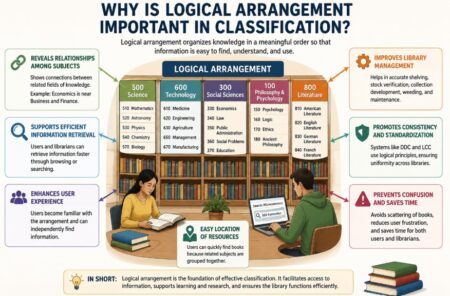
The classification system assigns a unique identifier, often a number or a combination of letters and numbers, to each item based on its subject. These identifiers are typically arranged in a hierarchical manner, with broad categories at the top level and more specific subcategories beneath them. The goal of a classification scheme is not only to group similar materials together but also to facilitate easy browsing and searching by topic.
Various classification systems have been developed over the years to cater to different types of libraries and information needs. Some of the most widely used systems include the Dewey Decimal Classification (DDC), the Universal Decimal Classification (UDC), and the Colon Classification (CC). Each system has its own structure, approach to categorization, and specific areas of application, but they all share the common objective of organizing knowledge in a way that is accessible to library users.
A well-designed library classification scheme supports efficient information retrieval, resource sharing, and interlibrary collaboration, making it an indispensable tool in the organization and management of knowledge in modern libraries. Whether in academic institutions, public libraries, or digital repositories, classification schemes play a crucial role in ensuring that information is organized and readily available for users to explore and discover.
There are several classification schemes used in libraries, including:
A. Dewey Decimal Classification (DDC)
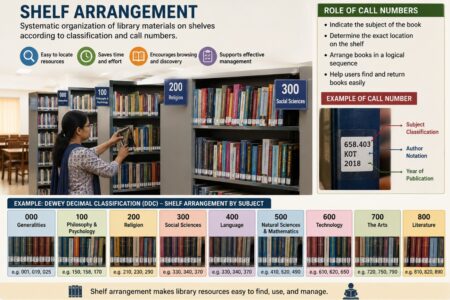
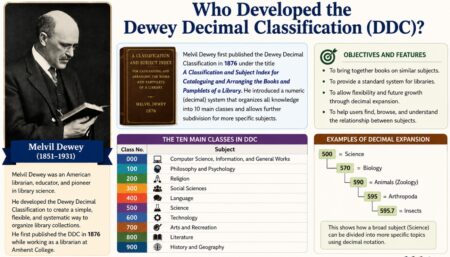
The Dewey Decimal Classification (DDC) system is a widely used library classification scheme designed to organize books, journals, and other resources based on their subject matter. Developed by Melvil Dewey in 1876, the DDC system has become one of the most popular methods for organizing knowledge, particularly in public libraries and school libraries. Its primary goal is to divide the vast body of human knowledge into 10 main classes, each representing a broad field of knowledge, and then further subdivide each class into more specific topics.
The system is decimal-based, meaning it uses numbers, along with decimal points, to represent different subject areas. For example:
- 000-099: General works, Computer science, Information
- 100-199: Philosophy and psychology
- 200-299: Religion
- 300-399: Social sciences
- 500-599: Natural sciences and mathematics
- 600-699: Technology (applied sciences)
- 700-799: The arts
- 800-899: Literature
- 900-999: History and geography
Each of these main classes is broken down into subclasses using additional decimal places to represent more specific areas of study. For example, the number 530 is used for physics, while 531 would represent mechanics within that field.
B. Library of Congress Classification (LCC)
The Library of Congress Classification (LCC) system is a library classification scheme used primarily by academic and research libraries to organize and categorize books, journals, and other library materials. Developed by the Library of Congress in the early 20th century, LCC has become one of the most widely used classification systems in college and university libraries around the world.
LCC is based on an alphanumeric system, meaning it uses a combination of letters and numbers to classify subjects. Unlike the Dewey Decimal Classification (DDC), which is primarily numerical, LCC uses letters to represent broad subject categories and numbers to specify more detailed subcategories. The system organizes knowledge into 21 main classes, each represented by a letter, followed by further divisions and subdivisions to refine the categorization. For example:
- A: General Works
- B: Philosophy, Psychology, Religion
- C: Auxiliary Sciences of History
- D: History (General)
- E-F: History of the Americas
- G: Geography, Anthropology, Recreation
- H: Social Sciences
- J: Political Science
- K: Law
- L: Education
- M: Music and Books on Music
- N: Fine Arts
- P: Language and Literature
- Q: Science
- R: Medicine
- S: Agriculture
- T: Technology
- U: Military Science
- V: Naval Science
- Z: Bibliography, Library Science, Information Resources
C. Universal Decimal Classification (UDC)
The Universal Decimal Classification (UDC) is a highly flexible and detailed system used for organizing and classifying knowledge in libraries, information centers, and digital repositories. Developed by Paul Otlet and Henri La Fontaine in the late 19th century, UDC was designed to expand upon the Dewey Decimal Classification (DDC) system by offering a more precise and adaptable approach to classification. UDC is widely used in specialized libraries, research institutions, and digital libraries due to its ability to handle complex, interdisciplinary subjects and large collections of information.
At its core, the UDC system uses a decimal notation to represent various subjects. The system divides knowledge into broad categories, and each of these categories can be further subdivided by adding decimal points. For instance, 500 represents the general category of natural sciences, while 530 specifically covers physics, and 531 refers to mechanics. This hierarchical and decimal-based structure provides a simple way to classify broad topics, as well as a method for detailing specific subtopics in a logical, organized manner.
One of the standout features of UDC is its analytic-synthetic nature. This means that UDC can both break down complex subjects into smaller, more manageable parts (analytic) and combine different aspects of knowledge to create new, more specific classifications (synthetic). For example, UDC can combine medicine (61) and technology (6) to create a new category for medical technology (615). This allows the system to accommodate a wide range of multidisciplinary and interdisciplinary subjects, making it particularly valuable for libraries that handle a diverse array of topics. The use of symbols and punctuation marks further enhances the system’s flexibility. Colons, slashes, and other punctuation symbols are used to denote relationships between subjects and add additional specificity. For example, 530:62 represents “mathematics applied to computing,” where the colon separates the broader subject of mathematics (530) from its specific application in computer science (62).
D. Colon Classification (CC)
Colon Classification (CC) is a library classification system developed by S.R. Ranganathan in 1933. It is unique in that it uses a faceted classification approach, which allows for the systematic organization of knowledge into components or facets, each representing a distinct aspect of a subject. This method of classification is different from other traditional systems like the Dewey Decimal Classification (DDC) or Universal Decimal Classification (UDC), which rely on hierarchical, decimal-based structures.
The facets of Colon Classification include five basic categories:
- Personality (who or agent of the subject)
- Matter (what or subject matter)
- Energy (how or action or process)
- Space (where or place)
- Time (when or period)
Each of these categories represents a core dimension of a subject, and they are combined using colon notation. The colons serve as separators between different facets, allowing for the detailed expression of complex relationships within a subject. For example, a classification number might look like this: 5:10:20, where:
- 5 represents Mathematics (Matter),
- 10 represents Calculation (Energy),
- 20 represents Arithmetic (Time, as it reflects a specific period of mathematics).
Difference Between Dewey Decimal Classification (DDC), Universal Decimal Classification (UDC), and Colon Classification (CC)
The Dewey Decimal Classification (DDC), Universal Decimal Classification (UDC), and Colon Classification (CC) are three significant classification schemes used by libraries and information centers worldwide. Each system is designed to organize knowledge, but they differ in their structure, methodology, and application. Understanding these differences can help libraries choose the most appropriate system based on their needs, collection type, and user base. Below is a detailed comparison of these classification schemes:
| Aspects | Dewey Decimal Classification (DDC | Universal Decimal Classification (UDC) | Colon Classification (CC) |
| Origin and Development | Developed by Melvil Dewey in 1876, the DDC is one of the oldest and most widely adopted classification systems. It was originally designed for public libraries and school libraries, aiming to provide an easy and systematic way of organizing knowledge for a broad audience. | The UDC was developed by Paul Otlet and Henri La Fontaine in the late 19th century as an expansion of the DDC. The UDC system was created to handle more detailed and specialized classifications, incorporating symbols and punctuation marks to enhance its flexibility. | Developed by S.R. Ranganathan in 1933, the CC system is unique in that it uses a faceted classification approach. It was primarily designed for Indian libraries and focuses on multidisciplinary classification, using a combination of facets like personality, matter, energy, space, and time. |
| Structural Framework | The DDC divides knowledge into 10 main classes, each represented by a number from 000 to 999. These main classes are subdivided into smaller sections using decimal points, making the system hierarchical. The DDC is linear and relatively simple in design, suitable for general knowledge organization. | Similar to the DDC, the UDC is also based on a decimal system, but it incorporates symbols and punctuation marks (such as colons, slashes, and equal signs) to link and combine topics. This analytic-synthetic structure allows for a much more flexible classification, capable of handling complex, multidisciplinary subjects by breaking down and combining categories. | Unlike the DDC and UDC, the CC system is based on a faceted approach. It does not use a strict hierarchical structure but instead breaks down subjects into various facets (personality, matter, energy, space, and time). These facets are combined using colons to form classification numbers, allowing for highly customizable and detailed classifications. |
| Ease of Use and Learning | The DDC is known for being relatively simple and easy to learn, especially for smaller libraries, public institutions, and educational libraries. The straightforward, numeric-based structure makes it easy to categorize books and materials without requiring advanced knowledge of the system. | While UDC is also based on a decimal system, it is more complex due to the use of symbols and punctuation marks. This additional complexity makes UDC more suitable for specialized libraries and research institutions where detailed and flexible classification is required. However, it may present a steeper learning curve for library staff unfamiliar with its symbols and structure. | The CC system is perhaps the most complex of the three due to its faceted classification method and colon notation. It requires a deep understanding of the facets and the rules for combining them. This complexity makes CC ideal for libraries that deal with interdisciplinary knowledge but may not be the best choice for general-purpose libraries. |
| Multidisciplinary and Interdisciplinary Classification | The DDC is somewhat limited in its ability to handle interdisciplinary subjects. Its hierarchical structure is not as adaptable to the increasingly interdisciplinary nature of modern research. Subjects that span multiple disciplines can be difficult to classify accurately within the DDC framework. | UDC excels in multidisciplinary classification. Its analytic-synthetic structure allows for the combination of multiple fields and the breakdown of complex subjects into more granular categories. This flexibility makes UDC particularly suitable for specialized libraries or research centers that handle interdisciplinary topics such as biotechnology, environmental science, or digital humanities. | The CC system is particularly well-suited for interdisciplinary and complex topics. Its faceted approach enables the classification of knowledge across multiple dimensions. For example, a research topic that spans several fields can be classified by combining facets related to personality, matter, energy, and space. This makes CC highly effective in libraries that focus on multidisciplinary collections. |
| Global Use and Adoption | The DDC is widely used worldwide, particularly in public libraries and school libraries. It is a global standard for library classification, especially in English-speaking countries. Its simplicity and adaptability make it a common choice for general-purpose libraries. | UDC is also widely adopted, but its primary use is in specialized libraries, research institutions, and digital repositories. It has a global reach, with translations into over 50 languages, but is more prevalent in academic and technical settings. | While CC is widely used in Indian libraries, it has not gained the same global adoption as DDC or UDC. Its use is primarily limited to regions in South Asia, although it is still influential in libraries focused on complex and interdisciplinary topics. |
| Global Use and Adoption | The DDC is widely used worldwide, particularly in public libraries and school libraries. It is a global standard for library classification, especially in English-speaking countries. Its simplicity and adaptability make it a common choice for general-purpose libraries. | UDC is also widely adopted, but its primary use is in specialized libraries, research institutions, and digital repositories. It has a global reach, with translations into over 50 languages, but is more prevalent in academic and technical settings. | While CC is widely used in Indian libraries, it has not gained the same global adoption as DDC or UDC. Its use is primarily limited to regions in South Asia, although it is still influential in libraries focused on complex and interdisciplinary topics. |
| Flexibility and Adaptability | DDC is generally less flexible than UDC and CC. While it can accommodate new knowledge, its hierarchical structure and focus on broader categories, make it less adaptable to rapidly changing fields of study. The system is primarily used in libraries with general collections and does not easily handle multidisciplinary or interdisciplinary research. | UDC is highly flexible and adaptable. Its design allows for the easy integration of new fields of knowledge and the adaptation of its structure to meet modern needs. UDC can expand into new areas such as technology, digital media, and artificial intelligence, ensuring its relevance in rapidly changing fields. | CC’s faceted approach makes it highly adaptable, especially for libraries dealing with complex, evolving fields. However, its adaptability comes with the cost of complexity, requiring libraries to maintain a high level of expertise to manage the system effectively. |
| Applications | Best suited for general knowledge libraries, public libraries, and educational institutions, where the need for complex classification is minimal. It is ideal for broad subject matter with a straightforward approach to categorization. | Most effective in specialized libraries, research institutions, and digital libraries that require multidisciplinary classification and the ability to manage complex subjects. UDC’s flexibility allows it to be used in both traditional libraries and modern digital information systems. | Primarily used in Indian libraries and in institutions that deal with interdisciplinary or specialized topics. It is ideal for libraries that need to classify complex knowledge across multiple dimensions. |
Each of the Dewey Decimal Classification (DDC), Universal Decimal Classification (UDC), and Colon Classification (CC) systems has its strengths and is suited to different types of libraries and information centers. DDC is straightforward and best for general collections; UDC excels in multidisciplinary and specialized environments, while CC offers a flexible, faceted approach for complex, interdisciplinary topics. Understanding the differences between these systems helps institutions select the one most appropriate for their specific classification needs, collection size, and user base.


8 Comments
thanks . Its really very informative to both Library professionals and students .
Very good work which has helped me
This this best site for research however we need to provide more information online that is still on paper for the future generation.
Thank you this side is very good
well done,good research.
Good
Thanks This side is very usefull
Aachi said h