Information becomes meaningful, accurate, and useful when it meets certain criteria that allow it to be effectively understood and applied. Meaningful information is relevant to the context or situation at hand, addressing specific questions or problems. It connects with the needs of the person receiving it, making it significant and purposeful. Accuracy, on the other hand, ensures that the information is truthful, reliable, and free from errors or misinterpretations. Accurate information is crucial because decisions and actions based on incorrect data can lead to mistakes and negative consequences. Lastly, for information to be useful, it must be clear, timely, and actionable. It should be presented in a way that can directly support decision-making, solve problems, or guide future actions. Information that is either too vague, outdated, or irrelevant will not serve its intended purpose, no matter how accurate it may be. Therefore, meaningful, accurate, and useful information collectively forms the foundation for effective decision-making and successful outcomes.
Key Characteristics of Information
Information is the cornerstone of decision-making, problem-solving, and learning across various domains, from business and technology to healthcare and education. For information to be effective, it must possess certain characteristics that ensure it is meaningful, reliable, and usable. These key characteristics determine how well information can be understood, interpreted, and applied. Below, we explore the key characteristics of information, along with practical examples to illustrate their importance.
- Relevance: Relevance is perhaps the most critical characteristic of information. For information to be valuable, it must directly relate to the problem or question at hand. Irrelevant information, no matter how accurate, can distract from important issues and lead to misguided decisions. Example: In a business context, a market analysis report on consumer behavior in a different country would be irrelevant if the company is focusing on its local market. Instead, the company would need data that specifically pertains to local consumer preferences.
- Accuracy: Accurate information is correct and free from errors or distortions. When making decisions based on information, accuracy is crucial because incorrect data can lead to faulty conclusions and potentially costly mistakes. Example: In healthcare, accurate medical information, such as the correct dosage of a medication or a patient’s medical history, is vital. A small error, such as a misspelled drug name or incorrect dosage, could have serious consequences for the patient’s health.
- Timeliness: Information must be timely, meaning it should be available when needed. In today’s fast-paced world, outdated information can lose its relevance, making it less useful or even misleading. Timeliness is particularly important when dealing with data that is subject to rapid change, such as stock market information or breaking news. Example: In the financial sector, real-time data on stock prices is essential for traders. If they rely on outdated stock price data, they might make decisions based on inaccurate market conditions, leading to losses.
- Completeness: For information to be fully useful, it must be complete. This means providing all the necessary details to understand the full context or answer a question. Incomplete information can lead to gaps in understanding or poor decision-making. Example: In project management, if a report on the project’s progress is missing key details like budget utilization or resource allocation, the project manager might misjudge the project’s status and make decisions that negatively affect the outcome.
- Clarity: Clarity refers to how easily information can be understood. Information should be straightforward, well-organized, and free from ambiguity. If information is presented in a complicated or unclear way, it can confuse the recipient and reduce its effectiveness. Example: A user manual for a piece of software should be clear and easy to follow. If the manual is filled with technical jargon or lacks step-by-step instructions, users may struggle to use the software correctly, leading to frustration and errors.
- Consistency: Consistency ensures that information does not contradict itself and remains uniform over time. Inconsistent information can lead to confusion and undermine trust in its reliability. Example: In a marketing campaign, if the brand message varies across different platforms (e.g., website, social media, and advertisements), it can confuse consumers about what the brand stands for. Consistency in messaging builds brand trust and recognition.
- Objectivity: Objectivity means that information is presented impartially, without bias or personal opinions influencing the data. Objective information allows individuals to make informed, fair decisions based on facts rather than emotions or skewed perspectives. Example: In scientific research, objectivity is crucial. Researchers should report their findings based on data rather than shaping the results to align with a preconceived hypothesis. This ensures that conclusions are drawn from valid evidence.
- Accessibility: Information needs to be easily accessible to those who need it. Whether stored in a database, a report, or on the internet, information should be structured in a way that allows easy retrieval and use. Example: In an organization, if important documents or internal reports are stored in a difficult-to-access format or location, employees may waste time searching for the data they need. A central, well-organized system improves efficiency and decision-making.
- Usability: Usability refers to how easily information can be applied to solve problems or make decisions. Usable information is presented in a way that is intuitive, practical, and aligned with the user’s needs. Example: In a customer service application, usability is essential for resolving customer issues quickly. If the interface is easy to navigate, the customer service representative can find relevant information swiftly and provide accurate solutions.
For information to be effective, it must possess several key characteristics: relevance, accuracy, timeliness, completeness, clarity, consistency, objectivity, accessibility, and usability. These characteristics ensure that information is meaningful, trustworthy, and applicable, empowering individuals and organizations to make informed decisions. Whether in business, healthcare, education, or any other field, information that meets these standards forms the foundation for successful outcomes.
How is the Quality of Information Measured?
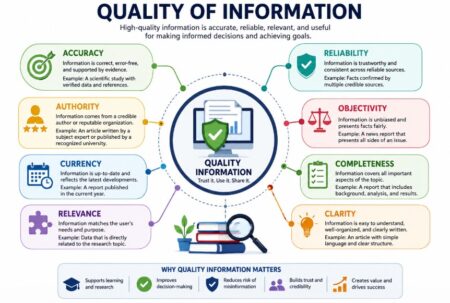
The quality of information is a critical factor that influences decision-making, problem-solving, and overall effectiveness across various industries. To determine whether information is reliable, useful, and applicable, it must be assessed against several key criteria. These criteria help ensure that the information serves its intended purpose and leads to accurate, informed actions. Below are the most common ways to measure the quality of information:
- Accuracy: The most fundamental criterion in evaluating the quality of information is its accuracy. Information is considered accurate if it is factually correct and free from errors or misinterpretations. Accurate information is reliable and consistent with established facts or scientific principles. For instance, in medical research, the quality of information is determined by whether the findings are precise and supported by valid data. Inaccurate information, on the other hand, can lead to misunderstandings, poor decisions, and even harmful consequences.
- Reliability: The reliability of the information refers to the trustworthiness of its source. Reliable information comes from credible, authoritative sources with a proven track record of providing truthful and well-researched data. For example, information obtained from peer-reviewed journals or reputable news outlets is often considered more reliable than anonymous blog posts or unverified social media content. The reliability of information is particularly crucial when used in fields like medicine, law, or finance, where incorrect information could lead to significant consequences.
- Relevance: The relevance of information is another vital aspect of quality. Information should be directly applicable to the context in which it is being used. Relevant information helps individuals make informed decisions by addressing their specific needs, problems, or questions. For example, in academic research, the relevance of sources is critical to ensure that the information is pertinent to the topic being studied. Irrelevant information may create confusion or divert attention from the core issues.
- Clarity: Clarity refers to how well the information is communicated. It must be understandable, well-organized, and free from ambiguity. Information that is unclear or convoluted can lead to confusion and misinterpretation. Whether written or verbal, clear information should be presented in a straightforward manner, with concise language that effectively conveys the intended message. In fields like education or business, clarity ensures that the audience grasps the content without unnecessary complexity.
- Timeliness: Timeliness is crucial when assessing the quality of information. Outdated information may no longer be relevant or accurate due to changes in circumstances, knowledge, or technology. For instance, the latest technological advancements or medical guidelines can drastically change the way we approach certain problems, and using outdated information could lead to ineffective or incorrect decisions. In rapidly evolving fields, up-to-date data is essential to maintain the relevance and usefulness of the information.
- Completeness: For information to be considered high-quality, it should be complete, covering all relevant aspects of the subject matter. Incomplete information can lead to misunderstandings or incomplete analyses, resulting in poor decisions. For instance, a business report should present all necessary data, including both positive and negative aspects of the situation, rather than omitting inconvenient details. Completeness also ensures that the audience has a full understanding of the topic and can make decisions based on all available facts.
- Objectivity: High-quality information should be objective, meaning it is free from bias, personal opinions, or subjective influences. Objectivity ensures that the information presented is based on facts rather than emotions or unverified viewpoints. In research and journalism, objectivity helps maintain credibility by providing balanced perspectives. Biased information, on the other hand, can skew the interpretation of facts and mislead the audience.
- Source Credibility: The credibility of the source plays a significant role in determining the quality of information. Trusted sources, such as experts in a particular field, established academic institutions, or well-known media outlets, are more likely to provide accurate and reliable information. Conversely, sources with a history of misinformation or a lack of expertise should be scrutinized carefully. A credible source provides confidence that the information is trustworthy and backed by sound evidence or research.
- Consistency: Finally, consistency checks if the information aligns with other established facts or data. Information that contradicts established knowledge or that is inconsistent with other reputable sources may raise doubts about its validity. Consistency is especially important when evaluating scientific studies, where results should be replicable and corroborated by multiple independent sources. Inconsistent information may signal errors or deliberate manipulation.
The quality of information is a multifaceted concept that depends on accuracy, reliability, relevance, clarity, timeliness, completeness, objectivity, source credibility, and consistency. As information continues to flood our daily lives from various channels, being able to assess its quality is crucial for making informed decisions. By carefully evaluating these criteria, we can better navigate the information landscape and ensure that the data we rely on is both trustworthy and useful.
How Context Affects the Interpretation of Information
Context significantly influences how information is interpreted, as it provides the framework within which meaning is assigned to data or statements. Without understanding the context, information can easily be misconstrued, leading to inaccurate conclusions or even miscommunication. For example, a simple phrase like “I’m fine” can convey different emotions depending on the tone of voice, the situation, or the relationship between the speaker and the listener. In a casual conversation, it might be understood as a truthful statement, but in a high-stress scenario, it could be interpreted as a sign of distress or masking true feelings.
Context is crucial for interpreting statistics or data in fields like business or science. A drop in sales or a decrease in productivity might seem alarming at first glance, but without knowing the broader context—such as seasonality, market trends, or external factors—it could lead to misguided decisions. For example, an economic recession may cause a temporary decline in profits, but understanding this within the larger historical or economic context helps interpret the data correctly.
Cultural and societal contexts are also key. A gesture or word might have vastly different meanings depending on cultural norms. A direct or blunt approach might be considered rude in some cultures, but in others, it could be seen as an indication of honesty or efficiency. Context influences how individuals from different backgrounds interpret verbal and non-verbal cues, making it crucial to consider cultural nuances in communication. Moreover, context dictates the relevance of information. What is considered relevant in one situation might be irrelevant in another. For instance, a historical fact that is pertinent to a political debate might seem trivial in a casual social setting. Understanding the context helps determine the significance of the information in a given scenario.
The Role of Structure in the Effectiveness of Information
The structure of information plays a pivotal role in its effectiveness, as it directly influences how easily the information can be understood, accessed, and used. Well-structured information is organized logically and presented in a manner that guides the recipient through the content, ensuring that key points are clear and easy to follow. A clear structure allows individuals to quickly find relevant data, grasp complex concepts, and apply the information to make informed decisions. Without proper organization, information can become overwhelming, confusing, or even misleading, leading to misunderstandings and poor decision-making.
For instance, in a report or presentation, a structured layout with headings, subheadings, bullet points, and clearly defined sections helps readers navigate the content efficiently. This organization enhances readability and ensures that the most critical information is highlighted and easily accessible. Furthermore, structure aids in connecting related ideas and concepts, providing a coherent flow that enhances the overall understanding of the topic.
In digital formats, such as websites or databases, the structure of the content is equally important. Information should be categorized and indexed in a way that users can easily search and retrieve the data they need. The arrangement of information in an intuitive and user-friendly format increases its usability, allowing individuals to access and utilize it effectively.
How ICT Has Enhanced Access to Library Resources for Users
The integration of information and communication technology (ICT) into library services has dramatically transformed how users access resources, making them more convenient, efficient, and user-friendly. In the past, users had to physically visit libraries during specific hours to access materials, often relying on card catalogs and manual processes to locate books or other resources. ICT has eliminated many of these barriers, enhancing the overall user experience in several impactful ways.
One of the primary ways ICT has enhanced access to library resources is through the development of digital catalogs and Online Public Access Catalogues (OPAC). These systems have replaced traditional card catalogues, allowing users to search for materials by title, author, subject, or keyword at any time from any location. Users no longer need to physically browse shelves or rely on library staff for assistance, as digital catalogs provide a more efficient and accurate way to locate items. Furthermore, these systems offer real-time updates, showing the availability of materials and even allowing users to reserve them online.
ICT has also revolutionized the way libraries manage and provide access to digital resources such as e-books, online journals, databases, and multimedia content. With the advent of digital libraries and e-libraries, users can access a vast range of academic articles, research papers, textbooks, and other materials from anywhere in the world, 24/7. This digital shift has been especially important for students, researchers, and professionals, as they can now obtain the information they need without being limited by the physical constraints of a traditional library.
The availability of mobile applications and online platforms has made it even easier for users to interact with library services. With these tools, users can check out, renew, or return materials, reserve books, and receive notifications about new acquisitions or upcoming events—all from their smartphones or tablets. These mobile apps provide a level of convenience that traditional library services could not offer, giving users the ability to engage with library resources on-the-go.
Cloud-based storage solutions further enhance access by enabling libraries to store vast amounts of digital content securely. With cloud technology, resources are no longer limited to a library’s physical space. Digital materials can be accessed remotely, making it easier for users to obtain necessary resources from anywhere in the world. This is particularly beneficial for individuals in remote areas, those with mobility challenges, or those who simply cannot make frequent trips to the library.
The integration of ICT in libraries has significantly expanded access to resources. Through online catalogs, digital libraries, mobile applications, and cloud storage, users now enjoy a more convenient, efficient, and flexible way to access materials. By breaking down barriers related to time, location, and physical space, ICT has made library resources more accessible to a broader audience, enhancing the overall user experience and making libraries more relevant in today’s digital age.
How Mobile Applications and Online Catalogues Have Transformed Library Services and User Engagement
Mobile applications and online catalogues have fundamentally transformed library services and user engagement, providing users with unprecedented convenience, accessibility, and interactivity. Traditional library systems, which require users to visit the physical location during set hours, are now augmented by digital tools that allow for round-the-clock access to library resources. This transformation has made libraries more user-friendly and responsive to the needs of a modern, tech-savvy audience.
Online catalogues, or Online Public Access Catalogs (OPACs), have revolutionized how users search for and access library materials. These digital systems replace the traditional card catalog, offering a much more efficient and accessible way for users to find books, articles, e-books, and other resources. Advanced search features allow users to filter by author, title, subject, or format, and they can see real-time availability and locations of materials. The ability to reserve books online and receive notifications when they are ready for pickup further streamlines the process, saving time and improving the user experience. Online catalogues also make it easier to explore digital resources, such as databases and e-books, without needing to visit the library physically.
Mobile applications have further enhanced library services by providing users with a portable, on-the-go connection to the library. These apps allow users to check out, renew, and return items using their smartphones, eliminating the need for a visit to the physical library. They also provide push notifications about library events, new acquisitions, and overdue materials, keeping users informed and engaged. With mobile apps, users can browse digital collections, access e-books and audiobooks, and explore other online resources, making it possible to engage with the library no matter where they are. These tools also enable libraries to offer personalized recommendations based on users’ borrowing habits, creating a more customized and engaging library experience.
Together, online catalogues and mobile applications have shifted the library from a physical space with limited access to a dynamic, digital service available to users at their fingertips. These technologies have made libraries more accessible, convenient, and user-friendly, empowering patrons to interact with library resources in ways that suit their individual needs and lifestyles. By extending library services beyond traditional hours and locations, mobile apps and online catalogues have transformed library engagement, fostering deeper connections between libraries and their communities.