What Is Post-Coordinate Indexing?
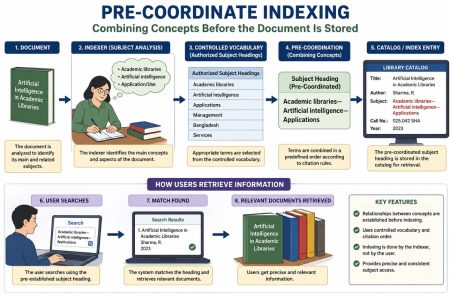
Post-coordinate indexing is a method of indexing in which individual terms or descriptors that represent the subject content of a document are assigned independently during the indexing process and are only combined at the time of information retrieval. This approach contrasts with pre-coordinate indexing, where subject headings are constructed in a predetermined order before being stored. Post-coordinate indexing allows users to combine relevant terms during their search according to specific information needs, making it one of the most widely used indexing techniques in computerized information retrieval systems.
In post-coordinate indexing, each significant concept within a document is represented by an independent descriptor or keyword. These descriptors are stored separately in the database without establishing fixed relationships between them. When a user performs a search, the retrieval system combines the selected terms using Boolean operators such as AND, OR, and NOT to retrieve relevant documents. As the coordination of terms occurs after indexing—during the search process—this method is called post-coordinate indexing.
Example 1: Academic Library
Suppose a journal article discusses the use of artificial intelligence in academic libraries. Instead of assigning a single complex subject heading, the indexer assigns the following independent descriptors:
- Artificial Intelligence
- Academic Libraries
- Chatbots
- Information Retrieval
A user can retrieve the document by combining these descriptors in different ways, such as:
- Artificial Intelligence AND Academic Libraries – retrieves documents discussing AI applications in academic libraries.
- Chatbots AND Academic Libraries – retrieves documents related to chatbot services in libraries.
- Artificial Intelligence NOT Chatbots – retrieves AI-related library documents, excluding those related to chatbots.
Thus, the same document can satisfy different search requirements without changing its original indexing.
Example 2: Medical Database
Consider a research paper on the treatment of diabetes using insulin therapy. The document may be indexed with the following descriptors:
- Diabetes
- Insulin
- Drug Therapy
- Adults
A researcher searching for Diabetes AND Insulin will retrieve documents about insulin treatment for diabetes. Another user searching for Diabetes AND Adults will find studies specifically related to adult patients.
Example 3: Digital Library Search
A digital library that stores a document on renewable energy technologies may use these descriptors:
- Renewable Energy
- Solar Energy
- Wind Energy
- Sustainable Development
Users can perform different searches based on their needs, such as:
- Renewable Energy AND Sustainable Development
- Solar Energy OR Wind Energy
- Renewable Energy NOT Wind Energy
This flexibility allows users to retrieve highly relevant information without requiring the indexer to anticipate every possible subject combination.
The primary objective of post-coordinate indexing is to provide flexibility, precision, and efficiency in information retrieval. Since users can formulate their own search strategies by combining different descriptors, the same indexed document can meet various information needs. This significantly improves retrieval effectiveness, especially in large electronic databases.
Post-coordinate indexing is particularly suitable for computerized information retrieval systems because new search combinations can be created at any time without modifying the stored index. Users have greater control over the search process and can broaden or narrow their results simply by changing the combination of search terms.
Today, post-coordinate indexing is extensively used in Online Public Access Catalogs (OPACs), digital libraries, institutional repositories, and bibliographic databases such as Scopus, Web of Science, PubMed, and Google Scholar, as well as in modern web search engines. For instance, a researcher searching Google Scholar for “machine learning” AND “healthcare” retrieves publications that include both concepts, demonstrating the practical application of post-coordinate indexing. Similarly, in an OPAC, a user searching for “climate change” AND “Bangladesh” retrieves books and articles that discuss both topics together.
Due to its adaptability, efficiency, and ability to support complex searching, post-coordinate indexing has become one of the most important indexing methods in modern library and information science. It remains a cornerstone of digital information retrieval systems.
Purpose of Post-Coordinate Indexing in Information Retrieval
The primary purpose of post-coordinate indexing is to enable accurate, flexible, and efficient information retrieval. Unlike pre-coordinate indexing, where subject headings are predetermined by the indexer, post-coordinate indexing allows users to combine individual indexing terms or descriptors when searching. This flexibility empowers users to create their own search strategies using Boolean operators such as AND, OR, and NOT. As a result, users can retrieve information that closely aligns with their specific needs while minimizing unnecessary or irrelevant results. For example, a researcher interested in the role of artificial intelligence in academic libraries can search for “Artificial Intelligence AND Academic Libraries,” while another user focused on library chatbots might search for “Chatbots AND Academic Libraries.” Both searches can yield the same document if it has been indexed with these descriptors, illustrating the adaptability of post-coordinate indexing.
Another important goal of post-coordinate indexing is to enhance the precision and recall of information retrieval systems. By combining different descriptors, users can narrow their searches to find highly relevant documents or broaden them to include a wider array of related materials. For instance, searching for “Renewable Energy AND Solar Energy” will retrieve documents specifically about solar energy. In contrast, using “Renewable Energy OR Wind Energy” expands the search to include documents on either renewable energy in general or wind energy. This capability to refine search results is especially beneficial in large digital collections containing millions of records.
Post-coordinate indexing also aims to support the efficient organization and retrieval of information in computerized databases. Since descriptors are stored independently, the indexing process becomes simpler and more cost-effective, as indexers do not need to anticipate every possible subject combination. Instead, the retrieval system dynamically combines descriptors based on the user’s query. This approach is widely used in Online Public Access Catalogs (OPACs), digital libraries, institutional repositories, and bibliographic databases such as Scopus, Web of Science, PubMed, and Google Scholar. For example, in an OPAC, a student can search for “Climate Change AND Bangladesh” to retrieve books and articles specifically addressing climate change issues in Bangladesh, without the need for a predefined subject heading.
Post-coordinate indexing enhances user autonomy by allowing researchers, students, and professionals to tailor their searches according to their own knowledge and objectives. As new topics and interdisciplinary research areas emerge, users can create new combinations of existing descriptors without requiring a redesign of the index. This adaptability makes post-coordinate indexing particularly suitable for modern information retrieval systems that manage rapidly growing and continuously changing collections of digital information.