What Is a Narrower Term (NT)?
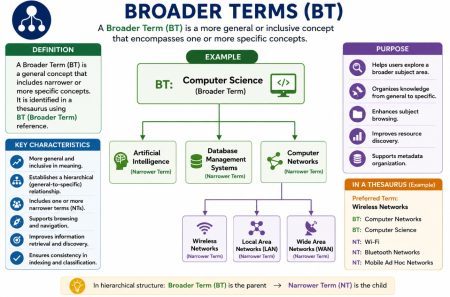
A narrower term (NT) refers to a more specific concept that falls under a broader concept within the hierarchical structure of a controlled vocabulary, thesaurus, subject heading list, taxonomy, or other knowledge organization system. It represents a subordinate or child concept that shares the general characteristics of a broader term while focusing on a more precise aspect of the subject. In a thesaurus, narrower terms are linked to their corresponding broader terms (BTs) through hierarchical relationships, making it easier for users to navigate systematically from general concepts to more specialized topics. This hierarchical organization aids information professionals in accurately classifying resources and allows users to retrieve information at an appropriate level of specificity.
The primary purpose of a narrower term is to enhance the precision of knowledge organization and information retrieval. Broader terms provide an overview of a subject area, while narrower terms identify individual categories, subtopics, or specialized concepts within that broader category. For instance, “Renewable Energy” is a broader term that encompasses narrower terms such as “Solar Energy,” “Wind Energy,” “Hydroelectric Power,” and “Geothermal Energy.” Each of these narrower terms represents a distinct form of renewable energy while remaining conceptually subordinate to the broader category. Similarly, “Computer Security” includes narrower terms like “Network Security,” “Application Security,” “Cloud Security,” and “Mobile Security.”
In a thesaurus, narrower terms are indicated using the NT (Narrower Term) reference. This reference appears with a broader or preferred term to show the more specific concepts that fall under it. For example, the preferred term “Environmental Pollution” may include the following narrower terms:
- NT Air Pollution
- NT Water Pollution
- NT Soil Pollution
- NT Noise Pollution
These NT references help users understand the internal structure of a topic and identify the specific areas most relevant to their information needs. Rather than searching broadly for environmental pollution, a researcher interested solely in water quality can navigate directly to “Water Pollution” and find more focused resources.
Narrower terms play an important role in improving subject browsing and resource discovery. Users often begin with a broad topic and then refine their searches as they gain a better understanding of the subject. The hierarchical relationships enable this progressive refinement. For example, a student researching “Public Health” may narrow the search to “Epidemiology,” “Health Promotion,” “Occupational Health,” or “Environmental Health,” depending on the specific focus of their study. This ability to move from general to specific concepts makes searching more efficient and reduces the retrieval of irrelevant materials.
Another important function of narrower terms is to support accurate indexing and metadata creation. Information professionals assign the most specific subject heading that accurately represents the content of a resource whenever possible. For instance, a book focused entirely on “Machine Vision” should be indexed under that narrower term rather than only under the broader term “Computer Vision.” Likewise, a report specifically discussing “Mangrove Ecosystems” should be designated that narrower term instead of the broader heading “Ecosystems.” This level of specificity enhances the precision of information retrieval and aids users in locating highly relevant materials.
In modern digital libraries, bibliographic databases, institutional repositories, and semantic search systems, narrower terms contribute to richer metadata and more effective navigation. Search platforms utilize hierarchical relationships to recommend more specific topics, refine search queries, and organize collections logically. For example, a digital repository may classify “Deep Learning” as a narrower term under “Machine Learning,” allowing users to explore increasingly specialized areas of artificial intelligence while maintaining a clear understanding of the broader conceptual framework.