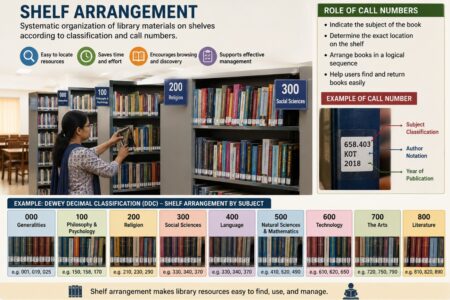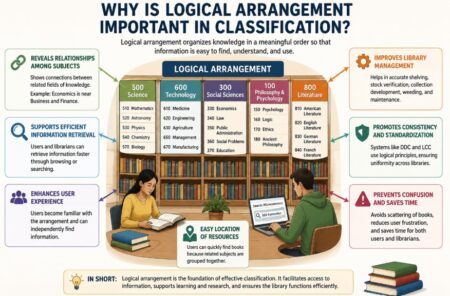
Library classification is essential for organizing materials on library shelves in a systematic way according to their subject content. Instead of arranging books randomly or by title or author, classification schemes assign a unique class number to each resource. These class numbers determine the specific position of materials, ensuring that they are organized logically and consistently. This systematic arrangement helps both library users and staff locate, retrieve, and reshelve materials efficiently.
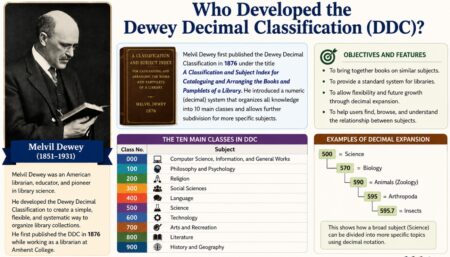
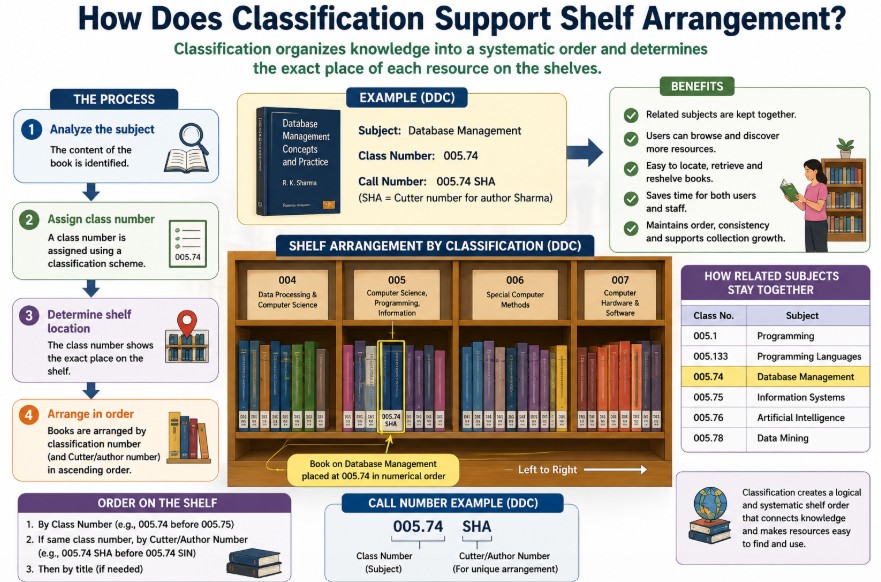
One of the primary benefits of classification is that it groups materials on similar subjects together. For instance, in the Dewey Decimal Classification (DDC) system, books on computer science are generally assigned to the 000 class, social sciences to the 300 class, and history to the 900 class. Within the computer science section, more specific topics are arranged in numerical order. A book classified as 005.133 (Programming Languages) would be shelved near books classified as 005.1 (Programming) and 005.74 (Database Management). This arrangement allows users interested in a particular subject to find multiple relevant resources in close proximity.
Classification also provides a clear and predictable order on the shelves. Since class numbers are organized either numerically or alphanumerically, every item has a designated place. For example, a book with the call number 005.74 DAT will be shelved before a book with the call number 005.75 INF, because 005.74 comes before 005.75. Similarly, in the Library of Congress Classification (LCC) system, books are arranged alphabetically by class letters and then numerically. A book with the call number QA76.73 (Computer Programming) would be placed before QA76.9 (Computer Systems). This standardized arrangement eliminates confusion and ensures consistency throughout the collection.
Another significant advantage of classification is that it simplifies the shelving and reshelving process for library staff. When returned books arrive at the circulation desk, staff can quickly determine their correct shelf location by checking the classification number. For example, if a returned book has the call number 658.8, staff know that it belongs in the marketing section within the broader business category. Without a classification system, staff would have to rely on memory or create arbitrary arrangements, making collection management much more challenging.
Classification also enhances browsing, one of the most valuable ways users discover information. For instance, a student searching for a book on knowledge management classified under 658.4038 may notice nearby books on organizational learning, information management, and business intelligence. Because related materials are shelved together, users can easily explore additional resources that may support their assignments or research projects. This opportunity for discovery would be greatly diminished if books on similar topics were scattered throughout the library.
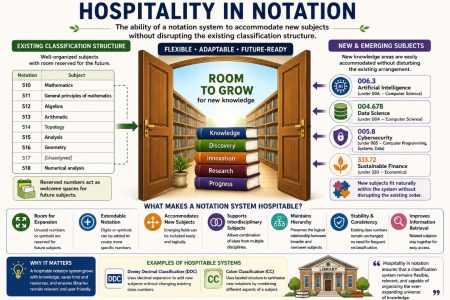
In large academic and research libraries, classification is particularly important, as collections may contain hundreds of thousands of items. Classification organizes the layout so that each subject occupies a specific section of the library. For example, engineering books may be located in one area, literature books in another, and medical resources in yet another. This subject-based arrangement enables users to navigate extensive collections efficiently without being overwhelmed by the sheer volume of materials. Furthermore, classification supports effective space management and collection growth. As new books are added, they can be placed in their appropriate subject areas according to their classification numbers. For instance, if several new books on artificial intelligence are acquired, they can be integrated into the existing computer science section without disrupting the overall shelf arrangement. This flexibility allows libraries to expand their collections while maintaining an organized structure.