Why Is It Important to Understand Knowledge Management Processes in Organizations?
Understanding Knowledge Management (KM) processes is critically important for organizations because knowledge has become one of the most valuable strategic resources in the modern economy. Knowledge Management processes—such as knowledge creation, acquisition, organization, storage, sharing, and application—enable organizations to systematically handle both explicit and tacit knowledge. When these processes are clearly understood, organizations can ensure that valuable insights, expertise, and experience are not lost but captured and reused to support long-term growth and sustainability. This understanding helps organizations move beyond informal knowledge practices toward structured and purposeful knowledge use.
A clear understanding of Knowledge Management processes also improves organizational efficiency and decision-making. Employees who know how knowledge flows within the organization can quickly access relevant information, avoid duplication of work, and reduce errors caused by incomplete or outdated knowledge. For example, documented best practices and lessons learned from previous projects allow teams to make informed decisions without repeatedly “reinventing the wheel.” As a result, organizations save time, reduce operational costs, and enhance overall productivity.
Moreover, understanding KM processes is vital to preserving organizational memory. In many organizations, critical knowledge resides in the minds of experienced employees. When staff retire, resign, or change roles, this tacit knowledge is at risk of being lost. By understanding and implementing KM processes such as knowledge capture and documentation, organizations can retain valuable expertise and ensure continuity in operations. This is particularly important in knowledge-intensive environments such as libraries, universities, research institutions, and corporate organizations.
Another key reason for understanding Knowledge Management processes is their contribution to innovation and continuous learning. Knowledge creation and sharing encourage collaboration across departments and promote the exchange of ideas. When employees understand how knowledge is generated and shared, they are more likely to participate in learning communities, contribute new insights, and apply existing knowledge in innovative ways. This continuous learning culture strengthens an organization’s ability to adapt to technological changes, market competition, and evolving user or customer needs.
Finally, understanding Knowledge Management processes supports strategic alignment and competitive advantage. Organizations that effectively manage their knowledge can align individual expertise with organizational goals, ensuring that the right knowledge reaches the right people at the right time. This strategic use of knowledge enhances service quality, improves customer satisfaction, and strengthens organizational competitiveness. In an era where success increasingly depends on intellectual capital, understanding Knowledge Management processes is essential for building resilient, agile, and knowledge-driven organizations.
The Key Processes Involved in Knowledge Management
Knowledge Management (KM) is a systematic, continuous approach that enables organizations to effectively manage knowledge as a strategic asset. It involves a series of interconnected processes through which knowledge is created, captured, organized, shared, and applied to achieve organizational goals. Understanding these key processes is essential for implementing successful Knowledge Management practices in organizations such as libraries, academic institutions, corporate enterprises, and research organizations. The major processes involved in Knowledge Management are discussed below.
- Knowledge Creation: Knowledge creation is the foundational process of Knowledge Management. It involves generating new knowledge through learning, research, innovation, collaboration, and experience. Knowledge is created when individuals and teams solve problems, conduct research, share ideas, or reflect on past experiences. In academic institutions, knowledge creation occurs through teaching and research activities, while in organizations, it emerges from innovation, project work, and continuous improvement initiatives. Knowledge creation ensures that organizations remain dynamic and adaptable in changing environments.
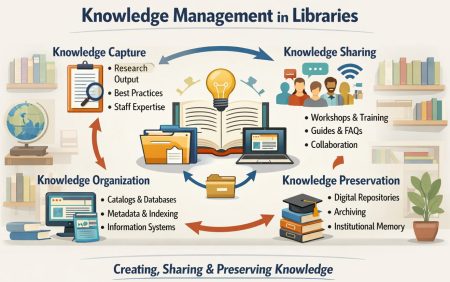
- Knowledge Acquisition and Capture: Once knowledge is created, it must be acquired and captured so that it can be preserved and reused. This process involves identifying valuable knowledge and documenting it in various forms, such as reports, manuals, guidelines, case studies, or digital content. Tacit knowledge is captured through interviews, mentoring, storytelling, and observation, while explicit knowledge is collected from documents and databases. Effective knowledge capture prevents knowledge loss and ensures continuity within the organization.
- Knowledge Organization: Knowledge organization focuses on structuring and classifying knowledge so that it can be easily accessed and understood. This includes categorization, indexing, metadata creation, and the use of classification systems or taxonomies. Organized knowledge reduces information overload and enables users to locate relevant knowledge efficiently. In libraries and information centers, this process is especially important for managing both print and digital knowledge resources.
- Knowledge Storage and Preservation: Knowledge storage involves maintaining knowledge in secure and reliable repositories such as databases, digital libraries, intranets, and content management systems. Preservation ensures that knowledge remains accessible over time and protected from loss, damage, or obsolescence. Proper storage and preservation support long-term access to organizational knowledge and maintain institutional memory, particularly in organizations with high staff turnover.
- Knowledge Sharing and Dissemination: Knowledge sharing is one of the most critical processes in Knowledge Management. It involves distributing knowledge across individuals, teams, and departments through formal and informal channels. Knowledge can be shared through meetings, training programs, workshops, online platforms, and collaborative tools. This process promotes learning, collaboration, and the effective use of collective expertise, transforming individual knowledge into organizational knowledge.
- Knowledge Application: The ultimate goal of Knowledge Management is the application of knowledge to real-world situations. Knowledge application involves using available knowledge to solve problems, make decisions, improve services, and innovate. Knowledge becomes valuable only when it is applied effectively. This process ensures that Knowledge Management contributes directly to organizational performance, efficiency, and strategic success.
- Knowledge Evaluation and Updating: Knowledge Management is an ongoing process that requires regular evaluation and updating of knowledge resources. This involves assessing the relevance, accuracy, and usefulness of knowledge and removing outdated or incorrect information. Continuous evaluation ensures that knowledge remains current and aligned with organizational needs. Feedback from users plays a key role in improving Knowledge Management systems and practices.
The key processes involved in Knowledge Management—knowledge creation, capture, organization, storage, sharing, application, and evaluation—work together as an integrated cycle. Each process supports the others, creating a dynamic system that transforms individual expertise and information into organizational intelligence. By effectively managing these processes, organizations can enhance learning, innovation, decision-making, and long-term sustainability in an increasingly knowledge-driven world.
How Do Knowledge Management Processes Support Organizational Learning?
Knowledge Management (KM) processes play a vital role in supporting organizational learning by providing a structured and systematic way to create, acquire, share, and apply knowledge within an organization. Organizational learning is not limited to formal training programs; it is embedded in everyday activities, interactions, and decision-making processes. For example, when a library, university, or corporate organization documents service improvements or project outcomes, employees can learn from previous experiences rather than starting from scratch. Through effective KM processes, individual knowledge is transformed into collective organizational learning, thereby improving performance and adaptability.
Knowledge creation forms the foundation of organizational learning by encouraging employees to generate new ideas and solutions through experience, problem-solving, and collaboration. For instance, when a library team develops a new user service model after analyzing user feedback, or when an IT department designs an improved workflow to solve recurring technical issues, new knowledge is created. Knowledge acquisition further strengthens learning by enabling organizations to draw on external sources such as training workshops, professional conferences, online courses, research publications, and benchmarking with other institutions. A university library, for example, may adopt best practices in digital repositories after studying successful implementations in other academic libraries.
Knowledge capture and preservation are essential for sustaining organizational learning over time. Much valuable knowledge exists in tacit form within the minds of experienced employees. KM processes help convert this tacit knowledge into explicit forms through documentation, guidelines, manuals, and lessons learned reports. For example, when senior staff document cataloguing procedures, reference service strategies, or database troubleshooting steps, new employees can learn quickly and maintain service continuity. This process helps build organizational memory and prevents the loss of expertise due to staff retirement or turnover.
Organizational learning also depends on how effectively knowledge is organized and made accessible. Knowledge organization processes such as classification, indexing, tagging, and metadata creation ensure that learning resources can be easily retrieved. For example, a well-structured digital repository or intranet allows staff to quickly locate training materials, policy documents, or past project reports. When knowledge is organized properly, employees can learn from existing resources and apply that learning to new situations without wasting time searching for information.
Knowledge sharing plays a crucial role in transforming individual learning into collective learning. KM processes encourage sharing through formal mechanisms such as workshops, training sessions, communities of practice, and team meetings, as well as through informal interactions such as mentoring and peer discussions. For instance, regular staff meetings where employees share successful service strategies or challenges faced in user support help spread learning across departments. In academic or corporate settings, collaborative platforms and discussion forums also facilitate continuous knowledge exchange.
Finally, knowledge application and evaluation strengthen organizational learning by linking knowledge to action and reflection. Applying knowledge in real situations—such as using documented best practices to improve customer service or applying lessons learned from past projects to new initiatives—allows employees to learn through practice. Continuous evaluation, feedback, and knowledge updates ensure that learning remains relevant and effective. For example, reviewing service performance data or user feedback can lead to refining existing procedures. Through this continuous cycle of application and evaluation, Knowledge Management processes support sustained organizational learning, innovation, and improvement in a knowledge-driven environment.