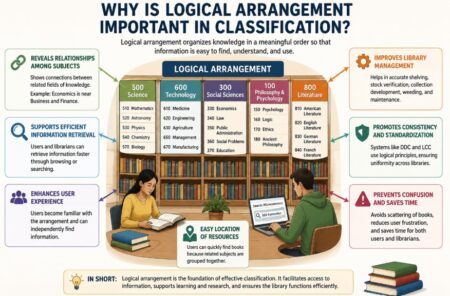
What is Subject-Based Arrangement in a Library Collection?
Subject-based arrangement in a library collection refers to the systematic organization of library materials according to their subject or topic, using recognized classification schemes. In this method, books and other information resources dealing with the same or closely related subjects are grouped together and placed on the shelves in a logical order. Instead of arranging materials by author name or title, subject-based arrangement emphasizes the intellectual content of each item, ensuring that all resources on a particular subject can be found in one designated area of the library. For example, books on computer science, such as programming, databases, and artificial intelligence, are shelved together, while materials on economics, management, or sociology are placed in their respective subject sections. This allows users searching for information on a topic to find multiple relevant resources in one place.
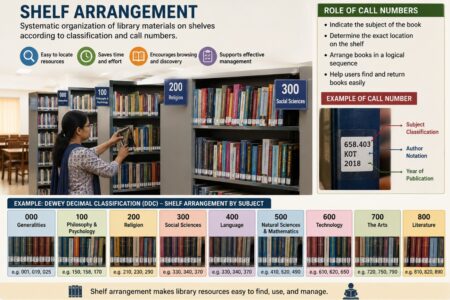
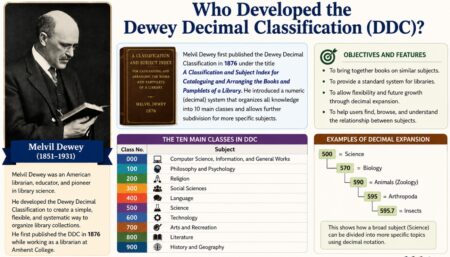
In practice, a subject-based arrangement is achieved through library classification systems, such as the Dewey Decimal Classification (DDC), the Library of Congress Classification (LCC), and the Universal Decimal Classification (UDC). Each item is assigned a call number that represents its subject and determines its exact location on the shelves. For instance, under DDC, books on education are placed in the 370s, medical sciences in the 610s, and literature in the 800s. Similarly, in an academic library using LCC, materials on engineering are grouped under class “T,” while social sciences fall under class “H.” These numerical or alphanumeric codes guide both users and librarians in locating and shelving materials accurately.
Subject-based arrangement also supports effective browsing and comparative study. For example, a student preparing a literature review on renewable energy can browse the shelves in the energy or environmental science section and easily compare textbooks, research reports, and reference works on solar, wind, and biomass energy placed side by side. In digital library catalogs, the same principle applies through subject headings and classifications, enabling users to retrieve both print and electronic resources related to a topic. Overall, by grouping similar subjects together and providing clear examples of knowledge organization, subject-based arrangement strengthens information access, enhances user satisfaction, and helps libraries serve as organized and reliable centers of learning and research.
Why Libraries Arrange Their Collections According to Subject Rather Than Alphabetically
Libraries organize their collections by subject rather than alphabetically because subject-based organization reflects the intellectual content of the materials and supports meaningful information discovery. An alphabetical arrangement—by author or title—may be useful for locating a known item, but it does not bring together resources that discuss the same topic. In contrast, subject-based arrangement groups all materials on a particular subject in one place, allowing users to see the breadth and depth of resources available on that topic. For example, books on marketing, finance, and human resource management can be found together under the broader subject of business studies, making it easier for students and researchers to explore related areas without searching the entire library.
Another important reason for subject-based arrangement is that it facilitates browsing and learning, especially in academic and research libraries. Many users visit libraries without a specific title or author in mind; instead, they seek information on a general topic. Subject-based shelving allows such users to browse systematically and discover additional relevant materials placed nearby. For instance, a student studying environmental science may begin by looking for books on climate change and, while browsing the same shelf, also find useful materials on environmental policy, sustainability, or renewable energy. This form of intellectual browsing would not be possible if books were arranged strictly in alphabetical order.
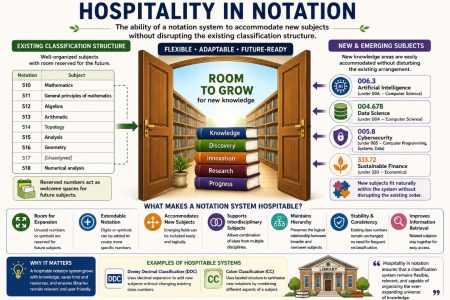
Subject-based arrangement also improves efficiency in library management and information retrieval. Classification systems provide a logical and expandable framework that can accommodate new subjects and growing collections without disrupting existing order. Alphabetical arrangement becomes impractical in large libraries, where thousands of titles and authors are involved, leading to frequent reshuffling and user confusion. By organizing materials according to subject, libraries ensure consistency across physical shelves, online catalogs, and digital collections.
Importance of Subject-Based Arrangement in a Library Collection
Subject-based arrangement is important in a library collection because it provides a logical and systematic way of organizing knowledge, making information easier to locate, understand, and use. By grouping materials according to their subject content, libraries ensure that all resources related to a particular topic are placed together. This allows users to access multiple relevant books and materials from a single location instead of searching across different shelves. For example, a student studying economics can find textbooks, reference books, and research materials on microeconomics, macroeconomics, and development economics in the same subject area, which saves time and improves research efficiency.
Another key importance of subject-based arrangement lies in its support for browsing and independent learning. Many library users do not search for a specific title or author; rather, they explore a topic to gain a broader understanding. Subject-based shelving encourages this exploratory behavior by enabling users to discover related materials placed side by side. For instance, while looking for books on educational psychology, a reader may also find useful resources on learning theories, child development, or assessment methods in the same section. This type of intellectual browsing enhances comprehension and promotes deeper engagement with a subject, which would be difficult in an alphabetical arrangement.
Subject-based arrangement is also essential for effective library management and long-term collection development. It works in close coordination with classification systems and online catalogs, ensuring consistency between physical and digital resources. As library collections grow and new subject areas emerge, subject-based organization allows for systematic expansion without disrupting the existing order. Moreover, it helps librarians in tasks such as shelving, inventory control, collection evaluation, and user guidance.
Role of Subject-Based Arrangement in Achieving the Fundamental Objectives of a Library
Subject-based arrangement directly supports the fundamental objectives of a library by ensuring systematic organization, easy access to information, and effective use of knowledge resources. One of the primary objectives of a library is to provide the right information to the right user at the right time, and subject-based arrangement helps achieve this by grouping related materials together according to their intellectual content. When books and other resources on the same subject are placed in a single, clearly defined area, users can locate relevant information quickly and efficiently. This organized structure reduces confusion, saves users’ time, and enhances overall access to knowledge.
Another fundamental objective of a library is to promote learning, research, and intellectual development. Subject-based arrangement facilitates purposeful browsing and comparative study, which are essential for academic inquiry. By arranging materials by subject, libraries enable users to explore a topic in depth, compare different viewpoints, and identify relationships between concepts. For example, a researcher studying social sciences can easily move from sociology to political science or economics within adjacent subject areas, gaining a broader and more integrated understanding. This systematic exposure to related resources strengthens the educational and research-supporting role of the library.
Subject-based arrangement also supports the objective of efficient library management and preservation of resources. A well-organized subject structure allows librarians to manage collections effectively, monitor usage patterns, and plan balanced collection development. It ensures consistency between physical shelving and online catalogs, making resource discovery more reliable in both traditional and digital environments. By maintaining order, scalability, and ease of retrieval, subject-based arrangement helps libraries fulfill their core mission of organizing recorded knowledge and making it accessible for present and future users.
How Subject-Based Arrangement Helps Users Locate Information Quickly
Subject-based arrangement helps users locate information quickly by organizing library materials according to their subject content, allowing all resources on a specific topic to be found in one designated area. When users search for information on a particular subject, they do not need to move randomly from shelf to shelf; instead, they can go directly to the relevant subject section. For example, a student looking for materials on accounting can visit the accounting or business studies section and find textbooks, reference books, and supplementary readings placed together. This focused arrangement significantly reduces search time and enhances information retrieval efficiency.
Another way subject-based arrangement speeds up information access is by supporting logical browsing and recognition of related materials. Once users reach the correct subject area, they can easily scan nearby shelves to find additional resources on closely related topics. For instance, a user searching for books on computer networking may also encounter materials on data communication, cybersecurity, or wireless technologies in the same section. The proximity of related subjects helps users quickly expand their search without needing to consult multiple catalogs or request repeated assistance.
Subject-based arrangement also works in close coordination with library catalogs and call numbers, which guide users directly to the exact shelf location of a resource. When a user finds a call number in the OPAC, it clearly indicates the subject and shelf position of the item. This consistency between catalog information and physical arrangement ensures smooth navigation within the library. As a result, subject-based arrangement minimizes confusion, supports independent use of the library, and enables users to locate relevant information accurately and efficiently.