Hierarchical classification is a fundamental approach to organizing knowledge in which subjects are arranged in a systematic order from broader concepts to more specific topics. This method is based on the principle of logical subdivision, where a general class is progressively broken down into smaller and more specialized subclasses. By establishing clear relationships between broader and narrower subjects, hierarchical classification creates a structured framework that reflects the inherent organization of knowledge. This approach enables users to understand not only individual subjects but also their position within a wider conceptual context.
In library and information science, hierarchical classification plays a crucial role in the development of major classification systems such as the Dewey Decimal Classification and the Library of Congress Classification. These systems rely on hierarchical structures to ensure consistency, predictability, and ease of navigation across large and diverse collections. Through hierarchical arrangement, users can move systematically from general subject areas to specific resources, facilitating both browsing and precise information retrieval. Shelf arrangement, subject indexing, and online catalog browsing all benefit from the clarity provided by hierarchical relationships.
Beyond physical libraries, hierarchical classification continues to be relevant in digital information environments, where it supports subject navigation, taxonomy development, and knowledge representation. Although modern information resources often span multiple disciplines, the hierarchical approach provides a stable foundation upon which more flexible classification methods can be integrated. As a result, hierarchical classification remains a cornerstone of knowledge organization, offering a logical, structured, and user-oriented means of arranging information in both traditional and digital library systems.
What is Hierarchical Classification?
Hierarchical classification is a method of organizing knowledge in which subjects are arranged in a structured order from broader concepts to progressively more specific ones. It is based on the principle that a general subject can be logically divided into narrower and more detailed categories, forming a clear chain of relationships among subjects. For example, the broad subject Science can be subdivided into Natural Science and Social Science; Natural Science may further be divided into Physics, Chemistry, and Biology, and Biology can be narrowed down to Botany and Zoology. Such step-by-step subdivision helps users understand both the scope of a subject and its position within the overall knowledge structure.
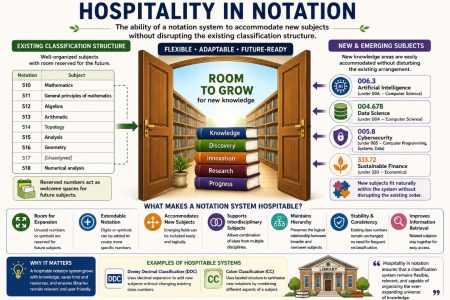
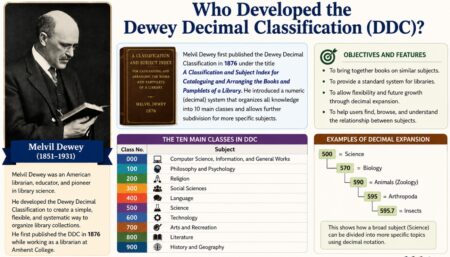
In library and information science, hierarchical classification is clearly reflected in widely used classification systems such as the Dewey Decimal Classification (DDC) and the Library of Congress Classification (LCC). In DDC, the main class 500 – Natural Sciences and Mathematics is divided into 510 – Mathematics, 520 – Astronomy, 530 – Physics, and so on. The class 530 – Physics is further subdivided into 531 – Classical Mechanics, 532 – Fluid Mechanics, and 533 – Gas Mechanics. This hierarchical arrangement allows related books to be placed together on library shelves and enables users to browse systematically from general subjects to specific topics.
Hierarchical classification is also applicable in digital environments, such as online catalogs and subject taxonomies. For instance, in an OPAC or digital repository, a user searching under Computer Science may navigate through levels such as Programming Languages, then Object-Oriented Programming, and finally Java Programming. Even though modern information often crosses disciplinary boundaries, hierarchical classification provides a stable and logical framework for organizing resources. By offering clear examples of broader-to-narrower relationships, this approach continues to support effective browsing, subject understanding, and information retrieval in both traditional and digital library systems.
Importance of Hierarchical Structure in Knowledge Organization
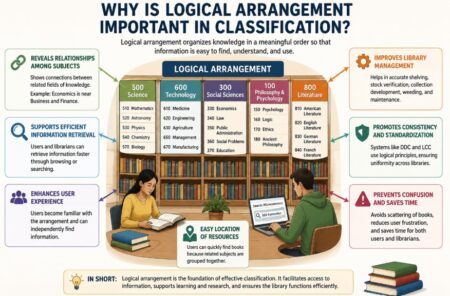
The hierarchical structure is important in knowledge organization because it provides a logical and systematic framework for arranging information from general concepts to more specific subjects. By establishing clear relationships between broader and narrower topics, hierarchy helps users understand how individual pieces of information fit within a larger knowledge system. This structured progression reduces confusion, ensures consistency, and makes complex bodies of knowledge easier to comprehend. Users can grasp the overall subject area first and then move step by step toward detailed and specialized information.
In library and information systems, hierarchical structures play a vital role in classification, shelving, and information retrieval. Classification systems such as the Dewey Decimal Classification and the Library of Congress Classification rely on hierarchical arrangements to group related materials together. This enables users to browse shelves or online catalogs efficiently, as resources on similar topics are located near each other. For example, a user exploring books on Education can easily move from general works to specialized areas such as Higher Education or Educational Psychology through hierarchical subdivisions.
Hierarchical structure is also essential in digital knowledge organization, including databases, taxonomies, and online catalogs. It supports intuitive navigation by allowing users to move up and down levels of subject categories, which enhances browsing and discovery. Even in environments where information is interdisciplinary, hierarchical organization provides a stable foundation that can be combined with other approaches, such as faceted classification.
Main Characteristics of a Hierarchical Classification System (with Examples)
A hierarchical classification system is a structured method of organizing knowledge in which subjects are arranged according to levels of generality and specificity. It follows a logical order that reflects the natural relationships among subjects and supports efficient information retrieval. The main characteristics of a hierarchical classification system, along with relevant examples, are discussed below.
- Arrangement from General to Specific: One of the most important characteristics of hierarchical classification is the arrangement of subjects from broad classes to narrower, more specific ones. Each subject is placed within a larger subject category. For example, the broad subject Science can be divided into Natural Science and Social Science. Natural Science may further be subdivided into Physics, Chemistry, and Biology, while Biology can be narrowed down to Botany and Zoology. This step-by-step arrangement helps users move logically from general knowledge to specialized topics.
- Logical Subdivision of Subjects: Hierarchical classification relies on logical and meaningful subdivision rather than arbitrary grouping. Each level represents a clear intellectual breakdown of the higher level. For instance, in the Dewey Decimal Classification (DDC), 500 – Natural Sciences and Mathematics is logically subdivided into 510 – Mathematics, 520 – Astronomy, 530 – Physics, and 540 – Chemistry. These divisions are based on subject relationships and disciplinary boundaries.
- Clear Broader–Narrower Relationships: A defining feature of hierarchical classification is the clear relationship between broader and narrower subjects. Each subclass derives its meaning from the parent class. For example, Educational Psychology is understood as a narrower subject under Education, while Higher Education is another subdivision of the same broader class. These relationships help users understand how subjects are connected within the knowledge structure.
- Predictable and Consistent Structure: Hierarchical systems follow a consistent pattern of classification, which makes them predictable for users. Once users understand the structure, they can anticipate where a subject will be located. For example, in DDC, if 370 represents Education, users can expect related topics such as 371 – Schools and their activities and 378 – Higher Education to be found nearby. This consistency enhances ease of navigation and retrieval.
- Support for Systematic Browsing: Hierarchical classification strongly supports browsing by placing related subjects together. In a library shelf arrangement, books on Computer Science are placed near each other, allowing users to browse from general works on computing to specific topics such as Programming, Databases, or Artificial Intelligence. Similarly, in an OPAC, users can browse subject hierarchies to explore related materials efficiently.
- Basis for Shelf Arrangement and Cataloging: In libraries, hierarchical classification provides the foundation for both shelf arrangement and catalog organization. For example, books classified under Economics are shelved together, with subdivisions such as Microeconomics and Macroeconomics arranged in sequence. This physical arrangement reflects the intellectual hierarchy and supports easy discovery of related resources.
- Stability and Control: Hierarchical classification systems are designed to be stable and controlled, ensuring long-term consistency. Changes or additions are made carefully to preserve the overall structure. For example, when new topics emerge in Computer Science, such as Data Science, they are placed within an existing hierarchy rather than disrupting the entire system. This stability is crucial for managing large and growing collections.
- Limited Flexibility for Interdisciplinary Subjects: An important characteristic of hierarchical classification is its limited flexibility in handling interdisciplinary subjects. Topics such as Environmental Studies, which combine elements of science, economics, and policy, may not fit neatly into a single hierarchy. Despite this limitation, hierarchical classification remains effective as a foundational structure and is often supplemented with additional classification techniques.
A hierarchical classification system is characterized by its logical arrangement from general to specific, clear broader–narrower relationships, consistency, and strong support for browsing and retrieval. Through examples from library classification systems and subject organization, it is evident that hierarchical classification provides a stable and systematic framework for organizing knowledge in both traditional and digital information environments.
Role of Hierarchy in Efficient Information Location
Hierarchy helps users locate information efficiently by organizing knowledge in a structured manner from general subjects to specific topics. When information is arranged hierarchically, users can begin their search at a broad level and gradually narrow it down according to their needs. This step-by-step progression reduces search complexity and prevents users from being overwhelmed by large amounts of information. By clearly showing how subjects are related, hierarchy enables users to understand where a particular topic belongs within the overall knowledge structure.
In library systems, hierarchical organization significantly improves browsing and retrieval. Classification systems such as the Dewey Decimal Classification arrange books so that related subjects are physically and intellectually close to each other. For example, a user interested in Education can browse the general class first and then move toward more specific areas such as Higher Education or Educational Psychology without searching the entire collection. Similarly, in an online public access catalog (OPAC), hierarchical subject trees allow users to move from broader categories to narrower ones, making exploration faster and more intuitive.
Hierarchy is equally valuable in digital information environments, including databases, digital libraries, and subject taxonomies. It supports intuitive navigation by allowing users to move upward for broader context or downward for detailed information. This structured navigation minimizes trial-and-error searching and increases retrieval accuracy.
Application of Hierarchical Classification in Library Classification Systems
Hierarchical classification is a core principle underlying most traditional library classification systems. It organizes knowledge by arranging subjects in a logical sequence from general to specific, allowing libraries to manage large collections systematically and support efficient information retrieval. The application of hierarchical classification can be clearly observed in how subjects are structured, materials are shelved, and catalogs are designed in library systems.
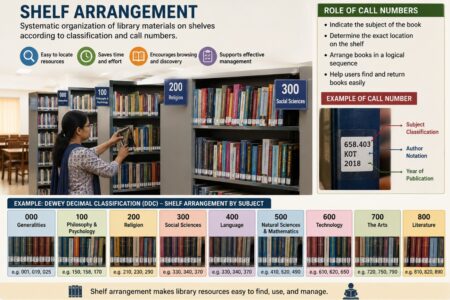
- Organization of Knowledge into Main Classes; Library classification systems begin by dividing the entire body of knowledge into a limited number of broad main classes. For example, the Dewey Decimal Classification (DDC) organizes knowledge into ten main classes, such as 000 – Computer science, information & general works, 100 – Philosophy, 300 – Social Sciences, and 500 – Natural Sciences. Each of these represents the highest level in the hierarchy. This broad grouping helps libraries provide an overall structure to their collections and enables users to identify major subject areas easily.
- Subdivision into Divisions and Sections: Each main class is further subdivided into more specific divisions and sections, reflecting the hierarchical nature of subject organization. In DDC, the main class 500 – Natural Sciences is subdivided into 510 – Mathematics, 520 – Astronomy, 530 – Physics, and so on. These divisions are then further broken down into even more specific topics, such as 530.1 – Theoretical Physics or 530.12 – Quantum Mechanics. This layered structure allows for the precise placement of materials according to subject depth.
- Broader–Narrower Subject Relationships: Hierarchical classification establishes clear broader–narrower relationships among subjects. Each specific topic derives its meaning from its position within the broader subject context. For instance, Educational Psychology is classified under Education, indicating that it is a specialized branch of that broader field. These relationships help users understand subject scope and guide them in navigating related topics effectively.
- Shelf Arrangement Based on Hierarchy: One of the most visible applications of hierarchical classification is shelf arrangement in libraries. Books are placed on shelves according to their classification numbers, which reflect their hierarchical subject placement. As a result, materials on similar or related topics are shelved together. For example, books on Economics, Microeconomics, and Macroeconomics appear in close physical proximity, enabling users to browse systematically and discover related resources easily.
- Consistency and Predictability in Classification: By applying a hierarchical structure, library classification systems ensure consistency in how subjects are treated across collections. Similar subjects follow similar patterns of subdivision, making the system predictable for both librarians and users. Once users become familiar with the hierarchy, they can anticipate where materials on a particular topic are likely to be located, reducing search time.
- Management of Collection Growth: Hierarchical classification supports the continuous growth of library collections. New subjects or emerging topics are incorporated by adding them at appropriate levels within the existing hierarchy rather than disrupting the entire system. For example, newer fields in Computer Science can be placed within the broader hierarchy of technology and applied sciences. This flexibility within a stable framework ensures long-term usability of the classification system.
Hierarchical classification is applied in library classification systems through structured subject organization, logical subdivision, shelf arrangement, and catalog navigation. Arranging knowledge from general to specific and maintaining clear subject relationships enables libraries to manage vast collections efficiently and helps users locate information quickly and logically. Despite the rise of digital and interdisciplinary resources, hierarchical classification remains a foundational element of effective library classification systems.