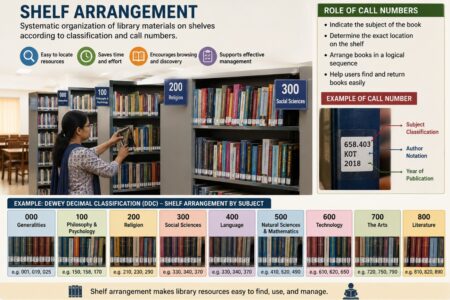
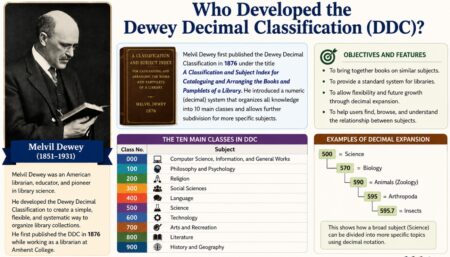
Classification numbers play a crucial role in helping users locate books and other resources within a library. These numbers, often referred to as call numbers, are assigned to each item based on its subject matter and follow a systematic arrangement, such as the Dewey Decimal Classification (DDC) or the Library of Congress Classification (LCC) system. For example, in the DDC system, books on computer science are placed in the 000–099 range, so a title like Introduction to Artificial Intelligence may have the call number 006.3, while materials on psychology are grouped under the 150s, such as General Psychology classified as 150.1. Similarly, in the LCC system, books on literature fall under the letter P, so an American literature book might be labeled PS3562.A45, while history texts fall under D, such as D511 for World War I.
By organizing materials in this logical and consistent order, classification numbers ensure that books on similar subjects are grouped together, making it easier for users to browse related topics. For instance, a student looking for a book on Database Management Systems under QA76.9.D3 in LCC may also find nearby resources on computer programming or software engineering. When a user searches for a book in the library’s catalog, the classification number acts like an address, guiding them directly to the correct shelf and position. This system not only saves time but also enhances the browsing experience, as patrons often discover additional resources while navigating the shelves. In essence, classification numbers serve as a bridge between the catalog and the physical collection, ensuring that vast amounts of information are organized, accessible, and easy to retrieve.
How Do Classification Numbers Guide Users in Finding Materials on Shelves?
Libraries are more than just storehouses of books; they are well-organized systems designed to make knowledge easily accessible. One of the most important tools in this organization is the classification number, also known as the call number. These numbers serve as a navigational tool that guides users directly to the location of books and other resources on the shelves. Without classification numbers, library collections would be chaotic, and users would struggle to locate the materials they need.
- Organizing Knowledge into Systematic Order: One of the primary functions of classification numbers is to arrange materials in a logical and consistent sequence. Classification systems like the Dewey Decimal Classification (DDC) and the Library of Congress Classification (LCC) divide all fields of knowledge into categories and subcategories. For example, in the DDC system, books on literature are placed in the 800s, while books on science are placed in the 500s. Within these categories, materials are further broken down into more specific subjects. This means a book on Botany (581) will always be placed near other plant science resources, while a book on Physics (530) will be located near other physical science texts. Such systematic grouping saves users time by ensuring that all materials on a given subject are physically clustered together.
- Acting as an Address for Each Book: Classification numbers serve as the exact address of each book within the library. Just as houses in a city are identified by street names and numbers, books in a library are identified by call numbers. For example, in a library using the LCC system, a book on Artificial Intelligence might be labeled QA76.9.A43, which directs the user first to the general computing section (QA76), then to artificial intelligence specifically. Similarly, in DDC, a book on Macroeconomics may carry the number 339.5, leading users directly to the economics section and then to the specific shelf dealing with macroeconomic topics. This precise addressing system eliminates confusion and ensures users can locate their desired resource without trial and error.
- Grouping Related Materials Together: A unique advantage of classification numbers is that they bring related subjects into proximity. This arrangement not only helps users find the book they initially sought but also introduces them to additional materials they may not have considered. For instance, a student searching for a book on Database Management Systems in LCC under QA76.9.D3 will likely encounter books on programming, software development, and system architecture in the surrounding shelves. This makes browsing an enriching activity where users can expand their knowledge by exploring materials that naturally cluster around their area of interest. Such a serendipitous discovery is a hallmark of well-organized libraries and is made possible by classification numbers.
- Linking Catalogue Searches to Physical Shelves: Modern libraries often begin with a digital search, typically through the Online Public Access Catalogue (OPAC). The catalog provides bibliographic details of a resource, such as the title, author, publication date, and most importantly, the call number. This call number is the crucial link between the digital search system and the physical shelves. For example, if a user searches for Principles of Marketing in OPAC and finds the call number 658.8, they know exactly where to go on the shelves to retrieve the book. Without classification numbers, the catalog would serve little purpose, since users would still have to manually search through large collections to find what they need. The integration of catalog and shelving through classification numbers creates a seamless pathway from search to retrieval.
- Enhancing Efficiency and Accuracy: Another important role of classification numbers is to enhance efficiency in both retrieval and reshelving. For users, this means quick access to materials without wandering aimlessly through shelves. For staff, it means a reliable system to maintain order in the collection. For instance, if a book on Nursing Ethics in DDC is labeled 174.2, staff can easily identify where it should be returned after use, ensuring it is accessible to the next user. Without such a system, books would often be misplaced, leading to wasted time and frustration. In large libraries with hundreds of thousands of resources, classification numbers act as a safeguard against chaos, guaranteeing that every item has a fixed, retrievable place.
Classification numbers are more than mere labels; they are the backbone of library organization and accessibility. They systematically arrange knowledge, act as precise addresses for books, cluster related subjects for deeper learning, connect digital catalogs with physical shelves, and streamline both retrieval and reshelving processes. By doing so, they ensure that libraries function as efficient gateways to knowledge. Without classification numbers, even the most resource-rich library would struggle to meet the needs of its users, highlighting their indispensable role in guiding readers to the information they seek.
How Do Classification Numbers Ensure That Similar Subjects Are Grouped Together?
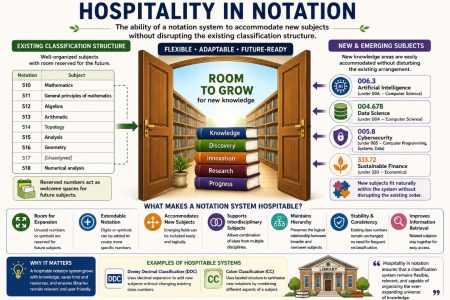
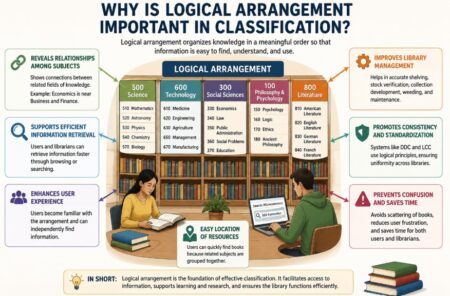
Classification numbers are central to how libraries organize and present information, ensuring that similar subjects are grouped together in a logical and consistent way. Systems such as the Dewey Decimal Classification (DDC) and the Library of Congress Classification (LCC) divide knowledge into broad categories and then narrow them into more specific subjects. For example, in DDC, the 500s are reserved for natural sciences, with subdivisions like 510 for Mathematics, 520 for Astronomy, and 530 for Physics. This structure guarantees that all science-related books are located near one another, while each branch of science has its own precise place. Similarly, in the LCC system, political science books fall under J and economics under H, keeping related materials clustered logically.
The numerical or alphanumeric order of classification numbers translates directly to shelf arrangement, which helps users navigate collections efficiently. A book on Plant Biology with the call number 581.1 will sit next to one on Plant Physiology at 581.2 in DDC, while in LCC, an American History book at E183.7 will be close to a Civil War History title at E468.9. This sequence not only organizes books but also encourages subject-based browsing, allowing users to discover related resources. For instance, a student looking for Digital Marketing in DDC (658.872) will find it surrounded by books on broader marketing strategies (658.8) and e-commerce (658.87), enriching their research process.
Classification numbers also highlight interdisciplinary connections by keeping related subjects consistently arranged. In LCC, psychology is classified under BF, while education falls under L, yet both are arranged predictably so that researchers in Educational Psychology can easily consult materials from both sections. Moreover, as collections expand, classification ensures that new resources are seamlessly integrated. A book on Artificial Intelligence Ethics will be placed with existing AI titles under QA76.9.A43 in LCC or 006.3 in DDC, preserving subject continuity across time.
How Do Classification Numbers Reduce Confusion When Searching for Resources?
Libraries often contain thousands of resources, and without a proper system, users would face great difficulty in locating the materials they need. Classification numbers, also known as call numbers, help reduce this confusion by providing a clear and consistent way to organize and retrieve resources. These numbers create a standardized method of arrangement, ensuring that materials on similar subjects are grouped together and can be easily found on the shelves. For example, in the Dewey Decimal Classification (DDC) system, 330 represents economics, while in the Library of Congress Classification (LCC), economics falls under HB–HJ within the social sciences. Because these systems are widely used, once users understand them, they can confidently apply the same logic in any library, which reduces uncertainty and inconsistency.
Classification numbers also act like precise addresses for books. Each number or alphanumeric code directs users to an exact spot on the shelves, saving them from having to search aimlessly. For instance, a book on Environmental Economics might carry 333.7 in DDC or HD75.6 in LCC, and this specific call number leads directly to the right shelf. This system prevents overlap and misplacement by keeping related subjects clustered in one section, such as computer science books being grouped under 004–006 in DDC or QA75–QA76.9 in LCC.
In addition, classification numbers reduce confusion by linking the catalog to the physical shelves. When users search in the Online Public Access Catalog (OPAC) and find a book such as Modern Physics listed under 530.12, they can be confident that it will be located in the physics section of the shelves. This direct connection from digital search to physical location removes ambiguity and makes searching more efficient. Finally, classification numbers encourage user confidence and independence. Once students and researchers learn how the sequence works, they no longer need constant staff assistance. For example, a student who understands that psychology is found in 150 in DDC or under BF in LCC can navigate to those sections independently.
In short, classification numbers minimize confusion by standardizing subject organization, acting as reliable addresses, preventing misplacement, linking catalog searches to shelves, and empowering users to navigate collections confidently. They transform libraries from overwhelming spaces filled with books into structured and user-friendly environments where knowledge can be accessed with ease.
Reference Link: