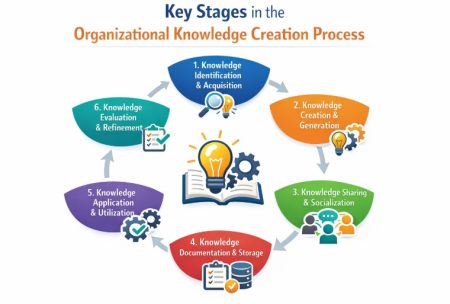
The knowledge acquisition process refers to the systematic way through which individuals or groups gather, absorb, and internalize information to transform it into usable knowledge. It is more than just collecting facts; it involves interpreting, analyzing, and connecting new information with what is already known, thereby creating a deeper understanding. For example, a medical student who studies anatomy from textbooks does not stop at memorizing terms; they acquire knowledge by applying those concepts during practical dissections and clinical practice, turning information into real-world expertise. Similarly, a librarian learning a new digital cataloguing system goes beyond reading the manual by experimenting with the software, attending training sessions, and reflecting on challenges; they transform instructions into practical knowledge. This process often begins with exposure to new ideas through observation, study, or experience, and continues with reflection and practice until the knowledge becomes meaningful and applicable. Knowledge acquisition is essential because it equips people with the skills and insights needed to solve problems, make decisions, and adapt to changing circumstances. Whether in education, professional development, or everyday life, such as a child learning to ride a bicycle through trial and error or a researcher mastering new methodologies, the process of acquiring knowledge ensures that learning is continuous and dynamic, allowing individuals and societies to grow intellectually and practically.
How Does Knowledge Acquisition Differ from Information Gathering?
The concepts of information gathering and knowledge acquisition are often confused, but they represent two distinct processes. Information gathering refers to the act of collecting raw data, facts, or content from different sources such as books, articles, websites, lectures, or surveys. For instance, a student researching climate change may collect statistics on rising global temperatures, greenhouse gas levels, and reports from international organizations. At this stage, the material remains fragmented, unprocessed, and may lack context. In contrast, knowledge acquisition goes beyond simply collecting information; it involves processing, analyzing, and internalizing what has been gathered to develop a meaningful understanding. When the same student begins to interpret climate data, connect it with causes like industrial emissions, and evaluate its implications for future generations, they move from gathering information to acquiring knowledge.
The main differences lie in the depth and purpose of each process. Information gathering is often broad, surface-level, and can even be passive, whereas knowledge acquisition is active, requiring critical thinking, reflection, and synthesis. Information on its own may be temporary and easily forgotten, while knowledge is lasting because it is internalized and connected to prior experiences. For example, a new employee may gather information by reading company manuals and policies, but they acquire knowledge when they apply those policies in real work situations, solve problems, and make decisions based on what they have learned.
The Key Stages of Acquiring Knowledge
Acquiring knowledge is not a one-step process but rather a gradual journey that moves from exposure to information to the internalization and application of understanding. This process involves several stages through which learners engage with new material, reflect on it, and eventually use it in meaningful ways. Understanding these stages is important for students, professionals, and researchers because it provides a framework for effective learning and lifelong intellectual growth.
Stage 1: Exposure to Information
The first stage of acquiring knowledge begins with exposure to information. This involves encountering new data, concepts, or ideas through various channels such as reading books, listening to lectures, observing real-life events, conducting research, or engaging in conversations. At this stage, learners are like sponges- they are introduced to content but may not yet fully understand it.
For example, a high school student learning about photosynthesis may be introduced to the process through a textbook diagram or a teacher’s explanation. Similarly, a professional entering a new workplace may receive information during orientation sessions or by reading company policies. At this stage, the emphasis is on awareness- becoming familiar with what exists, without yet having the depth of understanding.
Stage 2: Comprehension and Understanding
Exposure alone is not enough; learners must begin to comprehend the information they encounter. Comprehension involves breaking down concepts, clarifying meanings, and making sense of terminology. It is the point where information starts to become knowledge, as learners attempt to understand the “how” and “why” behind the facts.
For instance, a university student studying economics may not just memorize the definition of “inflation” but also try to understand what causes it and how it affects markets and everyday life. Teachers, mentors, and reference materials play a crucial role at this stage by guiding learners through complex content, answering questions, and providing explanations. Without comprehension, information remains superficial and easily forgotten.
Stage 3: Analysis and Connection
Once comprehension is achieved, the next step is analysis and connection. Learners begin to critically examine the information, identify patterns, compare it with prior knowledge, and evaluate its significance. This stage strengthens memory and builds deeper understanding by creating links between new knowledge and what is already known.
For example, a medical student who has studied anatomy may connect the structure of the heart with its physiological functions and analyze how these relate to diseases such as heart failure. In everyday life, a person learning a new language might compare grammar rules of the new language with those of their native language to better grasp differences and similarities. Analysis allows learners to move from simple understanding to insight, as they start to see the bigger picture.
Stage 4: Application and Practice
Knowledge becomes most powerful when it is applied. At this stage, learners take what they have understood and put it into action in real or simulated contexts. This may involve problem-solving, hands-on practice, experimentation, or using knowledge to make decisions.
For instance, a computer science student who learns about algorithms may practice by coding programs and testing them with different datasets. A child learning mathematics may apply multiplication concepts while calculating prices in a store. Application is crucial because it moves knowledge from theory into practice, making it useful, relevant, and enduring. Practice also strengthens retention because learners engage actively rather than passively.
Stage 5: Reflection and Internalization
The final stage of acquiring knowledge is reflection and internalization. Reflection involves evaluating what has been learned, identifying mistakes, and considering how new knowledge fits into broader contexts. Internalization means that the knowledge is absorbed into long-term memory and becomes part of the learner’s skills, habits, or worldview.
For example, after completing a group project on environmental sustainability, a student may reflect on how their research connects to real-world challenges like climate change. A professional who attends leadership training may reflect on past experiences and think about how new strategies can improve workplace communication. This stage ensures that knowledge is not only remembered but also integrated into the learner’s intellectual and practical toolkit. It transforms temporary learning into lifelong knowledge.
The stages of knowledge acquisition- exposure, comprehension, analysis, application, and reflection- form a continuous cycle of learning. Each stage builds upon the previous one, turning raw information into meaningful understanding that can be applied in diverse contexts. By consciously engaging with each stage, learners can deepen their knowledge, retain it longer, and use it effectively in real life. This structured process highlights that learning is not just about gathering information but about making it part of one’s personal and professional growth.
The Main Techniques Used in the Knowledge Acquisition Process
The acquisition of knowledge is not a random or one-dimensional activity; it is a structured process that draws upon various techniques to help individuals and organizations absorb, interpret, and apply information meaningfully. Knowledge acquisition involves more than simply storing facts in memory; it requires methods that foster critical thinking, problem-solving, and the ability to transfer learning to real-world situations. Different techniques have been used across history, from traditional methods such as observation and reading to modern digital tools that enhance interactive learning. Together, these techniques ensure that knowledge becomes not only internalized but also applicable in diverse personal, academic, and professional contexts.
- Observation: Observation is one of the earliest and most intuitive ways of acquiring knowledge. It is a process of learning by watching events, behaviors, or natural phenomena, and it plays a central role in both childhood development and scientific discovery. Children, for example, learn how to communicate, behave, and interact socially by observing their parents, peers, and teachers. In science, observation is the foundation of empirical research; astronomers observe celestial movements to understand planetary systems, while biologists observe animal behavior to form theories about ecosystems. Observation provides learners with direct, unfiltered information, allowing them to witness processes in their natural context. However, it requires attentiveness, patience, and sometimes structured tools like microscopes or sensors to capture details that might otherwise be overlooked.
- Reading and Study: Reading is a cornerstone of formal education and one of the most structured techniques for acquiring knowledge. Through books, research papers, articles, and digital texts, learners gain access to the accumulated wisdom of centuries. Study is more than simply reading; it includes active strategies such as note-taking, summarizing, highlighting, and making comparisons between different sources. For example, a law student studying constitutional rights reads primary documents such as legal acts and court judgments while also engaging with scholarly commentaries to understand multiple interpretations. Similarly, librarians and researchers rely on extensive study of academic databases like JSTOR, Scopus, or Research4Life to stay informed about developments in their fields. Reading provides breadth of knowledge, while focused study creates depth.
- Experimentation and Practice: Experimentation is an active, hands-on technique that involves testing theories, applying skills, and learning through trial and error. It bridges the gap between theory and practice by enabling learners to see how knowledge operates in real-life contexts. For instance, a chemistry student who learns chemical formulas in class gains a deeper understanding by conducting laboratory experiments to see actual reactions. Similarly, engineers test prototypes to discover limitations, while language learners engage in conversation practice to strengthen vocabulary and pronunciation. Practice ensures that abstract concepts are not only memorized but also applied, refined, and adjusted through real-world interaction. Mistakes are not setbacks in this process; they are opportunities for improvement and deeper understanding.
- Questioning and Inquiry: Questioning is a dynamic technique that transforms passive learning into active exploration. By asking questions, learners challenge assumptions, clarify doubts, and push beyond surface-level understanding. The Socratic method, developed in ancient Greece, is a classic example of systematic questioning used to uncover deeper truths. In modern classrooms, teachers encourage inquiry by prompting students to ask “why,” “how,” and “what if” questions, which lead to critical thinking. For example, a student studying history might ask, “Why did certain revolutions succeed while others failed?” This inquiry encourages exploration of political, economic, and cultural factors. Inquiry fosters curiosity, encourages multiple perspectives, and leads learners toward independent and analytical thinking—essential qualities for innovation and problem-solving.
- Discussion and Collaboration: Knowledge acquisition is often social, and discussion and collaboration are vital techniques in deepening understanding. By sharing perspectives, debating ideas, and building upon others’ insights, learners gain access to collective intelligence. In universities, group projects encourage collaboration where students combine research findings to produce joint presentations. In professional settings, brainstorming sessions or team meetings allow members to tackle problems collectively, drawing on diverse experiences. Discussions also play an important role in eliminating misconceptions; when ideas are challenged, learners are forced to clarify or adjust their understanding. Collaborative techniques highlight that knowledge is not just an individual pursuit but a shared process that thrives in communities of learning.
- Reflection and Self-Assessment: Reflection is an introspective technique where learners evaluate what they have learned, how they have learned it, and how it can be applied in different contexts. It encourages critical awareness of strengths, weaknesses, and areas for improvement. For instance, medical students often reflect on clinical experiences to connect textbook knowledge with patient care. Similarly, professionals may reflect on past projects to identify successful strategies and avoid repeating mistakes. Self-assessment tools such as journaling, quizzes, or personal checklists reinforce learning by making individuals actively review and evaluate their progress. Reflection turns knowledge into wisdom because it encourages learners not only to recall information but also to apply it in a broader and more meaningful way.
- Use of Technology and Digital Tools: In the modern era, technology has revolutionized knowledge acquisition. Digital platforms provide access to massive open online courses (MOOCs), e-libraries, interactive simulations, and global databases. Students and researchers can now access scholarly articles through platforms like Google Scholar, PubMed, and ResearchGate, while professionals use digital knowledge bases and online training modules for workplace learning. Tools like simulation software, virtual labs, and AI-driven tutoring systems make learning more engaging and personalized. For example, medical students can practice surgical procedures through virtual reality simulations before entering real operating rooms. Technology not only expands access to knowledge but also adapts to individual learning styles, making the process more flexible, efficient, and interactive than ever before.
The knowledge acquisition process is enriched by multiple techniques, each serving a unique purpose in turning raw information into meaningful, applicable knowledge. Observation provides firsthand insights; reading and study build foundational understanding; experimentation brings theory into practice; questioning fosters curiosity; discussion encourages shared learning; reflection deepens internalization; and technology makes knowledge more accessible and interactive. These techniques, when combined, create a holistic learning environment that ensures knowledge is not only gained but also retained and applied effectively. In a world where information is abundant, the real challenge is to use the right techniques to transform it into knowledge that empowers individuals and societies.
How Do Observation, Experience, and Study Contribute to Knowledge Acquisition?
The process of knowledge acquisition relies heavily on observation, experience, and study, each playing a distinct but interconnected role in helping individuals transform information into meaningful understanding. Observation serves as the starting point, allowing people to learn by carefully watching events, behaviors, or natural processes. For example, children acquire language and social skills by observing their parents and peers, while medical trainees gain insights by watching senior doctors perform surgeries. Observation is powerful because it provides direct, contextualized information that sparks curiosity and prepares the learner for deeper engagement.
Experience, on the other hand, moves beyond passive watching and introduces active involvement. It provides learners with hands-on opportunities to practice, experiment, and learn through trial and error. A student learning to swim, for instance, cannot rely on observation alone- they must enter the water, practice strokes, and gradually refine their skills. Similarly, professionals in fields such as engineering, medicine, or teaching acquire essential knowledge by directly participating in tasks, solving problems, and adapting to real-life situations. Experience strengthens retention because it combines theory with emotions and practical application, making knowledge more personal and long-lasting.
Study complements both observation and experience by offering structured access to the accumulated wisdom of others. Through reading books, research articles, and scholarly works, learners can develop strong theoretical foundations that extend far beyond what they could learn alone. For instance, a student studying physics equations builds the necessary conceptual framework to later design machines or conduct experiments, while a librarian studying classification systems like Dewey Decimal or Library of Congress Classification gains the knowledge needed to organize and manage collections effectively. Study encourages critical thinking by exposing learners to multiple perspectives and interpretations, broadening their understanding of complex issues.
Together, observation, experience, and study form a powerful framework for knowledge acquisition. Observation often sparks the questions that lead to deeper study, while study provides theories and models that guide observation and enrich experiences. Experience then consolidates both by allowing learners to apply knowledge in real-life contexts. For example, a medical student studying anatomy applies theoretical concepts while observing surgeries and later gains mastery through supervised practice. By reinforcing one another, these three approaches ensure that knowledge is not only acquired but also understood, retained, and applied effectively.
How Do Students Acquire Knowledge Differently from Professionals?
Students and professionals acquire knowledge in different ways because their goals, contexts, and motivations vary significantly. Students generally learn within structured academic settings such as schools and universities, where knowledge acquisition is guided by curricula, lectures, textbooks, and examinations. Their focus is on building a broad foundation of theoretical understanding, often relying on memorization, comprehension, and exploratory learning. For instance, a business student may study financial models through lectures and case studies without yet applying them in real-world contexts. Mistakes at this stage are expected and treated as part of the learning process, with teachers and mentors offering guidance and correction.
Professionals, on the other hand, acquire knowledge primarily through practical application and continuous learning in the workplace. Their focus is less on memorization and more on applying, expanding, and adapting knowledge to solve real-world problems. For example, a doctor may stay updated on medical advancements through research articles, conferences, or professional workshops, and then apply new treatments directly in patient care. Professionals often engage in self-directed learning, using digital platforms, peer networks, and specialized training to stay current. Unlike students, mistakes in professional practice carry real-world consequences, which makes reflection and careful analysis critical in their knowledge acquisition process.
The key differences lie in purpose, methods, and motivation. Students acquire knowledge to prepare for exams, degrees, and future careers, while professionals acquire knowledge to solve problems, innovate, and remain competitive in their fields. Students tend to focus on broad, foundational learning, whereas professionals pursue specialized and applied knowledge. Motivation also differs: students are often driven by external factors such as grades or qualifications, while professionals are guided by intrinsic needs like career advancement, problem-solving, or innovation. Despite these differences, the two processes are interconnected, since students eventually become professionals who apply their academic foundations in real-world contexts, and professionals may return to structured study to refresh or expand their expertise. Together, these approaches demonstrate that knowledge acquisition is a lifelong process that evolves from guided learning in classrooms to independent, application-based learning in professional life.