Evidence plays a central role in transforming a belief or claim into recognized knowledge. In philosophy and everyday reasoning, knowledge is often defined as “justified true belief,” where justification largely depends on the presence of evidence. For example, if someone claims that the Earth orbits the Sun, this is not accepted as knowledge simply because it is widely believed to be supported by centuries of astronomical observations, mathematical calculations, and scientific experiments. Similarly, in history, the assertion that a particular event occurred must be backed by evidence such as written records, artifacts, or eyewitness accounts; without these, the event would remain uncertain or speculative. In daily life, too, evidence helps us make informed decisions; when a person feels ill, a doctor does not rely solely on symptoms described by the patient but orders tests such as blood work or X-rays to gather evidence before making a diagnosis. Across all disciplines, evidence functions as the critical bridge between thought and truth, ensuring that what we accept as knowledge is not only convincing but also verifiable. In this way, evidence safeguards the integrity of knowledge by making it testable, repeatable, and open to scrutiny, distinguishing it from unfounded belief or personal bias.
Why is evidence considered essential in transforming belief into knowledge?
Belief, in its simplest form, refers to a personal conviction that something is true, but while beliefs can be powerful, they are not always reliable indicators of reality. Knowledge, by contrast, is more than belief-it requires both justification and truth. The critical factor that distinguishes knowledge from belief is evidence. Evidence provides the justification needed to establish truth, eliminate bias, and ensure reliability. Without it, claims remain assumptions, opinions, or speculations. Evidence, therefore, is considered essential in transforming belief into knowledge.
In philosophy, knowledge is often described as “justified true belief,” which highlights that beliefs must be supported by justification to qualify as knowledge. For example, believing that exercise improves health becomes knowledge only when supported by medical studies, clinical trials, and measurable outcomes. Evidence functions as this justification, providing the foundation that elevates belief into reliable knowledge. Similarly, knowledge must correspond with reality, and evidence plays a crucial role in establishing whether a belief is true. Historical misconceptions such as the belief that Earth was flat persisted until navigation, astronomy, and later space exploration provided overwhelming evidence of Earth’s spherical shape. In this sense, evidence allows us to test claims against reality and distinguish fact from error.
Beliefs are also susceptible to bias, shaped by culture, emotions, or personal experiences, which can make them unreliable. Evidence provides a safeguard against such subjectivity by demanding objectivity, verification, and independence from personal perspective. For instance, a person may believe in the effectiveness of a diet based on anecdotal experience, but only scientific studies conducted on larger populations can confirm its actual benefits. By minimizing personal bias, evidence ensures that knowledge rests on objective and verifiable grounds. This principle extends across multiple disciplines. In science, experiments and peer-reviewed research provide the evidence required to support or reject theories. In history, knowledge of past events is built upon documents, artifacts, and eyewitness accounts, without which stories would remain speculative. In law, evidence forms the basis of justice, since belief alone cannot determine guilt or innocence. Even in everyday life, people rely on evidence to make decisions, such as checking nutritional information before choosing food or reviewing market data before making investments.
The dangers of accepting beliefs without evidence are evident throughout history. During the Middle Ages, diseases were commonly attributed to supernatural forces, resulting in ineffective or harmful treatments like bloodletting. It was only through evidence-based discoveries such as germ theory and antibiotics that medicine advanced and effective treatments became possible. Similarly, in modern times, conspiracy theories often gain popularity because they rely on belief without evidence, leading to misinformation and harmful consequences. Without evidence, beliefs remain fragile and uncertain; with it, they gain the strength to guide human understanding and progress.
The Role of Evidence in Establishing Something as Knowledge
The distinction between belief and knowledge has long been a central concern in philosophy, science, and human reasoning. While belief reflects a personal conviction, knowledge requires more; it demands justification and truth. Evidence serves as the critical element that transforms belief into knowledge, providing the necessary support to validate claims, test their reliability, and align them with reality. Without evidence, knowledge would collapse into mere opinion or speculation. Let’s explore the role of evidence in establishing something as knowledge, highlighting its importance in justification, truth verification, bias reduction, and practical application across different domains.
- Evidence as the Foundation of Justification: A belief cannot qualify as knowledge without justification, and evidence is the cornerstone of that justification. In philosophy, knowledge is often defined as “justified true belief,” where evidence provides the rational support necessary for acceptance. For example, believing that a specific medicine cures an illness becomes knowledge only when clinical trials and medical research confirm its effectiveness. Evidence, therefore, serves as the foundation upon which reliable knowledge is built, separating it from assumptions or untested convictions.
- Verifying Truth Through Evidence: Truth is an essential requirement for knowledge, and evidence is the tool through which truth is tested and confirmed. Claims must be measured against reality, and evidence provides the means to do so. For centuries, many believed that Earth was the center of the universe until astronomical evidence proved otherwise, leading to the heliocentric model. This shift illustrates how evidence challenges misconceptions and establishes claims that correspond with reality. Without evidence, truth cannot be distinguished from falsehood, and knowledge cannot be reliably established.
- Reducing Bias and Subjectivity: Beliefs are often shaped by personal experiences, cultural traditions, or emotional influences, making them prone to bias. Evidence helps overcome these limitations by providing objectivity and verification. For instance, an individual might believe in the effectiveness of a traditional remedy, but large-scale scientific studies are required to confirm whether the remedy truly works. By minimizing the influence of bias, evidence ensures that knowledge rests on objective and verifiable grounds, rather than on personal or cultural assumptions.
- Evidence Across Disciplines: The role of evidence is universal, but it manifests differently across disciplines. In science, controlled experiments and peer review ensure that knowledge is testable and reproducible. In history, artifacts, documents, and eyewitness accounts provide the evidence needed to reconstruct past events. In law, courts rely on physical evidence, testimony, and records to establish justice, since belief alone cannot determine guilt or innocence. Even in everyday life, individuals use evidence-such as comparing nutritional labels, analyzing financial data, or reviewing medical test results, to make informed decisions. In each case, evidence underpins knowledge by ensuring reliability and credibility.
- Consequences of Knowledge Without Evidence: Accepting beliefs without evidence can lead to misinformation, superstition, and harmful practices. A historical example can be found in medieval medicine, where diseases were attributed to supernatural causes, leading to ineffective treatments. Only with evidence-based discoveries such as germ theory and antibiotics did medicine advance to provide effective care. Similarly, in modern times, conspiracy theories thrive on belief without evidence, often misleading individuals and communities. These examples illustrate how the absence of evidence undermines the credibility and usefulness of knowledge claims.
Evidence plays a vital role in establishing something as knowledge by providing justification, verifying truth, reducing bias, and ensuring reliability across disciplines. It acts as the safeguard that distinguishes knowledge from mere belief or speculation, protecting human understanding from error and misinformation. Whether in science, history, law, or daily decision-making, evidence transforms subjective convictions into objective knowledge, making it a cornerstone of progress and intellectual integrity.
How Does the Quality or Reliability of Evidence Affect Whether Something Is Accepted as Knowledge?
Knowledge is more than a simple belief; it requires justification that is credible, trustworthy, and aligned with truth. Evidence provides the foundation for this justification, but not all evidence carries equal weight. The quality and reliability of evidence largely determine whether a claim can be accepted as knowledge. Weak or inconsistent evidence risks reducing a claim to speculation, while strong, reliable evidence instills confidence and credibility. In this way, the strength of evidence directly influences the acceptance of knowledge across disciplines and in everyday reasoning.
High-quality evidence is accurate, consistent, and verifiable, making it far more persuasive in supporting knowledge claims. In scientific research, for instance, a conclusion based on multiple controlled experiments is far more reliable than one supported by a single, unverified observation. A poorly designed or flawed study, even if it points toward a truth, may not be widely accepted until stronger, more consistent evidence emerges. This demonstrates that quality is not just a supporting factor but the very measure of whether evidence can transform belief into recognized knowledge.
Reliability further strengthens the acceptance of knowledge by ensuring that results can be replicated across different tests, contexts, and observers. Evidence that holds true over time and under varying conditions is far more trustworthy. For example, the claim that vaccines prevent disease is universally accepted as knowledge because it has been repeatedly confirmed through decades of medical research, widespread application, and real-world results. In contrast, anecdotal claims of miracle cures that cannot be reproduced or verified lack the reliability necessary to be accepted as knowledge.
When evidence is weak or unreliable, the risks are significant, as history demonstrates. In the medieval period, medical practices such as bloodletting were widely accepted because of misinterpreted or poor-quality evidence, delaying the development of effective treatments. Similarly, in the modern era, conspiracy theories often thrive on selective or misleading evidence. While such claims may gain belief, they fail to meet the standards of reliability and objectivity needed to qualify as knowledge. Accepting poor evidence as knowledge undermines truth and can have harmful consequences for individuals and society.
Different fields establish their own criteria for evaluating evidence quality, but the principle remains universal. In science, peer review and reproducibility ensure reliability. In history, evidence is judged by the credibility of sources, cross-checking of documents, and consistency of artifacts and testimonies. In law, evidence must meet standards of admissibility, corroboration, and credibility before being accepted in a verdict. Even in daily life, people evaluate evidence intuitively- such as trusting the advice of a qualified doctor over an unverified social media post. In every case, high-quality and reliable evidence strengthens claims, while weak evidence erodes credibility.
Can Knowledge Exist Without Evidence, or Would That Merely Count as Opinion or Belief?
Knowledge is generally understood as more than a simple belief; it requires justification and truth to be considered reliable. Without evidence, a claim may be deeply held or widely accepted, but it remains an opinion or belief rather than knowledge. For instance, someone might believe that a certain event occurred in history or that a particular remedy works, but without supporting documents, artifacts, or scientific testing, these claims cannot be verified and therefore cannot be classified as knowledge. Evidence acts as the bridge between conviction and certainty, transforming subjective belief into objective understanding. While personal intuition or cultural traditions may strongly influence what people believe, without evidence, these remain in the realm of opinion. Thus, knowledge cannot exist in its fullest sense without evidence, because it is evidence that gives beliefs credibility, reliability, and the capacity to withstand scrutiny across time and context.
How Can Evidence Be Misinterpreted or Misused, and What Impact Does That Have on Our Understanding of Knowledge?
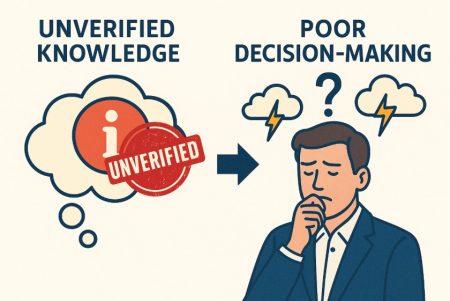
Evidence is the foundation of knowledge, but it can easily be misinterpreted or misused, leading to false conclusions and distorted understanding. One of the most common ways this happens is through cognitive biases, especially confirmation bias, where individuals selectively interpret information that supports their existing beliefs while ignoring data that contradicts them. For example, someone convinced of the effectiveness of an alternative medicine may highlight only positive testimonials or a few small studies while overlooking large-scale clinical trials that show no benefit. This selective interpretation creates a distorted sense of knowledge that appears justified but is in fact biased and unreliable.
Evidence can also be misused through selective reporting, often called “cherry-picking.” This occurs when only favorable results are presented while unfavorable or neutral findings are hidden. In the pharmaceutical industry, for instance, companies have sometimes been accused of publishing studies that emphasize a drug’s effectiveness while suppressing research that reveals harmful side effects. Such practices present an incomplete picture, leading patients, doctors, and policymakers to make decisions based on partial truths. This selective use of evidence undermines knowledge by preventing people from seeing the full range of data needed to reach accurate conclusions.
Another issue arises when evidence is presented without proper context. Data points may be technically accurate but misleading if stripped of the circumstances that give them meaning. For example, an apparent rise in crime rates may actually be explained by population growth or improved reporting methods. Similarly, a sudden increase in cases of a disease might result from better diagnostic tools rather than an actual surge in illness. Without context, evidence can create false impressions, leading to flawed assumptions, misguided policies, or even unnecessary fear. Context is, therefore, essential to ensure that evidence conveys a complete and accurate picture.
In some cases, evidence is not just misinterpreted but deliberately manipulated to serve specific political, economic, or ideological agendas. A well-known example is the tobacco industry, which historically funded biased studies to downplay the health risks of smoking. By creating doubt about well-established scientific findings, the industry delayed public awareness and policy changes, causing widespread harm. Such deliberate manipulation not only produces false knowledge but also erodes trust in research and institutions. When people lose faith in evidence, even legitimate findings may be met with skepticism, making it harder to establish reliable knowledge.
The consequences of misinterpreting or misusing evidence are far-reaching. In science, it can stall progress by sending research in false directions. In medicine, it can put lives at risk when treatments are adopted based on incomplete or distorted evidence. In society, it can fuel misinformation, conspiracy theories, and a general loss of trust in authorities. Ultimately, when evidence is unreliable or misused, the very foundation of knowledge becomes unstable. This instability undermines our ability to make informed decisions, solve problems effectively, and move forward as a society. Safeguarding the correct use of evidence is therefore essential to ensure that knowledge remains credible, trustworthy, and capable of guiding human understanding.