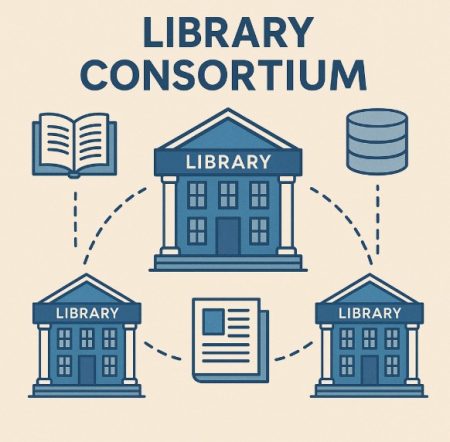
A library consortium is essentially a cooperative framework where multiple libraries unite to share resources, reduce costs, and expand access to knowledge for their users. Instead of each library operating in isolation with limited budgets and collections, consortia enable institutions to pool their strengths and achieve benefits that would be difficult to secure individually. This collaboration can take the form of joint subscriptions to databases and journals, interlibrary loan systems, cooperative cataloging, shared technological infrastructure, or training programs for library staff. For example, the OCLC (Online Computer Library Center) in the United States connects thousands of libraries worldwide, offering resource sharing and cataloging services on a global scale. Similarly, in South Asia, the INFLIBNET Centre in India has built a strong network of academic libraries, providing shared access to databases and e-resources at highly reduced costs.
In today’s digital and globalized world, access to knowledge is a fundamental driver of education, research, and innovation. Universities, research centers, and even industries rely heavily on timely and reliable access to scholarly resources. However, the steep rise in subscription fees for scientific journals, databases, and e-books has made it increasingly difficult for individual libraries to keep pace with user demand. For instance, leading academic publishers often charge universities thousands of dollars annually for a single journal subscription, which places smaller institutions at a significant disadvantage. Moreover, the digital revolution has produced an overwhelming flow of new knowledge, making it impossible for any one library to cover all areas comprehensively. This challenge is evident in Bangladesh, where many universities rely on the UDL Consortium and the Library Consortium of Bangladesh (LiCoB) to gain access to resources they could not otherwise afford.
Library consortia provide practical solutions to these challenges by negotiating collective licenses and subscription agreements with publishers, often securing substantial discounts. For example, through Research4Life, a global initiative, libraries in developing countries gain free or low-cost access to thousands of high-quality scientific journals and databases. This not only bridges the gap between institutions in developed and developing nations but also ensures that researchers and students, regardless of their location or institutional wealth, can participate in the global knowledge economy. Consortia also promote fairness and equity by allowing smaller libraries to provide the same level of information access as their larger counterparts, thereby reducing the knowledge divide within and across countries.
Beyond financial benefits, consortia also foster professional collaboration and knowledge exchange. Member libraries can share expertise, best practices, and innovations, strengthening institutional capacity across the network. For instance, the HathiTrust Digital Library, a consortium of major research libraries, has created one of the largest shared digital repositories in the world, making millions of digitized works accessible to users across member institutions. Similarly, consortia like CARL (Canadian Association of Research Libraries) and Jisc in the UK have led initiatives in open access publishing, research data management, and digital preservation, pushing libraries to the forefront of scholarly communication.
In this context, library consortia have become indispensable in the modern knowledge landscape. They function as powerful bridges between resource limitations and the ever-growing demands of education and research. By pooling resources, building collaborative networks, and negotiating collectively, consortia ensure broader, more equitable, and sustainable access to knowledge. This not only enhances research and learning outcomes but also fosters a culture of collaborative scholarship that aligns with the needs of a globalized society where knowledge is the key to progress.
The Role of Library Consortia in Enhancing Access to Knowledge
A library consortium is a collaborative arrangement among libraries designed to pool resources, expertise, and services for the collective benefit of its members. In the modern knowledge society, where access to information is a key driver of education, research, and innovation, such cooperation has become increasingly essential. Rising subscription costs for scholarly materials, the exponential growth of digital resources, and the demand for equitable access have made it impossible for individual libraries to operate in isolation. Library consortia provide a practical solution to these challenges by bridging knowledge gaps, negotiating favorable terms with publishers, and fostering a culture of collaboration and shared learning.
The concept of library cooperation dates back to the early twentieth century, when institutions first began sharing cataloguing and interlibrary loan services. However, with the advent of digital technology and the globalization of higher education, the role of consortia has expanded dramatically. Today, consortia exist at local, regional, and international levels, often serving as critical enablers of scholarly communication. For example, OCLC (Online Computer Library Center) connects thousands of libraries worldwide, while INFLIBNET in India and LiCoB in Bangladesh provide national frameworks for collaborative access to electronic resources. These initiatives highlight how consortia have transformed libraries from isolated entities into powerful networks of knowledge exchange.
The objectives of library consortia are wide-ranging and impactful. They focus on resource sharing, cost-effectiveness, equity in access, capacity building, and technological innovation. By providing access to larger collections of e-journals, e-books, and databases, consortia allow libraries to meet user needs that would otherwise remain unfulfilled. Through collective negotiation, they reduce subscription costs and make it possible for even smaller institutions to afford high-quality resources. They also promote fairness by ensuring that less-resourced libraries enjoy the same level of access as their wealthier counterparts. Beyond resources, consortia facilitate professional development by organizing joint training programs and workshops, while also driving technological advancements such as shared repositories, digital libraries, and remote authentication systems like Shibboleth or OpenAthens.
The most significant contribution of library consortia is their role in enhancing access to knowledge. By pooling financial and technological resources, they expand the availability of scholarly content across member institutions. Research4Life, for instance, provides developing countries with free or low-cost access to thousands of journals in health, agriculture, and environmental sciences, while the HathiTrust Digital Library, formed by a consortium of major research libraries, has created one of the world’s largest shared digital repositories, granting member institutions access to millions of digitized texts. Consortia also strengthen interlibrary loan and document delivery services, ensuring users have quick access to materials beyond their home institution’s holdings. This collective model reduces duplication, improves efficiency, and enhances the overall research experience, while narrowing the knowledge divide among institutions.
Examples from different regions illustrate this impact more clearly. In Bangladesh, the UDL Consortium and the Library Consortium of Bangladesh (LiCoB) enable universities and research institutions to access global e-journal databases at reduced costs, which is particularly vital in a developing country where funding is often limited. In India, the INFLIBNET Centre has pioneered large-scale e-resource sharing through its e-ShodhSindhu project, while globally, organizations such as OCLC, CARL in Canada, and Jisc in the UK have emerged as leaders in resource sharing, digital preservation, and open access publishing. These examples demonstrate the adaptability and effectiveness of consortia in both developed and developing contexts.
Despite their many successes, library consortia face challenges that need to be addressed for long-term sustainability. Financial stability is often uncertain, as many depend heavily on government grants or external funding. Technological inequality between member institutions can create disparities in access, while differences in governance, policies, and priorities may hinder effective collaboration. Licensing restrictions imposed by publishers also limit the full potential of collective bargaining. Overcoming these challenges requires strong leadership, supportive policies, ongoing investments in digital infrastructure, and capacity-building initiatives.
Looking to the future, library consortia are expected to play an even greater role in supporting open access publishing, developing digital repositories, and fostering collaborative research platforms. With the growth of artificial intelligence, data-driven research, and global knowledge networks, consortia will have new opportunities to innovate and add value to scholarly communication. Expanding partnerships across regional and national boundaries will further strengthen global knowledge exchange and reduce the digital divide.
In conclusion, library consortia represent one of the most effective strategies for enhancing access to knowledge in the twenty-first century. By pooling resources, negotiating collectively, and fostering collaboration, they ensure that even resource-constrained institutions can participate in the global knowledge economy. In doing so, consortia reduce financial and technological barriers while cultivating a culture of equitable, sustainable, and collaborative scholarship. As knowledge continues to grow in scale and significance, library consortia will remain indispensable bridges between information scarcity and the universal right to knowledge.