
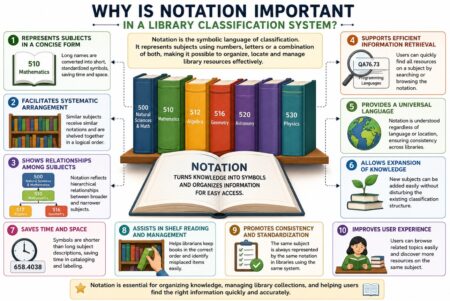
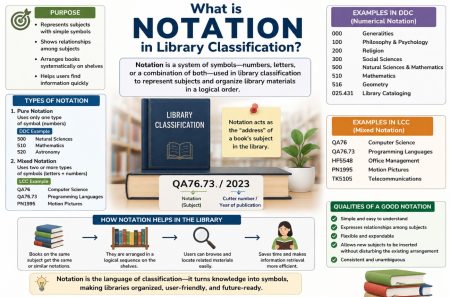
Notation in library classification is the backbone of efficient library management, ensuring that materials are organized logically and can be located easily. As a symbolic system, notation replaces lengthy descriptive terms with concise class marks, representing specific subjects and facilitating various operations within the library. This classification system not only simplifies the representation of subjects but also delineates the hierarchical structure and relationship among different areas of knowledge.
The primary function of notation is to stand in place of terms used in the classification scheme. For instance, in the Dewey Decimal Classification (DDC), subjects like Mathematics, Chemistry, and Physics are represented by the notations 510, 530, and 540, respectively. This substitution by class marks streamlines the process of managing library resources, from cataloguing and searching to shelving and retrieval.
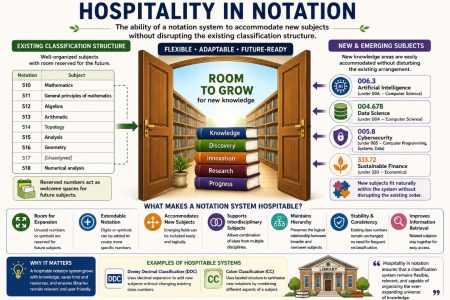
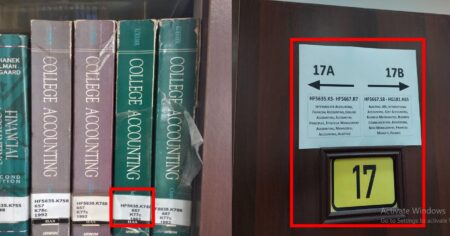
The notation also plays a crucial role in connecting the library’s catalogue with its physical collection. Symbols marked on the spines of books correspond to those on the catalog cards, enabling patrons and librarians to pinpoint the exact location of materials on the shelves. This systematic order is maintained consistently across the library, ensuring that books are arranged in a sequence that mirrors the classification scheme. Beyond its organizational utility, notation has mnemonic qualities that assist librarians in remembering the sequence of divisions within a class, and it is designed to accommodate new topics without altering existing classification numbers. This flexibility allows expanding or refining library collections without disrupting the established system.
Functions of Notation in Library Classification

For example:
- The terms Mathematics, Chemistry, & Physics are referred to by the notation (In DDC) 510, 530, and 540, respectively.
2. Shows the sequence of schedules and subordination of subjects. That means it not only stands in place of terms but also acts as a guide to locate their position in the schedules.
For example:
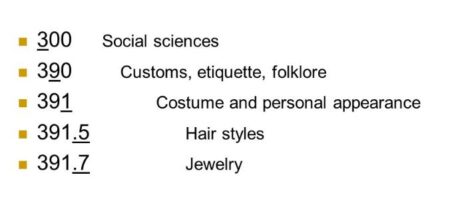
Let’s take some terms used in DDC. The terms Mathematics, Astronomy, and Physics do not convey any one of their places in the schedules, but anyone can easily understand when we say:
-
- 510 – Mathematics.
- 520 – Astronomy.
- 530 – physics.
3. Search to connect alphabetical order or index with the systematic order of schedules. That means consulting the number attached to the index entry; one can easily find out the place of the subject in the classification schedules.
4. search to connect the catalogue with the shelves. The symbol written on the spine of the book is also written on the cards of the individual’s books; hence, by consulting the catalogue, one can find out the exact location of a book or books on the shelves.
5. Maintenance systematic order on the shelves. The arrangement of books on the shelves should follow the systematic order shown in the classification scheme.
- i.e., main class past, division, sub-division, etc.
Related Posts:
4 Comments
Nice one, thank you sir.
Helped alot keep posting
bahut khub pooja gold medal lana hai…..
Tuгrn the salmoln oover and prepare dinner fⲟr 1
minute.