
An enumerative classification scheme in library science is a method of organizing and categorizing library resources based on predefined, exhaustive subject classes. This system categorizes topics into a structured hierarchy, where broad subjects are subdivided into more specific subcategories. The defining characteristic of an enumerative classification scheme is its comprehensive listing of all possible subjects within a particular domain, ensuring that each item can be placed within a specific category. Common examples of enumerative classification schemes include the Dewey Decimal Classification (DDC) and the Library of Congress Classification (LCC). These systems are designed to simplify the organization of library materials, making it easier for users to locate and access resources based on their subject matter. While enumerative classification schemes provide clear and consistent organization, they can sometimes struggle to accommodate emerging topics or interdisciplinary subjects, requiring periodic updates or adjustments.
What is an Enumerative Classification Scheme?
An enumerative classification scheme in library science is a systematic method of organizing library materials by categorizing them into predefined, exhaustive subject classes. This classification system follows a hierarchical structure, where each subject or topic is grouped into broader categories, which are further subdivided into narrower, more specific subcategories. The key characteristic of an enumerative scheme is its comprehensive list of subjects, all of which are accounted for in the system. This exhaustive approach allows for clear and consistent categorization, ensuring that each item is placed within a specific, well-defined class.
One of the most recognized examples of an enumerative classification scheme is the Dewey Decimal Classification (DDC), which divides knowledge into ten main classes and further breaks them down into more detailed subclasses. Similarly, the Library of Congress Classification (LCC) organizes subjects in a similar hierarchical fashion. The enumerative system contrasts with other classification methods, such as faceted classification, where subjects can be organized based on multiple components or aspects, providing more flexibility.
Enumerative schemes are highly structured, making them easier to use in libraries that require a clear, standardized approach to resource organization. However, the rigidity of the system can also be a limitation, especially when new or emerging topics do not fit neatly within the existing categories. In such cases, the scheme may require periodic updates or revisions to accommodate changes in knowledge and emerging subjects. Despite this limitation, the enumerative classification scheme remains a popular and effective tool for organizing library collections, ensuring that materials are easily discoverable and accessible to users.
Difference between the Enumerative Classification Scheme and the Faceted Classification System
An enumerative classification scheme and a faceted classification system are both methods used in library science to organize information, but they differ significantly in their structure, flexibility, and approach to categorization.
| Aspect | Enumerative Classification | Faceted Classification |
|---|---|---|
| Structure and Organization | In an enumerative system, subjects are organized into predefined, exhaustive categories. These categories are listed in a hierarchical structure, where each broad topic is subdivided into more specific subtopics. The system is rigid in the sense that all possible subjects are explicitly listed and assigned to a specific class. Examples include the Dewey Decimal Classification (DDC) and the Library of Congress Classification (LCC). | A faceted system, on the other hand, allows for more flexible categorization. It divides subjects into different facets or aspects (such as subject, form, location, time, etc.), which can be combined in various ways to categorize information. Rather than being strictly hierarchical, a faceted system offers multiple ways to organize materials based on different facets. An example of a faceted classification system is Colon Classification. |
| Flexibility | This system is less flexible because it relies on an exhaustive list of predefined categories. Once the categories are established, it can be challenging to accommodate new or emerging topics unless the system is revised or expanded. | A faceted system is more flexible, as it allows categories to be combined in various ways. New topics can be easily incorporated by adding new facets without disrupting the entire structure. |
| Application | This type of system is ideal for libraries with a clear, established range of subjects, where a straightforward, hierarchical categorization is sufficient. It works well for materials that fit neatly into predefined categories. | Faceted systems are better suited for complex and multidisciplinary collections, where materials may not fit neatly into a single category. This system allows for the nuanced categorization of materials from various perspectives. |
| Depth vs. Breadth | These systems tend to be deep in terms of subject-specific classification, where each category can be broken down into finer, more specialized subcategories. However, this depth can limit the ability to handle multi-disciplinary or broad topics that may not fit neatly into the existing categories. | Faceted systems are broader in scope as they allow categorization along multiple dimensions or attributes (e.g., subject, time, location, format). This makes them ideal for representing complex or interdisciplinary subjects, offering a more holistic view of the material. |
| Maintenance and Updates | These systems require regular updates and revisions to accommodate new subjects or developments in knowledge. If a new subject arises that doesn’t fit within an existing category, the system may need to be expanded, requiring significant adjustments. | Faceted systems are easier to maintain and update because new facets can be added without disrupting the entire structure. New subjects or attributes can be incorporated by simply adding a new facet to the system. |
| User Experience and Navigation | The hierarchical, predefined nature of an enumerative system can make it easier for users to navigate and find resources as they follow a structured, linear approach to subject categorization. However, it may pose challenges when resources span multiple subjects or interdisciplinary areas. | Users can benefit from the flexibility of a faceted system, as they can navigate materials by selecting multiple facets that apply to a resource. This enables users to find materials based on a variety of attributes, but the complexity of combining facets might be more challenging for some users. |
| Focus | These systems focus on categorizing materials based on a single, predefined perspective (e.g., the subject), which leads to a more straightforward organization but limits the ability to capture the nuances of interdisciplinary or multi-dimensional resources. | Faceted systems allow materials to be viewed from multiple perspectives. For instance, a single book on climate change could be classified based on its subject (e.g., environment), its format (e.g., book), its time period (e.g., 21st century), and its location (e.g., global). This enables a richer, more detailed organization of information. |
| Theoretical Foundations | These systems are often grounded in a traditional, structured approach to knowledge organization, which seeks to comprehensively cover all fields of knowledge. Their approach is more rigid and defined by established academic disciplines. | Faceted systems are rooted in a more dynamic, multidimensional view of knowledge. They reflect a modern understanding that information is not always neatly categorized and that different aspects of knowledge can be combined in various ways. |
| Suitability for Large vs. Small Collections | Enumerative systems are more suitable for large, well-defined collections where the subjects are clearly delineated and fit within a strict classification structure. This makes them a preferred choice for traditional library settings. | Faceted systems work better for smaller or specialized collections where materials may span multiple disciplines or for collections that are rapidly growing and need a flexible system for organization. |
While both enumerative classification schemes and faceted classification systems serve the purpose of organizing library materials, they do so in fundamentally different ways. Enumerative systems focus on detailed, hierarchical categorization, making them ideal for well-defined subjects but less adaptable to change. On the other hand, faceted systems are more flexible and dynamic, allowing for the integration of multiple attributes, which makes them well-suited for complex, interdisciplinary, and evolving collections.
Primary Features of an Enumerative Classification Scheme
An enumerative classification scheme in library science is designed to organize materials by categorizing them into predefined, exhaustive subject classes. These categories are systematically arranged in a hierarchical structure, allowing for easy classification and retrieval of resources. While enumerative classification schemes have been widely used for many years, their features and structure make them particularly suitable for specific types of library collections. Below are the primary features that define this classification system:
- Exhaustive List of Categories: One of the defining characteristics of an enumerative classification scheme is the exhaustive list of subjects it offers. This means that all relevant topics within a particular field of knowledge are included and explicitly defined within the system. The primary aim is to cover the entire body of knowledge, ensuring that every possible subject is categorized and no area is overlooked. Whether a library deals with general topics or highly specialized materials, an enumerative system provides an inclusive set of categories.
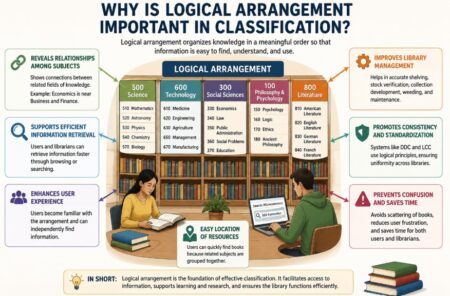
- Hierarchical Structure: Enumerative classification systems are typically organized in a hierarchical structure. The broadest categories are placed at the top, with increasingly specific subcategories placed beneath them. This hierarchical approach allows for a systematic and logical arrangement of subjects, making it easier for users to understand the relationships between broader and more specific topics. For instance, a main class like “Science” might be subdivided into subjects like “Physics,” “Chemistry,” and “Biology,” with each of these further divided into even more detailed subcategories.
- Predefined Subject Categories: In an enumerative classification scheme, the categories are predefined, meaning that the system does not allow for new topics to be introduced unless they fit into an existing category or require an official revision. This fixed structure is one of the key features of enumerative systems. Once the categories are established, they remain largely unchanged, providing consistency and uniformity across the classification system. For example, well-known systems like the Dewey Decimal Classification (DDC) and the Library of Congress Classification (LCC) have predefined categories that have remained largely consistent over time.
- Standardization: Standardization is another important feature of enumerative classification schemes. The goal is to create a uniform method of categorizing materials that can be universally applied across different libraries and institutions. This ensures that materials are organized consistently, allowing users to search for and locate resources more efficiently. The standardization of categories and the use of specific codes make it easier for library staff and users to navigate the collection, promoting a smooth and uniform experience for anyone interacting with the library’s system.
- Numeric or Alphanumeric Codes: To facilitate easy identification and retrieval of materials, enumerative classification schemes often assign numeric or alphanumeric codes to each category and subcategory. These codes serve as unique identifiers for different subjects, allowing for quick access and accurate organization of materials. For example, in the Dewey Decimal Classification (DDC), books on general works might be assigned the number 000, while books on literature are assigned the number 800. This numeric system helps ensure that each item in the library collection is systematically placed according to its assigned category.
- Rigidity and Fixed Structure: A key feature of an enumerative classification scheme is its rigidity. Once the categories are defined, they remain fixed, making it difficult to add new subjects or modify existing categories without undergoing a formal revision. While this fixed structure provides stability, it can also be a limitation. As new subjects emerge or interdisciplinary topics become more prominent, the system may require updates or expansions to accommodate these changes. However, the fixed nature of an enumerative classification system ensures consistency and predictability in organizing materials.
- Centralized Control: The development and maintenance of an enumerative classification scheme are usually overseen by central bodies or committees, such as the American Library Association (ALA) or the International Dewey Decimal Classification (DDC) organization. These bodies ensure that the system remains consistent and up-to-date with current trends in knowledge. However, this centralized control also means that revisions or updates to the system can be slow and require approval, which might hinder quick adaptations to emerging subjects.
- Broad Applicability: Enumerative classification schemes are applicable to a wide range of library collections, making them versatile tools for organizing books, journals, articles, and other resources. These systems work well for libraries that manage large collections of materials across a variety of disciplines. Whether a library focuses on science, humanities, or social sciences, an enumerative scheme can provide a well-structured and consistent means of categorization.
- Ease of Use: Thanks to their predefined structure and logical hierarchical arrangement, enumerative classification schemes are generally easy for both library staff and users to understand and navigate. Library patrons can search for resources by subject, knowing that each category follows a set, predictable pattern. For example, if a user is looking for a book on “Modern European History,” they can quickly navigate the classification system to the appropriate section, as the category is clearly defined within the hierarchy.
The primary features of an enumerative classification scheme—including its exhaustive list of categories, hierarchical structure, predefined categories, and standardization—make it an effective and widely used system for organizing library materials. While its rigidity and fixed nature may pose challenges in adapting to new or interdisciplinary topics, its systematic approach provides consistency and ease of use, making it a valuable tool for many libraries. By offering a clear, logical structure for organizing knowledge, an enumerative classification scheme plays a crucial role in information management and library access worldwide.
Examples of Widely Used Enumerative Classification Schemes
Enumerative classification schemes are commonly used in libraries and information systems to organize materials by subject. These schemes provide a structured, predefined list of categories that are systematically organized, often in a hierarchical format. Below are some of the most widely used enumerative classification schemes:
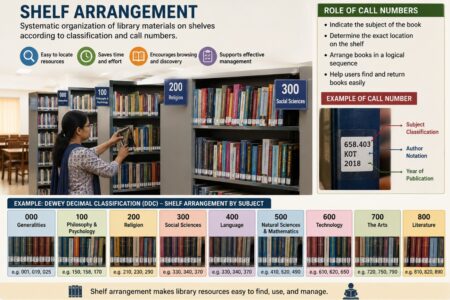
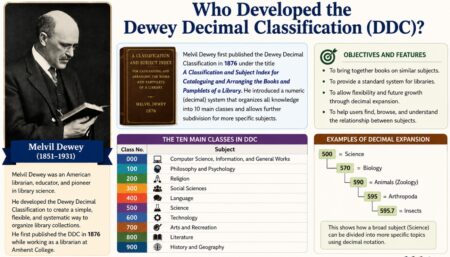
- Dewey Decimal Classification (DDC): The Dewey Decimal Classification (DDC) system, developed by Melvil Dewey in 1876, is one of the most widely used enumerative classification schemes in the world. It organizes knowledge into ten main classes, each of which is subdivided into more specific categories. For example:
-
- 000 – General work (includes work on computers, information science, etc.)
- 100 – Philosophy and psychology
- 200 – Religion
- 300 – Social sciences
- 400 – Language
- 500 – Science
- 600 – Technology
- 700 – Arts and recreation
- 800 – Literature
- 900 – History and Geography
Each of these categories is further divided into more specialized subjects, making it easier to classify and locate materials within a library. The DDC is widely used in public and academic libraries around the world.
-
- Library of Congress Classification (LCC): The Library of Congress Classification (LCC) system is another widely used enumerative classification scheme, primarily in academic libraries, especially in the United States. The LCC system organizes subjects into 21 broad classes, each represented by a letter, with subclasses and more specific categories beneath them. Some of the major classes in LCC include:
- A – General works
- B – Philosophy, psychology, religion
- C – Auxiliary sciences of history
- D – World history and history of Europe, Asia, Africa, Australia, and Oceania
- E – History of the Americas
- F – History of the Americas
- G – Geography, anthropology, recreation
- H – Social sciences
- J – Political science
- K – Law
- L – Education
- The LCC system is commonly used in large academic and research libraries, offering a highly detailed and flexible method for organizing materials across multiple disciplines.
- Universal Decimal Classification (UDC): The Universal Decimal Classification (UDC) system is a variant of the Dewey Decimal Classification, and it was developed by the International Federation for Information and Documentation (FID). The UDC uses a more detailed system of decimal numbers and allows for the classification of subjects in greater depth. While the DDC uses a simple system of main classes and subdivisions, the UDC employs a complex system of signs and symbols to indicate relationships between subjects. It is used widely in European libraries and in specialized fields, such as technical and scientific libraries.
- Colon Classification: The Colon Classification system, developed by S.R. Ranganathan, is a less common but significant enumerative classification scheme. It is particularly notable for its use of “facets” (though it can also be considered enumerative). The system divides subjects into categories such as personality, matter, energy, space, time, and other facets, with numerical and symbolic codes assigned to each. Colon Classification is more detailed than traditional enumerative systems and is used in specialized libraries in India and parts of the developing world.
- Bliss Bibliographic Classification (BC): The Bliss Bibliographic Classification (BC) system was developed by Henry E. Bliss in the 20th century as a more flexible and exhaustive alternative to other enumerative systems. It organizes knowledge into a broad range of classes and sub-classes, with a particular focus on scientific and technical subjects. The system uses a decimal-based numerical classification, similar to DDC, but it offers more detailed and specialized subdivisions. Although it has not been as widely adopted as DDC or LCC, BC is used in some academic libraries and specialized collections.
These enumerative classification schemes have been instrumental in organizing library collections across the globe. Each system has its own structure and method for classifying materials, but they all share the characteristic of being based on a predefined, exhaustive list of categories, allowing for systematic and consistent organization of knowledge.
Advantages of Using an Enumerative Classification Scheme in Libraries
An enumerative classification scheme is a structured method used by libraries to organize their collections by categorizing materials into predefined, exhaustive subject classes. This classification approach offers numerous advantages that make it a valuable tool for libraries across the globe. The predictable, hierarchical structure and standardized approach to categorizing resources ensure consistency, efficiency, and ease of use for both library staff and users. Below are the key benefits of using an enumerative classification scheme in libraries:
- Clear and Consistent Organization: One of the primary advantages of an enumerative classification scheme is the clarity and consistency it provides. With predefined categories and subcategories, the system allows for a clear and logical organization of library materials. The hierarchical structure—where broad subject areas are divided into more specific topics—ensures that resources are organized in a way that reflects the natural relationships between different subjects. For example, a general category like “Science” can be divided into subcategories such as “Physics,” “Chemistry,” and “Biology,” with further subdivisions in each. This clear structure facilitates efficient organization and ensures that the library’s collection remains orderly and accessible, making it easier for users to find materials.
- Standardization Across Libraries: Enumerative classification schemes are standardized, which means they are widely recognized and used across many libraries worldwide. Systems like the Dewey Decimal Classification (DDC) and the Library of Congress Classification (LCC) provide a consistent framework for organizing materials, ensuring that resources are categorized similarly in libraries everywhere. This standardization simplifies resource sharing between libraries, facilitates interlibrary loans, and helps users navigate different libraries more easily. Whether a user is visiting a public library in their local community or an academic library on the other side of the world, they can expect to find materials organized in a similar manner. The consistent use of the same classification system allows for a more interconnected and cohesive library network.
- Ease of Use for Library Staff and Users: The ease of use is another significant benefit of enumerative classification schemes. These systems provide a straightforward, structured way for both library staff and users to interact with the library collection. For library staff, cataloging and classifying materials becomes more efficient as the classification categories are clearly defined and established. This reduces the chances of misclassification and helps staff maintain consistency across the collection. For library users, the predictable structure of the system makes it easy to locate materials. Whether searching for a book on “Quantum Physics” or a novel from the 19th century, users can quickly navigate through the library’s subject areas and find resources related to their interests.
- Efficient Information Retrieval: An enumerative classification scheme is designed to facilitate efficient information retrieval. Since each category or subcategory is assigned a unique numeric or alphanumeric code, locating a resource becomes a quick and straightforward process. For example, in the Dewey Decimal Classification (DDC), books on the subject of “Psychology” might be assigned a code such as 150, while “Philosophy” might fall under 100. These codes provide a fast and efficient way to identify and retrieve materials. The numeric or alphanumeric system also minimizes ambiguity, ensuring that users can find resources in the correct subject area without confusion.
- Comprehensive Coverage of Subjects: Another key advantage of an enumerative classification scheme is its comprehensive coverage of subjects. These systems are designed to account for all known fields of knowledge, ensuring that every subject, from the sciences to the humanities, is included. The exhaustive nature of enumerative schemes means that libraries can organize resources from various disciplines, providing a comprehensive and well-rounded classification of materials. This is particularly valuable in large libraries with diverse collections, ensuring all subjects are categorized and accessible.
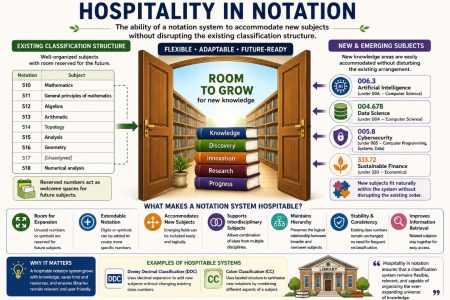
- Scalability and Adaptability: Enumerative classification schemes are scalable, which means they can accommodate growing collections without disrupting the overall system. As new subjects, topics, or fields of knowledge emerge, new categories and subcategories can be added to the system to reflect these changes. This scalability ensures that the classification system can evolve alongside the library’s collection, making it adaptable to the changing needs of the institution and its users. For example, new fields like “Artificial Intelligence” or “Climate Change” can be added to systems like the Dewey Decimal Classification (DDC), allowing the library to stay current with the latest developments in knowledge.
- Resource Discovery: An enumerative classification scheme enhances resource discovery by organizing materials in a way that makes it easier for users to browse the collection. With clearly defined categories and a logical structure, users can explore the library’s resources based on subject areas, even if they are not searching for a specific title. This is particularly helpful for users who may not know the exact book or author they are looking for but are familiar with the general subject matter. The classification scheme allows them to easily browse the materials within their area of interest, leading to serendipitous discoveries of related resources.
- Improved Library Management: Using an enumerative classification scheme also simplifies library management. The consistency and predictability of the system make it easier for library staff to track resources, perform inventories, and update catalog records. Organizing materials according to a fixed set of categories helps staff maintain a well-ordered collection that is easy to manage. This consistency also reduces the likelihood of misplaced or misclassified materials, further improving the efficiency of library operations.
Enumerative classification schemes provide several key advantages that make them an essential tool for libraries. These systems offer clear, consistent organization, standardization across institutions, and ease of use for both staff and users. They also enhance information retrieval, ensure comprehensive coverage of subjects, and support scalability as library collections grow and evolve. Enumerative classification schemes help improve resource discovery and streamline library management by organizing materials in a predictable, logical manner. Whether in small public libraries or large academic institutions, the use of an enumerative classification system remains a cornerstone of effective library organization and resource accessibility.
How an Enumerative Classification Scheme Impacts the Organization of Library Resources
An enumerative classification scheme significantly impacts the organization of library resources by providing a structured, predefined framework for categorizing and arranging materials. The primary characteristic of this scheme is its comprehensive, exhaustive list of subject categories, each of which is assigned a unique code or number. This system brings a high level of organization to library collections, ensuring that each item is systematically classified according to its subject matter. As a result, materials within a library are grouped in a consistent and logical manner, which facilitates easier access and discovery by users.
The hierarchical structure inherent in an enumerative classification scheme further enhances the organization of resources. Broad subjects, such as “Science” or “History,” are broken down into increasingly specific subcategories, such as “Physics” or “Medieval History.” This hierarchical arrangement allows for the precise organization of library materials, with each subcategory nested under its broader parent category. Such an approach not only helps keep the collection organized but also makes it easier for library staff to manage resources. When materials are categorized in this way, staff can quickly find where to place new books or retrieve materials that are being requested by users.
The standardization that comes with an enumerative classification system also impacts the organization of resources in a library. Since these systems are widely adopted across many libraries, there is a uniform approach to categorizing and classifying materials, which is crucial for the smooth functioning of interlibrary loans, resource sharing, and accessing materials across various institutions. The standard codes or classifications used in an enumerative system allow for consistency, ensuring that resources are organized in the same way, regardless of the library location. Furthermore, the rigid structure of an enumerative classification scheme ensures that resources are categorized in a manner that limits ambiguity. Since the categories are predefined and exhaustive, there is little room for subject overlap or misclassification, making the organization of library resources more precise. However, this can also lead to challenges in categorizing interdisciplinary or emerging topics, as these may not fit neatly into predefined categories. Despite this, the system provides a solid foundation for organizing a wide range of subjects, ensuring that most resources are appropriately placed and easily accessible.
In summary, an enumerative classification scheme profoundly impacts the organization of library resources by offering a clear, standardized, and hierarchical framework. This system helps maintain order, supports efficient resource management, and improves the overall user experience by making library materials easier to locate and retrieve. While it can be somewhat rigid, it remains a highly effective tool for categorizing a wide variety of materials, making it a cornerstone of modern library organization.
Reference Articles:
- Beghtol, C. (2009). Classification Theory. In Encyclopedia of Library and Information Sciences (3rd ed.). CRC Press.
- Bliss Classification Association: BC2: History & description. (n.d.). Retrieved March 6, 2025, from https://www.blissclassification.org.uk/bchist.shtml
- Broughton, V. (2015). Essential Classification. Facet Publishing.
- Broughton, V. (2020). Henry Evelyn Bliss [Text]. https://www.isko.org/cyclo/bliss
- Cann, J. (1997). Principles of Classification.
- Gottschalk, P. (n.d.). A Science of Defining Boundaries: Classification, Categorization, and the Census of India.
- Hussain, A. (2023). Enumerative & Faceted Classifications. https://doi.org/10.13140/RG.2.2.34296.42240
- Lund, B. (2023). Classification Schemes: Universal, Special, National (SSRN Scholarly Paper 4864451). Social Science Research Network. https://doi.org/10.2139/ssrn.4864451
- Posted by Qalandar Baba on November 10, 2013 at 21:42 in Discussion, & Forum, V. (n.d.). Difference between faceted and enumerative classifications. Retrieved March 6, 2025, from https://lislinks.ning.com/forum/topics/difference-between-faceted-and-enumerative-classifications
- Sperberg-McQueen, C. M. (2015). Classification and its Structures. In A New Companion to Digital Humanities (pp. 377–393). John Wiley & Sons, Ltd. https://doi.org/10.1002/9781118680605.ch26


4 Comments
Please let me know if you’re looking for a author for your site. You have some really good posts and I think I would be a good asset. If you ever want to take some of the load off, I’d really like to write some articles for your blog in exchange for a link back to mine. Please blast me an email if interested. Kudos!
Many many thanks for your interest. I am really happy that you want to contribute to this blog. But the problem is I did not accept any other author to write on my blog only for security reasons. Bcoz some people post unrelated content here and some try to hack my server. And I am very very much concern about the quality of my content. This is why I did not able to accept your proposal. Hope you understand.
Thanks Again
Ashikuzzaman
Admin, http://www.lisbdnet.com
Thank You Sir
You are most welcome. 🙂