Books serve many purposes: they tell stories, explain ideas, record experiences, and help people develop knowledge and skills. Some invite readers into imaginary worlds, while others provide factual information, practical guidance, or detailed explanations of a subject. Whether someone reads a novel for enjoyment, studies a textbook for an examination, or consults a dictionary to understand an unfamiliar word, the type of book they choose shapes their reading experience.
The phrase “types of books” covers more than a list of literary genres. Although fiction and nonfiction are two familiar categories, books can also be grouped by their purpose, literary form, intended audience, and reading format. For example, a children’s science book may be nonfiction, serve an educational purpose, and be available in both print and digital editions. These categories overlap, allowing the same book to be described in several useful ways.
Understanding the different types of books helps readers discover new interests and select suitable materials for learning, research, or leisure. It also helps students, teachers, parents, and library professionals recommend books for different needs and audiences. This article explores the main categories of books, explains their distinctive features, and provides examples to help readers recognize and appreciate the variety available to them.
Types of Books / How Are Books Classified?
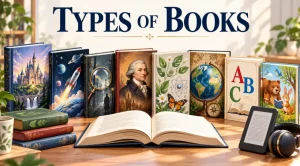 Books are classified by grouping them according to shared characteristics, such as their content, subject, genre, purpose, intended audience, and format. These groupings help readers understand what a book offers and choose materials that match their interests or needs. They also help publishers, booksellers, teachers, and librarians describe and organize books.
There is more than one way to classify a book. A category may describe what the book contains, how it presents its material, whom it addresses, or how readers access it.
| Basis of Classification | What It Describes | Examples |
|---|---|---|
| Content | The broad nature of the material, particularly the distinction between imagined narratives and factual writing. | Fiction and nonfiction |
| Subject | The topic or field of knowledge covered by the book. | History, science, art, business, and philosophy |
| Genre | Shared conventions, themes, or storytelling characteristics. | Mystery, romance, fantasy, horror, and science fiction |
| Literary Form | The structure or mode in which the work is written or presented. | Novels, novellas, short stories, poetry, and plays |
| Purpose | The main function the book serves for its readers. | Textbooks, reference books, scholarly books, and practical manuals |
| Intended Audience | The readers for whom the book is primarily written. | Children’s books, young adult books, and adult books |
| Format | The physical, digital, audio, or accessible presentation of the book. | Hardcovers, paperbacks, ebooks, audiobooks, large-print books, and Braille books |
These categories are overlapping rather than mutually exclusive. For example, a children’s science textbook available as an ebook can be described as nonfiction by content, science by subject, educational by purpose, children’s literature by audience, and digital by format. Each description highlights a different characteristic of the same book.
It is also useful to distinguish genre from literary form. A novel is a literary form, while mystery is a genre. A mystery novel may be published as a hardcover, paperback, ebook, or audiobook without changing its genre.
In libraries, these descriptive groupings are complemented by formal classification systems that organize materials in a structured arrangement, usually by subject. Understanding the different ways books are grouped therefore helps readers both explore reading choices and locate suitable materials in a collection.
Fiction Books and Their Common Genres
Fiction books tell stories shaped by an author’s imagination. Their characters, settings, and events may be invented, inspired by real life, or a combination of both. Through storytelling, fiction explores human experiences such as love, friendship, conflict, ambition, identity, and loss. It can entertain readers while encouraging them to consider unfamiliar situations and different perspectives.
Fiction is commonly grouped into genres based on shared themes, settings, plot patterns, and storytelling conventions. These categories help readers discover stories that match their interests. Some common genres and categories of fiction are explained below.
-
Literary Fiction: Literary fiction places particular emphasis on characterization, language, and the exploration of human experiences. It often examines relationships, social conditions, moral questions, and the inner lives of its characters. The term describes a broad category; literary qualities can also appear throughout other fiction genres.
Example: To Kill a Mockingbird by Harper Lee explores racial prejudice, justice, and moral growth through a story of childhood in the American South. -
Romance: Romance centers on the development of a romantic relationship. Its characters may face misunderstandings, personal struggles, family expectations, or social barriers as their relationship develops. Books published as genre romance generally offer an emotionally satisfying and optimistic ending.
Example: Pride and Prejudice by Jane Austen follows the changing relationship between Elizabeth Bennet and Mr. Darcy while examining marriage, social class, and personal judgment. -
Mystery and Crime Fiction: Mystery fiction usually revolves around an unanswered question, often involving a crime or an unexplained event. Readers follow clues, consider suspects, and work toward a solution alongside the investigating character. Crime fiction is a broader category that can also explore criminal motives, the experiences of victims, and the consequences of criminal activity.
Example: Murder on the Orient Express by Agatha Christie follows detective Hercule Poirot as he investigates a murder aboard a train. -
Thriller and Suspense: Thrillers create excitement through danger, uncertainty, and escalating tension. Their characters often face urgent threats, powerful opponents, or situations in which the consequences of failure are serious. Suspense develops as readers anticipate what might happen and whether the characters will escape or succeed.
Example: The Thirty-Nine Steps by John Buchan follows Richard Hannay as he becomes caught in a dangerous espionage plot. -
Science Fiction: Science fiction explores imagined situations involving science, technology, or possibilities beyond present experience. Common subjects include space travel, artificial intelligence, time travel, alien life, and future societies. These stories often examine how scientific or technological developments might affect individuals and communities.
Example: The War of the Worlds by H. G. Wells imagines a Martian invasion of Earth and humanity’s struggle to respond. -
Fantasy: Fantasy includes magic, supernatural forces, mythical beings, or worlds governed by different rules from everyday reality. Its settings may be entirely invented or may introduce magical elements into a familiar world. Common themes include quests, discovery, power, courage, and conflicts between opposing forces.
Example: The Hobbit by J. R. R. Tolkien follows Bilbo Baggins on a journey involving dwarves, a dragon, and a powerful magical ring. -
Historical Fiction: Historical fiction places an imagined story within a recognizable period of the past. Authors combine fictional characters or events with historical settings, customs, and social conditions. Real people and documented events may also appear within the narrative.
Example: A Tale of Two Cities by Charles Dickens is set in London and Paris during the years surrounding the French Revolution. -
Horror: Horror aims to evoke fear, dread, or unease. Its stories may involve ghosts, monsters, supernatural events, psychological disturbances, or threatening human behavior. Atmosphere, uncertainty, and a sense of vulnerability often contribute to the reader’s experience.
Example: Dracula by Bram Stoker centers on the vampire Count Dracula and the efforts of a group of people to stop him. -
Adventure: Adventure fiction emphasizes journeys, exploration, risk, and action. Characters encounter unfamiliar places, dangerous situations, or difficult challenges that test their courage and resourcefulness. Treasure hunts, sea voyages, survival stories, and expeditions are common features.
Example: Treasure Island by Robert Louis Stevenson follows young Jim Hawkins on a voyage involving pirates and buried treasure.
These genres frequently overlap. The Hobbit, for example, combines fantasy with adventure. A story may also blend mystery with romance or science fiction with horror, giving readers several ways to describe and discover the same book.
Nonfiction Books and Their Common Categories
Nonfiction books explore real people, events, experiences, subjects, and ideas. Their authors may explain scientific concepts, document historical events, reflect on personal experiences, or provide instructions for completing a task. Nonfiction can inform, educate, persuade, or encourage reflection, and its presentation ranges from straightforward explanations to engaging narratives.
Nonfiction includes many categories, each serving different interests and reading needs. Some of the most common are explained below.
-
Biographies, Autobiographies, and Memoirs: These books describe the lives and experiences of real people. They may explore a person’s background, relationships, achievements, challenges, and influence on society. The distinction between them concerns who writes the account and which parts of a life it covers.
Type Main Characteristics Example Biography An account of someone’s life written by another person. Steve Jobs by Walter Isaacson Autobiography An account written by the person whose life is described, often covering a broad period. The Story of My Life by Helen Keller Memoir A personal account focusing on selected experiences, periods, relationships, or themes in the author’s life. Educated by Tara Westover An autobiography generally provides a broader account of a life, while a memoir concentrates on experiences connected by a particular theme or period.
-
History: History books examine past events, societies, civilizations, and individuals. They may focus on a particular country, historical period, conflict, institution, or social movement. Authors interpret evidence such as letters, official records, newspapers, photographs, and eyewitness accounts to explain what happened and why it matters.
Example: The Guns of August by Barbara W. Tuchman examines the opening phase of the First World War and the decisions surrounding it. -
Science and Nature: Science and nature books explain the physical world, living organisms, scientific discoveries, and natural processes. Topics may include astronomy, biology, chemistry, geology, ecology, and environmental change. Some books introduce these subjects to general readers, while others provide detailed discussions for readers with specialist knowledge.
Example: A Brief History of Time by Stephen Hawking introduces questions about the universe, including its origins, black holes, space, and time. -
Travel: Travel books describe places, journeys, cultures, and encounters. Some provide practical information about destinations, transportation, accommodation, and local customs. Others present the author’s observations and experiences during a journey. Travel writing can therefore combine useful information with personal reflection and cultural description.
Example: Notes from a Small Island by Bill Bryson recounts his travels around Great Britain through personal observations and humorous commentary. -
Self-Help and Personal Development: Self-help books offer ideas, strategies, and exercises intended to support personal improvement. Common topics include habits, motivation, communication, confidence, time management, and goal setting. Their approaches vary, and readers may find different methods useful depending on their circumstances and goals.
Example: Atomic Habits by James Clear presents an approach to building habits through small, repeated changes. -
Business and Economics: Business books address subjects such as management, leadership, entrepreneurship, marketing, and organizational decision-making. Economics books examine how individuals, institutions, and societies produce, distribute, and use resources. Books in this broad category may provide practical guidance, explain theories, or analyze economic developments.
Example: The Wealth of Nations by Adam Smith examines economic activity, including the division of labor, markets, and trade. -
Essays and Commentary: Essay collections bring together shorter works in which an author explores ideas, experiences, or public issues. Their subjects may include culture, literature, politics, education, identity, and everyday life. Essays often combine observation, reflection, evidence, and argument, giving readers insight into the author’s perspective.
Example: Notes of a Native Son by James Baldwin brings together essays addressing race, identity, family, and society. -
How-To Books and Practical Guides: How-to books help readers perform tasks or develop particular skills. They usually provide instructions, explanations, examples, or illustrations. Common subjects include cooking, gardening, writing, photography, crafts, and home maintenance.
Example: The Elements of Style by William Strunk Jr. and E. B. White provides guidance on English usage and writing.
These categories often overlap. A biography of a scientist may also belong to science writing, while a personal account of a journey may combine travel writing with memoir. Nonfiction’s connection to the real world can also involve interpretation, argument, and individual perspective, so authors may approach the same subject in different ways.
Educational, Academic, and Reference Books
Educational, academic, and reference books support learning, teaching, research, and access to information. They are grouped mainly according to their purpose and how readers use them. Most belong to nonfiction, although they may discuss or reproduce fictional works for study.
Educational books help readers develop knowledge and skills, academic books contribute to scholarly discussion, and reference books help readers locate particular information. These purposes often overlap: the same book may support classroom learning, independent research, and occasional consultation.
-
Textbooks: Textbooks provide a structured introduction to a subject or course of study. Their content is usually organized into chapters that move through related topics in a logical sequence. They often include learning objectives, explanations, illustrations, worked examples, summaries, review questions, and suggested readings.
Textbooks are used at school, college, and university levels. Teachers may use them to organize lessons, while students use them to understand concepts and prepare for assessments.
Example: Principles of Economics by N. Gregory Mankiw introduces economic concepts such as supply and demand, markets, and the behavior of consumers and businesses. -
Workbooks and Practice Books: Workbooks help learners apply knowledge through exercises and activities. They may accompany a textbook or function as independent learning resources. Common features include questions, worksheets, problems, writing tasks, and space for recording answers.
Their main purpose is to reinforce learning through practice. Some also provide answer keys or explanations that help learners assess their progress.
Example: A mathematics workbook may contain exercises on fractions, percentages, and equations. A language workbook may ask learners to complete sentences, practice vocabulary, or correct grammatical errors. -
Academic and Scholarly Books: Academic books examine subjects through research, evidence, theoretical discussion, or detailed analysis. They are commonly written for researchers, university students, specialists, and readers seeking a deeper understanding of a field.
These books usually include citations and references so readers can identify the sources supporting an argument and explore related literature. Common forms include research monographs, which develop a sustained study of a topic, and edited collections, which bring together chapters by different contributors.
Example: The Five Laws of Library Science by S. R. Ranganathan develops principles concerning the use of books, readers’ needs, and the organization and development of libraries. -
Reference Books: Reference books organize information so readers can find specific facts, definitions, explanations, or guidance efficiently. Readers usually consult particular entries or sections according to their needs.
Common reference books include:
Type Main Purpose Example Dictionaries Explain words, including their meanings, spelling, pronunciation, or usage. Oxford English Dictionary Encyclopedias Provide explanatory articles about a broad range of subjects or a particular field. Encyclopaedia Britannica Atlases Present maps and related geographical information. The Times Comprehensive Atlas of the World Directories List people, organizations, institutions, or services, often with contact details. A university staff directory Handbooks Bring together guidance or essential information about a subject or activity. The Chicago Manual of Style Almanacs Compile facts, statistics, dates, and other information, often in annual editions. The World Almanac and Book of Facts Bibliographies Identify publications on a subject, by an author, or within another defined scope. A bibliography of publications on library science Reference works may be available in print or digital formats. Indexes, alphabetical entries, cross-references, and search functions help readers locate relevant information.
-
Technical and Professional Manuals: Technical and professional manuals explain procedures, systems, equipment, or professional practices. They often provide instructions, diagrams, examples, and troubleshooting guidance that readers can apply while completing a task. These books support training and continuing professional work in fields such as engineering, computing, healthcare, publishing, and librarianship.
Example: The Publication Manual of the American Psychological Association provides guidance on scholarly writing, presentation, citations, and references.
The boundaries between these categories are flexible. A professional manual can also serve as a reference book, while a scholarly book may become required reading for a university course. Their classification depends on their content, intended readers, and principal use.
Types of Books by Literary Form
Literary form refers to the structure and manner in which a written work is presented. It describes how an author organizes a story, expresses ideas, or develops an argument. A book may contain one extended work, such as a novel, or bring together several shorter works, such as poems, stories, or essays.
Form and genre describe different characteristics. For example, a novel is a literary form, while mystery, romance, and fantasy are genres. The following are some common literary forms found in books.
- Novels: A novel is an extended fictional narrative, usually written in prose. Its length allows an author to develop characters, explore relationships, describe settings, and sustain a plot through multiple events. Novels may follow one central storyline or connect several characters and storylines.
They appear across many genres, including historical fiction, romance, science fiction, and mystery.
Example: Things Fall Apart by Chinua Achebe explores the life of Okonkwo and changes affecting his Igbo community. - Novellas: A novella is a fictional narrative generally longer than a short story but shorter than a novel. It usually concentrates on a central conflict, a limited group of characters, or a closely connected sequence of events.
Novellas provide space for sustained character development while maintaining a relatively focused narrative. The boundaries between novels, novellas, and short stories can vary across publishing traditions.
Example: The Old Man and the Sea by Ernest Hemingway follows an aging fisherman’s struggle to catch and bring home a large marlin. - Short Stories and Short-Story Collections: A short story is a brief fictional narrative that often focuses on a particular incident, relationship, conflict, or moment of change. Its limited length encourages a concentrated approach to characterization, setting, and plot.
Several stories may be published together as a short-story collection. An anthology may bring together stories by different writers, often selected around a theme, period, or genre.
Example: Dubliners by James Joyce is a collection of short stories portraying different experiences of life in Dublin. - Poetry Collections: Poetry uses carefully chosen language, imagery, sound, rhythm, and other expressive techniques to communicate experiences and ideas. Poems may tell stories, describe places, express emotions, or reflect on personal and social questions. They can use rhyme, free verse, or other patterns.
A poetry book may contain a collection of individual poems or one extended poetic work.
Example: Gitanjali by Rabindranath Tagore brings together poems exploring devotion, spirituality, and human experience. - Plays and Drama: A play is a work written primarily for performance. Its action develops through characters’ dialogue, behavior, and interactions. The written text commonly includes stage directions and may be organized into acts and scenes.
Plays can also be read and studied as literature. A book may contain one play or a collection of dramatic works.
Example: Hamlet by William Shakespeare explores revenge, grief, power, and moral uncertainty through a dramatic narrative. - Essays and Essay Collections: An essay develops an author’s ideas, observations, reflections, or arguments about a subject. Essays may address literature, culture, politics, education, personal experiences, or everyday life.
A book may present one extended essay or collect several shorter essays. Depending on their purpose, these works can combine personal reflection with evidence, interpretation, and argument.
Example: A Room of One’s Own by Virginia Woolf is an extended essay examining women’s opportunities to write, including the importance of education and financial independence. - Graphic Narratives: Graphic narratives communicate stories or experiences through a sequence of images, often combined with dialogue, captions, and other text. Panel arrangement, visual detail, and the relationship between words and pictures contribute to the meaning.
This form includes graphic novels, graphic memoirs, and other illustrated narratives. It can present either fiction or nonfiction.
Example: Persepolis by Marjane Satrapi is a graphic memoir recounting experiences of growing up in Iran.
Literary forms can also blend. A novel may be written in verse, while a memoir may use graphic storytelling. These combinations show how authors adapt the structure and presentation of a work to suit the experiences and ideas they want to communicate.
Types of Books by Intended Audience
Books can be grouped according to the readers for whom they are primarily written. Authors and publishers consider factors such as age, interests, reading experience, language development, and background knowledge. These considerations influence a book’s vocabulary, illustrations, length, themes, and level of detail.
Three broad audience groups are children, young adults, and adults. Each includes fiction and nonfiction, with considerable variety within the group.
- Children’s Books: Children’s books support enjoyment, imagination, language development, and learning. They introduce readers to stories, information, relationships, and experiences through approaches suited to different stages of development.Books for very young children often emphasize pictures, repetition, rhythm, and shared reading. As children gain reading experience, books may introduce longer narratives, more detailed information, and increasingly complex characters and ideas.
Reader Group Common Features Example Babies and toddlers Simple pictures, familiar objects, rhythmic language, and short passages for reading aloud. Goodnight Moon by Margaret Wise Brown Young children listening to stories Pictures and words work together to develop a story and encourage discussion. The Very Hungry Caterpillar by Eric Carle Beginning independent readers Manageable vocabulary, short sentences, repetition, and illustrations that support understanding. Frog and Toad Are Friends by Arnold Lobel Developing independent readers Short chapters, sustained storylines, and a balance between text and illustrations. Dinosaurs Before Dark by Mary Pope Osborne Older children Longer narratives, more developed characters, and themes involving friendship, family, responsibility, and discovery. Charlotte’s Web by E. B. White Children’s nonfiction includes illustrated books about animals, science, history, geography, and other subjects. These books often use photographs, diagrams, captions, and explanations to make information accessible.
- Young Adult Books: Young adult books, often abbreviated as YA, are written primarily for teenage readers. YA fiction frequently features teenage protagonists and explores experiences involving identity, belonging, friendship, family relationships, independence, and responsibility.
This audience category includes many genres, such as fantasy, romance, mystery, historical fiction, and science fiction. Young adult nonfiction may cover biographies, social issues, science, personal development, and practical topics relevant to teenage life.
Example: The Outsiders by S. E. Hinton follows teenage characters as they navigate friendship, loyalty, conflict, and social divisions.
YA describes the intended readership of a book. Its genre and literary form provide additional information about the kind of reading experience it offers. - Adult Books: Adult books are written primarily for readers in adulthood. They cover a wide range of interests, experiences, and levels of specialist knowledge. Their subjects may include relationships, employment, parenthood, politics, history, personal identity, and social change.
Adult fiction includes literary novels and genres such as crime, romance, fantasy, and thrillers. Adult nonfiction ranges from accessible introductions and practical guides to detailed scholarly studies.
Example: The Remains of the Day by Kazuo Ishiguro explores memory, professional duty, relationships, and regret through the reflections of an English butler.
The complexity of adult books varies considerably. Some offer straightforward language and familiar subjects, while others assume substantial background knowledge or use demanding literary techniques.
Audience categories provide useful starting points for discovering books. Readers can enjoy works across these groups, and individual interests, reading confidence, language proficiency, and familiarity with a subject also influence which books suit them. Books may additionally address particular audiences, such as students, teachers, researchers, professionals, or language learners.
Types of Books by Reading Format
Reading format refers to how a book’s content is presented and accessed. Books may be read on printed pages, viewed on a digital device, listened to as recordings, or accessed through touch. The same work may be available in several formats, allowing readers to choose according to their preferences, circumstances, and accessibility needs.
Some format labels describe a book’s binding, while others describe its medium or presentation. Common examples include the following.
- Hardcover Books: Hardcover books, also called hardback books, have rigid covers that protect the pages and support the book’s structure. They often include a cloth, paper, or other covering over stiff boards. Some also have a removable paper dust jacket.This binding provides firm protection during handling and storage. Hardcover editions are common among novels, illustrated books, textbooks, and reference works. Their weight and size vary according to the paper, binding, and amount of content.
Example: A hardcover atlas may provide a sturdy binding for large pages containing detailed maps.
- Paperback Books: Paperback books have flexible covers, usually made from thick paper or card. Compared with hardcover editions of similar size and content, they are generally lighter and easier to carry.Paperbacks appear across fiction and nonfiction, including novels, biographies, poetry collections, and study materials. They range from compact editions to larger books with generous page layouts.
Example: A paperback novel offers a portable reading option for a journey or daily commute.
- Ebooks: Ebooks, or electronic books, are digital editions read on devices such as computers, tablets, smartphones, and dedicated ebook readers. They may present the same content as a printed edition or include additional digital features.Depending on the file and reading software, readers may be able to search the text, add bookmarks, highlight passages, adjust the font size, or change the display settings. Some ebooks allow text to adapt to the screen, while others preserve a fixed page layout.
Example: A searchable ebook textbook allows a student to locate a term and move directly to relevant passages.
- Audiobooks: Audiobooks present a book’s content through spoken narration. They may be narrated by the author, a professional narrator, multiple performers, or a synthetic voice.Readers can listen while resting, traveling, or carrying out activities that permit attention to the recording. Audiobooks also provide an audio route to literature and information for people who find visual reading difficult.
An unabridged audiobook presents the complete text, while an abridged audiobook provides a shortened version.
Example: An audiobook memoir narrated by its author allows listeners to hear the author’s interpretation, emphasis, and tone.
- Large-Print Books: Large-print books use larger lettering than standard-print editions. Their design may also include clear typefaces, increased spacing, and layouts that make the text easier to distinguish.These editions support readers who benefit from larger text, including some people with low vision. Enlarging the text may increase the number of pages or require a work to be divided into several volumes.
Example: A large-print mystery novel presents the story in a dedicated edition with larger text. Adjustable text in an ebook provides another way to enlarge lettering.
- Braille Books: Braille books present text through patterns of raised dots that readers identify by touch. Braille is a reading and writing system used by some blind and visually impaired people.Physical Braille books use embossed pages. Digital text can also be accessed through a refreshable Braille display, which produces changing patterns of raised dots. Braille publications can contain fiction, educational material, reference information, and other kinds of writing.
Example: A Braille edition of a children’s story enables a child who reads Braille to explore the written text through touch.
These descriptions can overlap. A large-print book may have a hardcover or paperback binding, while accessible digital text may support visual reading, speech output, or a Braille display, depending on the file and reading technology.