Hospitality in Notation
Hospitality in notation refers to a library classification system’s ability to accommodate new subjects, concepts, or subdivisions without disrupting the existing structure. In other words, a hospitable notation is designed with enough flexibility to allow the insertion of additional class numbers when new fields of knowledge emerge, or existing subjects expand. As knowledge grows, it becomes essential to provide appropriate classifications for new disciplines such as Artificial Intelligence, Data Science, Cybersecurity, and Digital Humanities. A hospitable notation ensures that these topics can be logically and systematically incorporated without requiring major adjustments to the overall classification scheme.
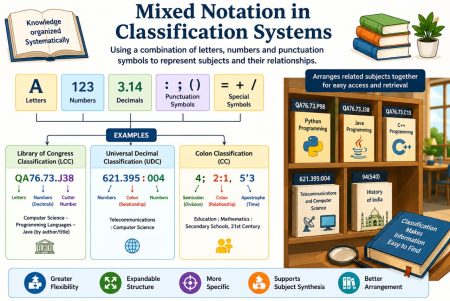
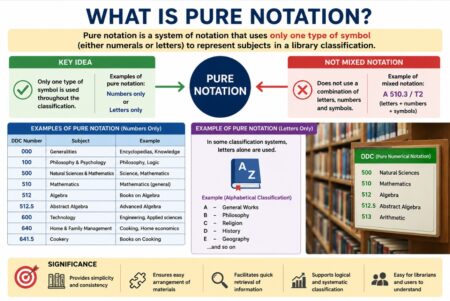
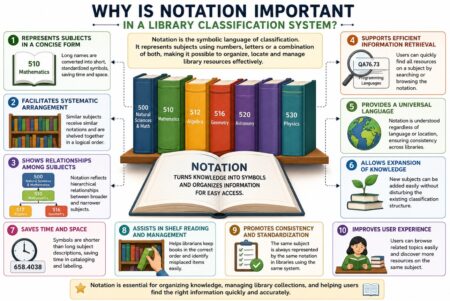
In library classification, notation consists of symbols—numbers, letters, or a combination of both—that represent subjects and establish the arrangement of materials on library shelves. A notation is considered hospitable when it intentionally leaves room for future expansion, either by reserving unused numbers or by allowing the addition of new symbols. This design enables the classification system to adapt to the continuous growth of knowledge while maintaining a logical sequence. For example, if a classification schedule reserves the numbers 510–519 for different branches of mathematics and the number 512.5 remains unused, that number can later be assigned to a newly recognized mathematical field without disturbing the surrounding classes.
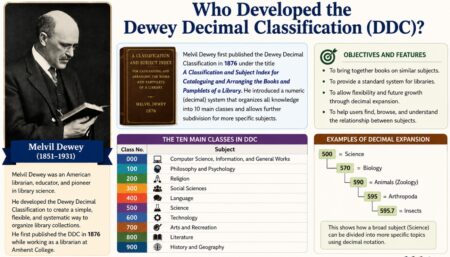
One of the best examples of hospitality in notation can be found in the Dewey Decimal Classification (DDC). DDC uses decimal notation, which allows classifiers to extend a class number simply by adding more digits after the decimal point. For instance, the main class 004 represents Computer Science. As the field of computer science has developed into specialized areas, additional decimal digits have been added to represent specific topics, such as 004.678 for the Internet, 006.3 for Artificial Intelligence, and 005.74 for Database Management. If a new discipline, such as Quantum Machine Learning, becomes widely recognized, further decimal digits can be added to create a unique class number without altering the existing numbers. This shows how decimal notation provides nearly unlimited room for expansion.
Another excellent example is the Colon Classification, developed by S. R. Ranganathan. Unlike enumerative systems, Colon Classification employs a faceted approach, allowing different aspects of a subject—such as personality, matter, energy, space, and time—to be combined to create new class numbers. For example, if a library acquires a book on Artificial Intelligence in Medical Diagnosis in Bangladesh, the classifier can synthesize a notation by combining the facets representing Artificial Intelligence, Medicine, Bangladesh, and the relevant time period. This capacity to construct new class numbers as needed makes Colon Classification one of the most hospitable classification systems ever developed.
Hospitality in notation is particularly crucial for interdisciplinary subjects, which often do not fit neatly into traditional subject boundaries. Take the field of Bioinformatics, for instance, which integrates biology, computer science, and statistics. A hospitable notation enables this emerging subject to be placed logically within the classification system while maintaining its relationship with the parent disciplines. Similarly, topics such as Climate Change Policy, Digital Libraries, FinTech, or Blockchain in Healthcare can be accommodated through expansion rather than by forcing them into unrelated classes.
The advantages of hospitality in notation are numerous. It helps classification systems remain current as knowledge evolves, supports the addition of new subjects without disturbing existing arrangements, reduces the need for extensive revisions, and ensures consistent shelf organization and cataloging. For example, when Data Science became an independent academic discipline, libraries employing hospitable notation were able to assign appropriate class numbers while preserving the classification of existing computer science and statistics materials. Likewise, as new technologies such as Generative AI and the Internet of Things (IoT) continue to develop, hospitable notation allows these subjects to be smoothly integrated into library collections.

What Makes a Notation System Hospitable?
In library classification, notation refers to the system of symbols—such as numbers, letters, or a combination of both—that represent subjects and systematically arrange library materials. An effective notation system should not only organize existing knowledge but also accommodate the continuous expansion of human understanding. This adaptability is known as “hospitality” in notation. A notation system is considered hospitable when it has sufficient flexibility to incorporate new subjects, concepts, and subdivisions without disrupting the existing classification structure. As new disciplines emerge and interdisciplinary research becomes more prevalent, hospitable notation is essential for maintaining an accurate, logical, and future-ready classification system.
1. Room for Future Expansion: A key characteristic of a hospitable notation system is its capacity for future expansion. Knowledge is constantly evolving, and new subjects regularly emerge. Therefore, a notation system should reserve unused numbers, letters, or symbol combinations to allow for the insertion of additional classes when necessary. Rather than forcing new subjects into inappropriate categories or renumbering existing classes, reserved spaces enable classifiers to expand the schedule naturally.
Example: Suppose a classification schedule contains the following numbers:
-
- 621.1 – Mechanical Engineering
- 621.2 – Electrical Engineering
- 621.3 – Civil Engineering
If 621.25 has been intentionally left unused, it can later be assigned to an emerging field such as Renewable Energy Engineering without affecting the existing classification numbers.
2. Extendable Notation: A hospitable notation system allows class numbers to be extended by adding additional digits, letters, or symbols. This feature makes it possible to represent increasingly specific topics while preserving their relationship to broader subjects.
The Dewey Decimal Classification (DDC) is an excellent example. Because DDC uses decimal notation, classifiers can add more digits after the decimal point whenever greater specificity is required.
Example:
-
- 006 – Special Computer Methods
- 006.3 – Artificial Intelligence
- 006.31 – Machine Learning
- 006.312 – Deep Learning
If a new subject such as Explainable Artificial Intelligence (XAI) becomes widely recognized, another decimal extension can be added without changing the existing numbers. This demonstrates how expandable notation supports the continuous growth of knowledge.
3. Ability to Accommodate Emerging Subjects: Modern knowledge is dynamic. New academic disciplines such as Data Science, Cybersecurity, Quantum Computing, Blockchain Technology, and Digital Humanities did not exist as independent fields a few decades ago. A hospitable notation system enables these emerging subjects to be incorporated quickly and logically.
Example: When Data Science became an established discipline, libraries using flexible classification systems could assign it an appropriate notation while maintaining its relationship with computer science, statistics, and mathematics. This avoids confusion and preserves the logical structure of the classification scheme.
4. Support for Interdisciplinary Subjects: Many modern research areas combine concepts from multiple disciplines. A hospitable notation system should be capable of representing these interdisciplinary relationships without forcing subjects into a single rigid category.
Example:
-
- Bioinformatics combines Biology and Computer Science.
- FinTech combines Finance and Information Technology.
- Environmental Economics combines Environmental Science and Economics.
- Digital Libraries combine Library Science and Information Technology.
A flexible notation allows these subjects to be classified, where users can easily locate related materials while reflecting their multidisciplinary nature.
5. Logical and Hierarchical Structure: A hospitable notation preserves the logical hierarchy between broader and narrower subjects. Users should be able to recognize the relationship between subjects simply by examining the notation.
Example:
-
- 500 – Natural Sciences
- 510 – Mathematics
- 519 – Probability and Statistics
- 519.5 – Statistical Methods
- 519.54 – Regression Analysis
Here, every additional digit indicates a more specific topic while maintaining its connection with the broader subject. Such hierarchy makes both shelving and information retrieval more efficient.
6. Faceted Construction: A highly hospitable notation system often employs a faceted approach, allowing classifiers to synthesize new class numbers by combining different aspects of a subject rather than relying solely on pre-enumerated schedules.
The Colon Classification (CC), developed by S. R. Ranganathan, is a classic example. It organizes subjects using facets such as Personality, Matter, Energy, Space, and Time (PMEST).
Example:
A book on Artificial Intelligence in Healthcare in Bangladesh (2025) can be represented by combining the facets for:
-
- Artificial Intelligence
- Healthcare
- Bangladesh
- 2025
Instead of requiring a pre-existing class number, the notation is constructed from these facets. This makes Colon Classification one of the most hospitable classification systems available.
7. Stability of Existing Class Numbers: Another important feature of hospitable notation is that existing class numbers remain unchanged when new subjects are added. Frequent renumbering would require libraries to update catalog records, relabel books, and rearrange shelves, consuming significant time and resources.
Example: If a library introduces a new collection on Generative AI, a hospitable notation system simply assigns a new number within the existing Artificial Intelligence sequence. Previously classified books remain in their original locations, ensuring consistency and minimizing disruption.
8. Long-Term Adaptability: Perhaps the greatest advantage of hospitable notation is its long-term adaptability. Classification systems are expected to serve libraries for decades, making it impossible to predict every future subject. A hospitable notation ensures that the system remains useful despite scientific discoveries, technological innovations, and changes in academic disciplines.
For example, topics such as Internet of Things (IoT), Metaverse, Quantum Machine Learning, and AI Ethics have emerged only recently. A hospitable notation system can integrate these subjects without requiring a complete redesign of the classification schedule.
A notation system is considered hospitable when it provides room for expansion, allows notation to be extended, accommodates emerging and interdisciplinary subjects, preserves logical hierarchy, supports faceted synthesis, maintains the stability of existing class numbers, and improves information retrieval. These characteristics enable library classification systems to evolve alongside human knowledge while preserving consistency and ease of use. Classification systems such as the Dewey Decimal Classification (DDC) and Colon Classification (CC) demonstrate how hospitable notation ensures that libraries remain capable of organizing both today’s knowledge and tomorrow’s discoveries. For this reason, hospitality is regarded as one of the most desirable qualities of an effective notation system.