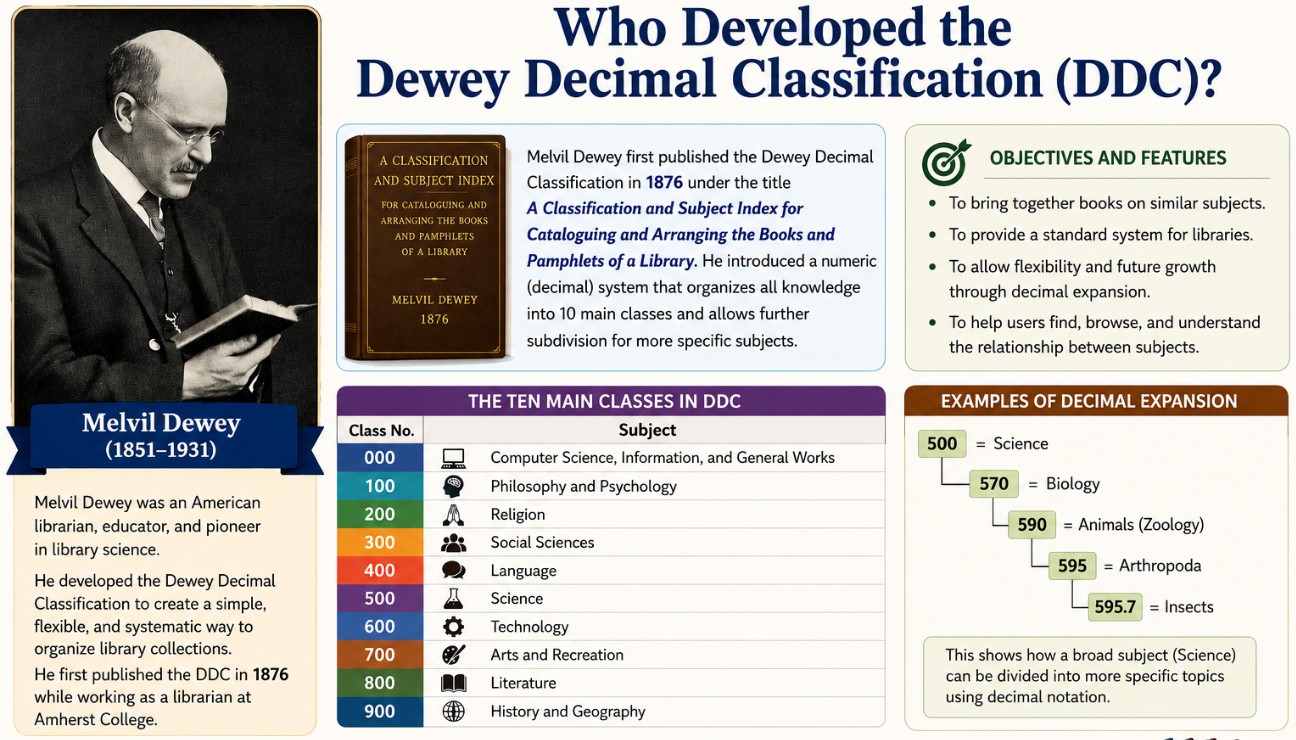
 The Dewey Decimal Classification (DDC) system was developed by Melvil Dewey (1851–1931), an American librarian, educator, and a pioneer in library science. Before the DDC was introduced, libraries typically organized books based on fixed shelf locations or simple subject groupings. This method made it challenging to arrange and use collections as they grew larger. Recognizing the need for a more systematic approach, Dewey designed a numerical classification system that could logically organize knowledge and enable libraries to expand their collections without disrupting existing organization.
Melvil Dewey first published the Dewey Decimal Classification in 1876 under the title A Classification and Subject Index for Cataloguing and Arranging the Books and Pamphlets of a Library. The system was revolutionary because it utilized Arabic numerals and a decimal structure to represent subjects. Dewey divided all human knowledge into ten main classes, each assigned a range of one hundred numbers. These classes could then be further subdivided into more specific subjects using decimal notation, making the system both flexible and expandable.
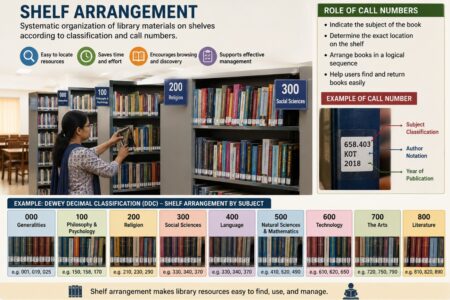
The ten main classes of DDC are:
| Class Number | Subject |
|---|---|
| 000 | Computer Science, Information, and General Works |
| 100 | Philosophy and Psychology |
| 200 | Religion |
| 300 | Social Sciences |
| 400 | Language |
| 500 | Science |
| 600 | Technology |
| 700 | Arts and Recreation |
| 800 | Literature |
| 900 | History and Geography |
One of the most important features of DDC is its hierarchical structure. Each subject can be divided into narrower topics while maintaining a logical relationship with broader subjects. For example:
- 500 = Science
- 570 = Biology
- 590 = Animals (Zoology)
- 595 = Arthropoda
- 595.7 = Insects
This structure enables users to move from a broad subject area to a very specific topic. Similarly:
- 300 = Social Sciences
- 330 = Economics
- 332 = Financial Economics
- 332.1 = Banking
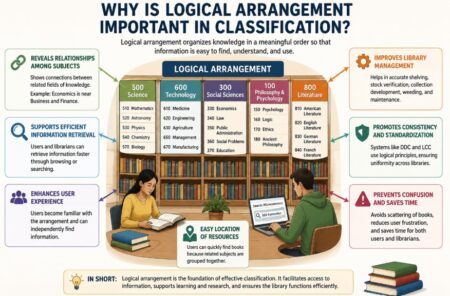
Such logical arrangement helps library users understand how subjects are related and makes information retrieval more efficient.
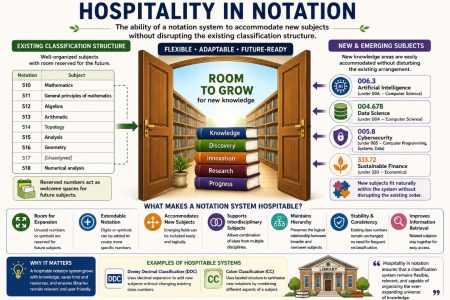
The DDC was developed with several objectives in mind. First, it sought to place books on similar subjects together so that users could easily find related materials. Second, it aimed to create a standard classification system that could be used by different libraries. Third, it provided flexibility for future growth by allowing new subjects to be added through decimal expansion. For example, if a new branch of knowledge emerges, additional decimal numbers can be assigned without changing the overall structure of the system.
Over the years, the Dewey Decimal Classification has undergone numerous revisions and updates to reflect changes in knowledge and society. Today, it is maintained by the OCLC and is available in both print and electronic formats. The system has been translated into many languages and is used in thousands of libraries around the world, particularly public, school, and academic libraries.
The significance of Melvil Dewey’s contribution lies not only in creating a practical classification scheme but also in establishing a logical framework for organizing knowledge. His system transformed library organization by making collections easier to manage, browse, and access. More than a century after its introduction, the Dewey Decimal Classification remains one of the most influential and widely used library classification systems in the world.