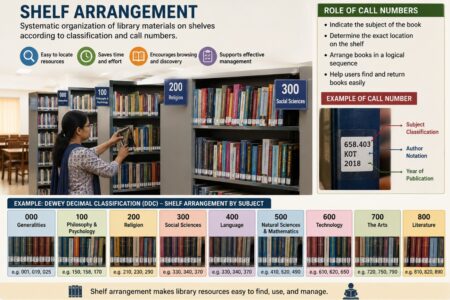
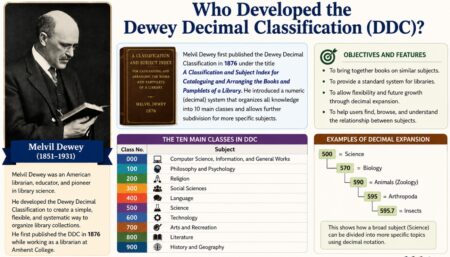
Classification is one of the fundamental operations in library and information management, serving as a systematic method for organizing knowledge and information resources. Its primary purpose is to group materials on similar subjects and arrange them in a meaningful order, making them easier to locate, access, and use. However, classification can only achieve this goal when it follows a logical arrangement.
Logical arrangement refers to the systematic organization of subjects and topics based on their natural relationships, similarities, and differences. By arranging knowledge logically, libraries create a structured pathway that guides users from broad subjects to more specific topics. For example, in the Dewey Decimal Classification (DDC), books on Science are located in the 500s, while Biology is found in the 570s and Zoology in the 590s, reflecting the hierarchical relationship among these subjects. Similarly, books on Economics are grouped together rather than being scattered throughout the library, allowing users to browse related materials efficiently.
This logical arrangement also helps users understand the connections between different fields of knowledge. For instance, books on Computer Science are often placed near Information Technology resources due to their close subject relationship. A student searching for a book on Microeconomics might discover additional resources on Macroeconomics, Economic Theory, or Business Studies simply by browsing nearby shelves. Without a logical arrangement, books on the same subject could be placed in different locations, leading to confusion and making information retrieval difficult.
Therefore, logical arrangement is a vital principle of classification because it enhances resource discovery, reveals relationships among subjects, supports efficient library operations, and improves the overall user experience. By organizing knowledge in a logical and systematic manner, libraries ensure that users can locate information quickly and effectively while gaining a better understanding of how different subjects are interconnected.
Logical Arrangement
Logical arrangement refers to the systematic organization of subjects, concepts, or information based on their natural relationships, similarities, and differences. In the context of library classification, this means arranging materials in a meaningful and orderly sequence so that related subjects are grouped together. This organization allows users to easily locate, understand, and access the information they need.
For example, in a library classification system, books on general Science are placed together, while more specific subjects like Physics, Chemistry, and Biology are categorized under the broader Science category. This logical structure helps users transition from general topics to more specialized areas of knowledge and understand the connections among different subjects.
Why Is Logical Arrangement Important in Classification?
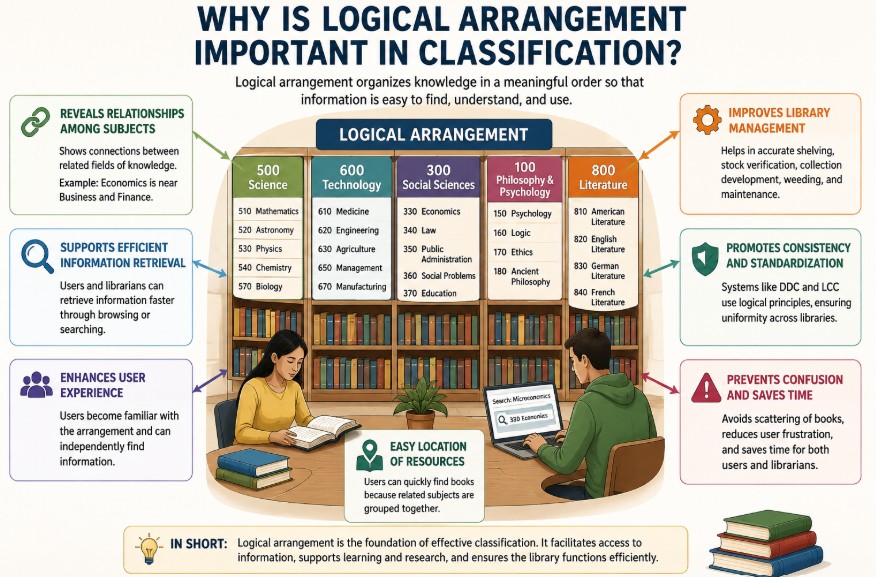
Logical arrangement is crucial in classification because it ensures that knowledge and information resources are organized systematically, meaningfully, and in a user-friendly manner. The primary goal of classification is to bring together materials on similar subjects while separating them from unrelated topics. This goal can only be achieved when resources are arranged logically based on their subject relationships. A logical arrangement allows users to navigate from broad areas of knowledge to more specific topics, making information easier to locate and understand. For instance, in a library, books on Science are grouped together and further divided into disciplines such as Physics, Chemistry, and Biology. This structured organization helps users quickly find relevant materials without having to sift through unrelated collections.
Logical arrangement also reveals the relationships among different subjects. Knowledge is interconnected, and a well-designed classification system reflects these connections. For example, books on Economics are often placed near those on Business and Finance, as these subjects are closely related. Consequently, a student searching for a book on Microeconomics may also come across useful materials on Macroeconomics, Banking, or Economic Development located nearby. This not only improves information retrieval but also encourages broader learning and exploration of related topics. Moreover, logical arrangement enhances the efficiency of library operations. When resources are organized in a logical sequence, librarians can shelve materials accurately, conduct stock verification more effectively, and easily identify misplaced items. For example, if all Computer Science books are classified within the same subject area, librarians can quickly determine if a book is in its proper location. Such an organization reduces confusion and saves valuable time for both library staff and users.
Furthermore, logical arrangement improves the overall user experience by making libraries easier to navigate. Users become familiar with the classification structure and can independently locate resources without constantly seeking assistance from librarians. A student looking for books on Environmental Science, for instance, can browse nearby shelves and find related materials on Ecology, Climate Change, and Natural Resource Management, as these subjects are arranged based on their logical relationships.
Logical arrangement also promotes consistency and standardization in library collections. Classification systems, such as the Dewey Decimal Classification (DDC) and Library of Congress Classification (LCC), organize knowledge according to established logical principles. This consistency allows users to understand and use library collections more effectively, even when visiting different libraries.
Without logical arrangement, books and other information resources would be scattered randomly, making information retrieval difficult and frustrating. Users would spend more time searching for materials, and librarians would face challenges in maintaining organized collections. Therefore, logical arrangement is a fundamental principle of classification, as it facilitates efficient access to information, highlights the relationships among subjects, supports effective library management, and enhances the overall usefulness of library collections.
Challenges of Poor Classification Arrangement
Poor classification arrangement presents numerous challenges for both library users and librarians. When information resources are not organized logically, users often struggle to locate relevant materials, resulting in frustration and wasted time. Books on the same or related subjects may be scattered across different locations, making it difficult for users to browse collections effectively. For example, if books on economics are placed in several unrelated sections instead of being grouped together, a student may overlook valuable resources that could support their studies or research.
Another significant challenge is inefficient information retrieval. A poorly arranged classification system forces users to spend more time searching for materials and increases their reliance on library staff for assistance. This can diminish user satisfaction and create congestion at service desks, especially during busy periods. In academic libraries, such difficulties may negatively impact learning and research activities by making access to information slower and less convenient. Additionally, poor classification management complicates library operations. Librarians may struggle to shelve books correctly, identify misplaced items, conduct stock verification, and maintain the collection. For instance, when related materials are not arranged systematically, a book may be returned to an incorrect location without being easily detected. Over time, these errors accumulate, further reducing the effectiveness of the library’s organizational system.
An illogical arrangement also obscures the relationships among subjects. Users may be unable to discover related materials through shelf browsing because connected topics are separated from one another. For example, books on environmental science, ecology, and climate change may be located far apart despite their close subject relationship. This arrangement limits opportunities for exploration, interdisciplinary learning, and serendipitous discovery of information.
Lastly, poor classification can lead to inconsistency and confusion within the library. Different sections may follow distinct organizational patterns, making it challenging for users to understand how materials are arranged. New users, in particular, may find the library intimidating and difficult to navigate. As a result, the overall accessibility and usability of the collection are diminished.
Consequently, ineffective classification systems hinder information retrieval, user satisfaction, library management, and knowledge discovery. To facilitate efficient access to information and provide effective library services, resources should be organized according to a logical and consistent classification structure.