Generalia Class in the Dewey Decimal Classification System
The Generalia Class, represented by the 000s in the Dewey Decimal Classification (DDC) system, is the first of the ten main classes. It serves as a category for general and interdisciplinary works that do not fit neatly into specific subject areas. Traditionally known as Generalia, this class encompasses a broad range of topics that are multidisciplinary in nature or intended for general reference. It includes subjects such as bibliographies, library and information science, encyclopedias, journalism, publishing, museums, and computer science. Since many of these subjects do not belong to a single academic discipline, they are grouped together within the 000 class.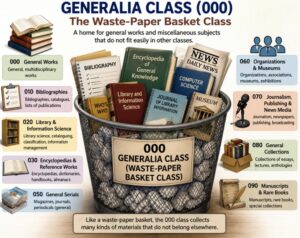
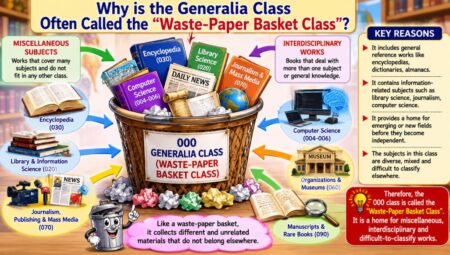
The Generalia Class is often referred to as the “Waste-Paper Basket Class” because it accommodates miscellaneous and difficult-to-classify materials that cannot be easily assigned to other main classes. This designation does not imply that the materials are unimportant; instead, it highlights the class’s role as a repository for general works and emerging fields of knowledge. For instance, encyclopedias and general reference sources often cover numerous subjects simultaneously, making them unsuitable for placement in any one specific discipline. Similarly, new areas of study are frequently housed within the 000 class until they become sufficiently established to warrant a separate classification.
In modern libraries, the Generalia Class plays a vital role in organizing reference materials and information-related disciplines. With the rapid growth of information technology, the scope of the 000 class has expanded significantly, particularly with the inclusion of computer science and information systems. As a result, the Generalia Class remains an essential component of the DDC system, providing a flexible framework for classifying multidisciplinary knowledge and supporting efficient information retrieval for library users.
Why is the 000–099 Class Called the Generalia Class?
The 000–099 class in the Dewey Decimal Classification (DDC) system is known as the Generalia Class. This class contains works of a general, multidisciplinary, or miscellaneous nature that do not belong to any single subject field. Unlike the other nine main classes, which focus on specific disciplines—such as philosophy (100s), social sciences (300s), or technology (600s)—the 000 class includes materials that cover multiple subjects at once or address the organization, communication, and management of knowledge itself. For example, a general encyclopedia like the Encyclopedia Britannica encompasses a wide range of topics and is therefore classified as 030 (Encyclopedias and Books of Facts).
The term “Generalia” highlights the broad and comprehensive nature of the materials in this class. Many resources in the 000s are designed for use across various disciplines and serve as reference tools for researchers, students, and the general public. For instance, 020 (Library and Information Sciences) includes books on cataloging, classification, and library management; 070 (Journalism, Publishing, and News Media) covers works related to newspaper publishing and mass communication; and 060 (Organizations and Museums) addresses materials concerning professional associations, museums, and exhibitions. Additionally, books on computer science and information technology are categorized in 004–006, which includes introductory texts on programming, databases, and artificial intelligence.
The 000–099 range is sometimes referred to as the “Waste-Paper Basket Class” because it contains miscellaneous and interdisciplinary subjects that do not fit conveniently into other main classes. For example, a book that discusses both science and history in a general way, or a broad reference work covering many fields of knowledge, may be classified in this range instead of a specific subject class. Emerging fields of study are often placed in the 000s before becoming more clearly defined; computer science is a notable example, having initially been assigned to the 000 class due to its close ties to information processing and knowledge management.