Knowledge Management (KM) in libraries refers to a systematic and strategic approach to identifying, capturing, organizing, sharing, and effectively using both explicit and tacit knowledge within a library organization. Traditionally, libraries have been recognized as repositories of recorded information; however, in the contemporary knowledge-driven environment, their role has expanded to include the management of institutional knowledge, professional expertise, and organizational learning. Knowledge Management enables libraries to move beyond mere collection and dissemination of information by integrating human knowledge, documented practices, and technological systems into a cohesive framework that supports continuous improvement and innovation.
In library contexts, Knowledge Management encompasses a wide range of practices, including the documentation of policies and procedures, sharing of staff expertise, preservation of institutional memory, and use of digital platforms such as intranets, repositories, and collaborative tools. Librarians possess significant tacit knowledge gained through professional experience, user interactions, and problem-solving activities; capturing and sharing this knowledge is essential for maintaining service quality and ensuring operational continuity. Through structured KM practices, libraries can reduce knowledge loss caused by staff turnover, enhance internal communication, and promote a culture of collaboration and learning among library professionals.
Knowledge Management plays a critical role in improving library services and decision-making. By leveraging accumulated knowledge and evidence-based practices, libraries can respond more effectively to users’ evolving information needs, adopt innovative service models, and support research and teaching activities more efficiently. In an era characterized by digital transformation and rapid technological change, Knowledge Management has become a foundational element for sustainable library development, enabling libraries to function not only as information centers but also as dynamic knowledge organizations that actively contribute to institutional goals and academic excellence.
What is Knowledge Management?
Knowledge Management (KM) is a systematic process of identifying, creating, organizing, sharing, and applying knowledge to improve individual and organizational performance. It focuses on managing both explicit knowledge, which is formally documented in books, databases, reports, and digital resources, and tacit knowledge, which resides in individuals’ experiences, skills, insights, and professional judgment. The primary goal of Knowledge Management is to ensure that valuable knowledge is not lost, remains accessible to the right people at the right time, and is effectively used to support learning, innovation, and informed decision-making.
In practice, Knowledge Management integrates people, processes, and technologies within an organization. It involves establishing structured workflows, documentation practices, and collaborative environments that encourage knowledge creation and sharing. At the same time, it emphasizes a supportive organizational culture where individuals are motivated to exchange ideas, lessons learned, and best practices. Technological tools such as knowledge repositories, intranets, content management systems, and collaborative platforms play a crucial role in capturing and disseminating knowledge, but they are most effective when combined with human expertise and well-defined processes.
Why is Knowledge Management Important for Modern Academic and Research Libraries?
Knowledge Management (KM) is vital for modern academic and research libraries because it enables them to function as active knowledge hubs rather than traditional storehouses of information. In contemporary universities, libraries support complex research activities, digital scholarship, and diverse user communities that require specialized and timely services. For example, when librarians document subject-specific search strategies, database selection guidelines, or reference interview techniques, this knowledge can be reused by other staff members to provide consistent, high-quality research support. KM ensures that such professional knowledge is systematically captured and shared, thereby improving service efficiency and user satisfaction.
Another important reason for the relevance of Knowledge Management is its role in preserving institutional memory and ensuring continuity of services. Academic and research libraries depend heavily on the tacit knowledge of experienced librarians, including expertise in managing electronic resources, handling copyright and licensing issues, and operating integrated library systems. For instance, if a senior systems librarian retires, documented workflows and troubleshooting guides stored in a knowledge repository can help new staff manage the library system without disruption. Through KM practices like policy manuals, standard operating procedures, and best-practice documentation, libraries can minimize knowledge loss and maintain operational stability.
Knowledge Management also enhances evidence-based decision-making and innovation in academic and research libraries. By collecting and analyzing usage statistics, user feedback, and internal reports, libraries can make informed decisions about resource allocation and service development. For example, analyzing database usage data alongside librarians’ experiential knowledge may help a library decide whether to renew, cancel, or replace a costly subscription. KM further supports innovation by encouraging staff to share lessons learned from pilot projects, such as implementing a research data management service or launching an institutional repository, enabling continuous improvement across the organization.
Knowledge Management strengthens the library’s role in supporting research and scholarly communication. Academic libraries often manage institutional repositories, research data services, and open access initiatives that require coordinated knowledge sharing. For example, guidelines on metadata standards, copyright compliance, and submission workflows can be documented and shared through KM platforms to assist both librarians and researchers. By doing so, libraries enhance research visibility, ensure long-term preservation of scholarly outputs, and support interdisciplinary collaboration within the institution.
Finally, Knowledge Management promotes a culture of continuous learning and collaboration among library professionals. Through practices such as staff training sessions, internal seminars, mentoring programs, and communities of practice, libraries encourage the exchange of ideas and expertise. For instance, a community of practice focused on information literacy instruction can allow librarians to share teaching materials, assessment methods, and classroom experiences. In modern academic and research libraries, Knowledge Management is therefore a strategic necessity that not only improves operational efficiency but also fosters innovation, adaptability, and sustainable development of library services.
Core Components of Knowledge Management Systems in Libraries
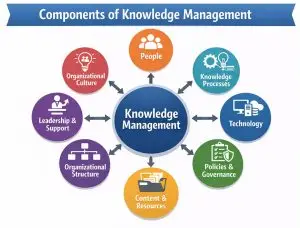 Knowledge Management (KM) systems in libraries are designed to systematically capture, organize, share, and apply knowledge to improve services, decision-making, and organizational learning. Unlike traditional information systems, which primarily focus on storing documents, KM systems integrate human expertise, organizational processes, and technological infrastructure to ensure that both explicit and tacit knowledge are effectively utilized. In the context of academic and research libraries, these systems play a strategic role in sustaining service quality, supporting research, and preserving institutional memory. The core components of Knowledge Management systems in libraries can be broadly categorized into people, processes, technology, content, and organizational culture.
- People (Human Capital):People are the most critical component of any Knowledge Management system in libraries. Librarians and library staff possess extensive tacit knowledge gained through professional experience, user interactions, problem-solving, and subject expertise. KM systems aim to capture and share this human knowledge through mechanisms such as mentoring, staff training, communities of practice, and collaborative platforms. For example, experienced reference librarians may share advanced database search techniques or research consultation strategies with junior staff, ensuring consistent and high-quality user support. Without active participation and a willingness to share knowledge among staff, KM systems cannot function effectively.
- Processes and Workflows:Well-defined processes form the backbone of Knowledge Management systems in libraries. These processes govern how knowledge is created, captured, documented, stored, shared, and reused. Standard operating procedures, policy manuals, workflow documentation, and best-practice guidelines are essential elements of this component. For instance, documenting workflows for electronic resource management or interlibrary loan services helps ensure continuity when staff changes occur. Clearly structured KM processes reduce duplication of effort, minimize errors, and enable libraries to operate more efficiently and consistently.
- Technology and Infrastructure:Technology provides the platform that enables Knowledge Management activities to occur at scale. In libraries, KM technologies may include intranets, content management systems, digital repositories, institutional repositories, document management systems, and collaborative tools. These technologies facilitate the storage, retrieval, and dissemination of knowledge across the organization. For example, a library intranet can host policy documents, training materials, troubleshooting guides, and service updates, making institutional knowledge easily accessible to staff. While technology is a crucial enabler, it must be aligned with user needs and supported by appropriate processes and training to be effective.
- Knowledge Content and Repositories:Knowledge content refers to the actual materials stored and managed within the KM system. This includes explicit knowledge such as manuals, reports, guidelines, project documentation, training resources, and research outputs. In academic libraries, knowledge repositories may also include institutional repositories that preserve theses, dissertations, faculty publications, and research data. Organizing this content using standardized metadata, classification schemes, and indexing practices ensures easy retrieval and reuse. Well-managed knowledge repositories help libraries preserve institutional memory and support evidence-based practices.
- Organizational Culture and Leadership Support:Organizational culture is a foundational component that determines the success or failure of Knowledge Management systems in libraries. A culture that encourages collaboration, openness, and continuous learning motivates staff to share knowledge rather than hoard it. Leadership plays a key role in fostering such a culture by recognizing knowledge-sharing efforts, providing incentives, and integrating KM into strategic planning. For example, library management may encourage staff to document lessons learned from projects or present best practices in internal seminars. Without leadership support and a positive culture of knowledge sharing, even the most advanced KM technologies may remain underutilized.
- Evaluation and Continuous Improvement:An effective Knowledge Management system includes mechanisms for evaluation and continuous improvement. Libraries must regularly assess the usefulness, accessibility, and impact of their KM initiatives through feedback, usage analysis, and performance indicators. For example, monitoring how frequently staff access internal knowledge repositories or evaluating improvements in service delivery can help identify gaps and areas for enhancement. Continuous assessment ensures that KM systems remain relevant, adaptive, and aligned with evolving institutional goals.
The core components of Knowledge Management systems in libraries—people, processes, technology, content, organizational culture, and evaluation—are deeply interconnected and mutually reinforcing. A successful KM system does not rely solely on technological solutions but requires active human participation, well-structured workflows, supportive leadership, and a culture of knowledge sharing. By effectively integrating these components, modern academic and research libraries can enhance service quality, preserve institutional knowledge, support research and learning, and remain resilient in an increasingly dynamic information environment.
The Role of Libraries in Transforming Information into Institutional Knowledge
Libraries play a central role in transforming scattered information into institutional knowledge by systematically organizing, contextualizing, and preserving it so that it becomes meaningful, reusable, and strategically valuable to the institution. While information consists of raw data, documents, and resources, institutional knowledge emerges when this information is curated, interpreted, and embedded within organizational practices. Libraries act as knowledge intermediaries by applying professional standards of organization, metadata, and classification, ensuring that institutional outputs—such as research publications, theses, policies, and reports—are not only stored but also made discoverable and usable over time.
One of the key ways libraries facilitate this transformation is by collecting and preserving institutional intellectual output. By managing institutional repositories, libraries capture research articles, dissertations, conference papers, and technical reports produced by faculty and students. When these materials are systematically archived with standardized metadata, persistent identifiers, and access controls, they collectively form a reliable knowledge base that reflects the institution’s scholarly identity and research strengths. This curated body of work enables future researchers, administrators, and policymakers to build upon existing knowledge rather than repeatedly starting from scratch.
Libraries also contribute to institutional knowledge by documenting and disseminating organizational practices, policies, and expertise. Through knowledge repositories, internal documentation, and service guidelines, libraries help transform experiential knowledge—such as effective research support strategies or best practices in digital resource management—into shared institutional assets. For example, documented workflows for research data management or information literacy instruction enable knowledge transfer across departments and generations of staff, strengthening organizational learning and continuity.
Libraries add value by contextualizing information through analysis, synthesis, and user engagement. Librarians support teaching and research by interpreting information resources, guiding users in critical evaluation, and integrating information into academic and administrative decision-making processes. Training programs, research consultations, and information literacy initiatives help users convert information into applied knowledge, which in turn contributes to the institution’s collective intellectual capacity.
Key Objectives of Implementing Knowledge Management in Libraries
Knowledge Management (KM) has become an essential strategic initiative for modern libraries as they transition from traditional information custodians to dynamic knowledge-centered organizations. Implementing Knowledge Management in libraries aims to systematically capture, organize, share, and apply knowledge to enhance services, strengthen institutional capacity, and support learning and research. The key objectives of Knowledge Management in libraries extend beyond technology adoption to encompass people, processes, and organizational development.
- Preserving Institutional Knowledge and Memory:One of the primary objectives of Knowledge Management in libraries is to preserve institutional knowledge and organizational memory. Libraries accumulate vast amounts of knowledge through policies, procedures, project experiences, and staff expertise. Without structured KM practices, this knowledge may be lost due to staff turnover, retirement, or organizational change. By documenting workflows, best practices, service guidelines, and lessons learned, libraries ensure continuity of operations and long-term stability. Preserved institutional memory enables libraries to build on past experiences and avoid repeating mistakes.
- Enhancing Knowledge Sharing and Collaboration:Knowledge Management fosters a culture of knowledge sharing and collaboration among library professionals. Libraries often operate across multiple service units such as reference, circulation, technical services, and digital initiatives. KM encourages the exchange of ideas, expertise, and insights across these units through collaborative platforms, internal knowledge repositories, and communities of practice. Improved knowledge sharing reduces duplication of effort, strengthens teamwork, and promotes collective problem-solving, ultimately improving service quality.
- Improving Service Quality and User Support:Another key objective of implementing Knowledge Management in libraries is to improve the quality, consistency, and effectiveness of library services. By systematically capturing and reusing knowledge such as reference responses, search strategies, instructional materials, and troubleshooting guides, libraries can provide more accurate and timely support to users. KM ensures that staff members have access to shared knowledge resources, enabling them to respond confidently to user needs and maintain high service standards across the organization.
- Supporting Informed Decision-Making:Knowledge Management supports evidence-based decision-making in libraries by integrating data, experience, and documented knowledge. Through KM systems, libraries can analyze usage statistics, user feedback, and internal reports alongside professional insights. This enables library management to make informed decisions regarding resource allocation, service development, policy formulation, and technology adoption. By leveraging organizational knowledge, libraries can better align their strategies with institutional goals.
- Promoting Continuous Learning and Professional Development:A central objective of Knowledge Management is to promote continuous learning and professional growth among library staff. KM systems support training programs, mentoring initiatives, and skill development by providing access to learning materials, documented expertise, and shared experiences. This objective is particularly important in an era of rapid technological change, where librarians must continuously update their competencies in areas such as digital scholarship, data management, and emerging information technologies.
- Enhancing Research Support and Knowledge Creation:In academic and research libraries, Knowledge Management aims to strengthen research support services and facilitate knowledge creation. By managing institutional repositories, research data services, and scholarly communication platforms, libraries help capture and disseminate research outputs. KM enables libraries to support open access initiatives, increase research visibility, and foster interdisciplinary collaboration, thereby contributing directly to the institution’s research mission.
- Increasing Organizational Efficiency and Sustainability:Knowledge Management also seeks to improve efficiency by streamlining workflows, reducing redundancy, and optimizing resource use. When knowledge is systematically organized and easily accessible, staff can perform tasks more efficiently and consistently. KM supports sustainable library operations by ensuring that expertise and best practices are retained and reused, reducing dependency on individual staff members.
The key objectives of implementing Knowledge Management in libraries focus on preserving institutional knowledge, enhancing collaboration, improving service quality, supporting informed decision-making, promoting continuous learning, and strengthening research support. By achieving these objectives, libraries can position themselves as resilient, innovative, and knowledge-driven organizations. Knowledge Management thus serves as a strategic framework that enables libraries to adapt to change, support institutional goals, and sustain their relevance in an increasingly knowledge-intensive academic environment.
Knowledge Management Practices Commonly Adopted in Academic Libraries
Academic libraries adopt a wide range of Knowledge Management (KM) practices to capture, organize, share, and apply knowledge in support of teaching, learning, and research. These practices integrate human expertise, organizational processes, and technological tools to ensure that both explicit and tacit knowledge are effectively utilized. The most commonly adopted Knowledge Management practices in academic libraries are discussed below.
- Documentation of Policies, Procedures, and Best Practices:One of the most fundamental KM practices in academic libraries is the systematic documentation of policies, procedures, workflows, and best practices. Libraries document activities related to circulation, cataloging, electronic resource management, reference services, and research support. These documents serve as institutional knowledge assets that ensure service consistency, support staff training, and reduce dependency on individual expertise. Such documentation is often stored in internal knowledge repositories or intranet systems for easy access.
- Knowledge Sharing through Staff Collaboration:Academic libraries actively promote knowledge sharing among staff through regular meetings, workshops, internal seminars, and collaborative platforms. Communities of practice are often formed around functional areas such as information literacy, digital scholarship, or electronic resource management. Through these forums, librarians share experiences, lessons learned, innovative service ideas, and problem-solving strategies, contributing to collective organizational learning.
- Capturing Tacit Knowledge and Expertise:Capturing tacit knowledge—knowledge gained through experience—is a key KM practice in academic libraries. Libraries use mentoring programs, job shadowing, peer learning, and reflective documentation to transfer experiential knowledge from senior staff to newer professionals. Exit interviews and project reports are also used to capture valuable insights before staff transitions occur, helping preserve institutional memory.
- Use of Knowledge Repositories and Intranets:Academic libraries commonly implement digital knowledge repositories and intranet platforms to store and manage organizational knowledge. These repositories may include manuals, training materials, service guidelines, project documentation, and frequently asked questions. Intranets provide a centralized space for accessing internal knowledge, announcements, and collaborative resources, making knowledge easily discoverable and reusable.
- Management of Institutional Repositories:The management of institutional repositories is a major Knowledge Management practice in academic libraries. By collecting, organizing, and preserving theses, dissertations, faculty publications, and research data, libraries transform individual research outputs into shared institutional knowledge. Institutional repositories enhance research visibility, support open access initiatives, and contribute to the long-term preservation of scholarly work.
- Research Support and Knowledge Services:Academic libraries adopt KM practices through research support services such as research consultations, literature review assistance, citation management training, and research data management guidance. By documenting effective search strategies, instructional materials, and consultation outcomes, libraries build a knowledge base that improves research support services and enables continuous service improvement.
- Leveraging Technology for Knowledge Sharing:Technology plays a crucial role in KM practices in academic libraries. Libraries use content management systems, collaborative tools, learning management systems, and digital platforms to facilitate knowledge sharing. Increasingly, libraries also adopt AI-driven tools, chatbots, and analytics to capture user interactions and service insights, which can be used to refine services and improve decision-making.
- Continuous Learning and Professional Development:Knowledge Management in academic libraries strongly emphasizes continuous learning and professional development. Libraries organize training programs, webinars, and skill development workshops to ensure staff remain updated with emerging trends and technologies. Learning materials and training outcomes are often documented and shared, reinforcing KM objectives and building organizational capacity.
- Evaluation and Knowledge-Based Decision Making:Finally, academic libraries adopt KM practices that support evaluation and evidence-based decision-making. By analyzing usage statistics, feedback, and internal reports, libraries generate actionable knowledge that informs policy development, collection management, and service planning. This practice ensures that decisions are guided by both data and professional insight.
Knowledge Management practices in academic libraries encompass documentation, knowledge sharing, tacit knowledge capture, repository management, research support, technology use, and continuous learning. Together, these practices help academic libraries preserve institutional knowledge, enhance collaboration, improve service quality, and support their broader academic and research missions.
How Can Libraries Capture and Document Staff Expertise and Experiential Knowledge?
Libraries can capture and document staff expertise and experiential knowledge by adopting structured Knowledge Management practices that transform individual experience into shared institutional assets. Much of the knowledge held by library professionals is tacit, developed through years of practical work, problem-solving, and user interaction, and it can easily be lost if not systematically recorded. One effective approach is documenting workflows, best practices, and troubleshooting procedures for key services such as reference support, electronic resource management, and library systems. When these documents are stored in centralized knowledge repositories or intranet platforms, they become accessible resources for all staff members and support service continuity.
Mentoring, peer learning, and job shadowing are also important methods for capturing experiential knowledge. Through close collaboration, experienced librarians can transfer practical skills and insights to newer staff. Libraries can strengthen this process by encouraging participants to document lessons learned, common challenges, and effective strategies during training and mentoring activities. In this way, informal knowledge exchange gradually becomes formal, reusable knowledge.
Libraries can further document staff expertise through project reports, case studies, and reflective notes prepared after completing major initiatives or resolving complex issues. These records capture contextual knowledge about decision-making processes, successes, and challenges, providing valuable guidance for future projects. Exit interviews and structured knowledge transfer sessions are another important practice, allowing libraries to capture critical insights from staff members before they leave or change roles.
Creating a supportive organizational culture is essential for successful knowledge capture. Library leadership should encourage openness, collaboration, and recognition of knowledge-sharing efforts, and integrate documentation activities into regular work responsibilities. By combining documentation, mentoring, reflective practices, and cultural support, libraries can effectively preserve staff expertise, strengthen institutional memory, and improve long-term service quality.
Methods Used by Libraries to Share Knowledge Among Staff Members
Knowledge sharing among staff members is a core element of effective Knowledge Management in libraries. Libraries rely heavily on the collective expertise, experience, and professional skills of their staff to deliver high-quality services and support teaching, learning, and research. To ensure that this knowledge is not confined to individuals but becomes an organizational asset, libraries adopt a range of formal and informal methods that encourage communication, collaboration, and continuous learning.
- Staff Meetings, Workshops, and Internal Seminars:One of the most widely used methods for knowledge sharing in libraries is regular staff meetings, workshops, and internal seminars. These forums provide librarians with opportunities to exchange information on new services, policy changes, system updates, and user needs. Staff members often share experiences from training programs, conferences, or pilot projects, allowing others to benefit from newly acquired knowledge. Such structured interactions promote transparency, collective problem-solving, and alignment across different library units.
- Mentoring, Peer Learning, and Job Shadowing:Mentoring and peer learning programs play a vital role in sharing experiential and tacit knowledge among library staff. Experienced librarians mentor junior or newly appointed staff by sharing practical insights, professional skills, and service strategies. Job shadowing and cross-training enable staff to learn through direct observation and hands-on participation in different roles or departments. These methods are particularly effective for transferring knowledge that is difficult to document, such as communication skills, decision-making approaches, and user engagement techniques.
- Documentation and Knowledge Repositories:Libraries commonly use documentation and centralized knowledge repositories to facilitate systematic knowledge sharing. Policies, standard operating procedures, workflow manuals, troubleshooting guides, and best-practice documents are stored in intranets or content management systems accessible to all staff members. By maintaining updated and well-organized documentation, libraries ensure that knowledge is easily retrievable and consistently applied across services. Knowledge repositories also support staff training and reduce dependency on individual expertise.
- Communities of Practice and Collaborative Groups:Communities of practice are an important method for promoting knowledge sharing in libraries. These groups bring together staff members who share similar responsibilities or interests, such as information literacy instruction, digital services, or electronic resource management. Through regular meetings and discussions, members exchange experiences, explore challenges, and develop shared solutions. Communities of practice foster professional dialogue, innovation, and collective learning within the organization.
- Use of Digital and Collaborative Technologies:Technology plays a significant role in enabling knowledge sharing among library staff. Libraries use collaborative tools such as shared document platforms, internal discussion forums, messaging applications, and project management systems to facilitate real-time communication and collaboration. Increasingly, libraries also adopt knowledge portals and intranet-based platforms that integrate documentation, announcements, and discussion spaces. These tools support asynchronous knowledge sharing, allowing staff to contribute and access knowledge regardless of time or location.
- Informal Knowledge Sharing and Organizational Culture:Informal interactions are equally important for knowledge sharing within libraries. Day-to-day conversations, peer consultations, and collaborative problem-solving contribute significantly to the flow of knowledge among staff. A supportive organizational culture that values openness, trust, and collaboration encourages staff to share ideas and experiences freely. Leadership support, recognition of knowledge-sharing efforts, and opportunities for professional development further strengthen this culture.
Libraries use a combination of structured mechanisms and informal practices to effectively share knowledge among staff. Through meetings, mentoring, documentation, communities of practice, digital tools, and a supportive organizational culture, libraries transform individual expertise into collective knowledge. These methods not only improve service quality and operational efficiency but also foster continuous learning, innovation, and long-term organizational resilience.
Major Challenges of Implementing Knowledge Management in Libraries
Knowledge Management (KM) has become an essential strategic approach for modern libraries seeking to improve service quality, preserve institutional knowledge, and support learning and research. Despite its benefits, implementing Knowledge Management in libraries is a complex process that involves organizational, cultural, technological, and financial challenges. Understanding these challenges is crucial for designing effective KM strategies that are sustainable and aligned with library goals.
- Cultural Resistance and Lack of Knowledge-Sharing Mindset:One of the most significant challenges in implementing Knowledge Management in libraries is resistance to knowledge sharing. Library staff may be accustomed to working independently or may perceive knowledge as a source of personal value and job security. This can lead to reluctance to document or share expertise. In the absence of a collaborative culture, KM initiatives often fail to engage staff. Overcoming this challenge requires strong leadership support, trust-building, and recognition of knowledge-sharing efforts as a valued professional contribution.
- Difficulty in Capturing Tacit Knowledge;Much of the valuable knowledge in libraries is tacit, residing in the experience, judgment, and skills of librarians. Capturing this experiential knowledge is inherently difficult because it is often informal and context-specific. While explicit knowledge can be documented in manuals and guidelines, tacit knowledge is best shared through mentoring, observation, and practice. Libraries often struggle to convert this form of knowledge into documented or transferable formats, particularly in environments with heavy workloads and limited time.
- Limited Technological Infrastructure:Inadequate or outdated technological infrastructure is another major challenge in implementing Knowledge Management systems in libraries. Effective KM requires reliable platforms such as intranets, content management systems, digital repositories, and collaborative tools. Many libraries, especially in resource-constrained settings, lack the financial and technical capacity to implement and maintain these systems. Even when technology is available, poor system design, insufficient integration, or inadequate user training can limit its effectiveness.
- Budget Constraints and Resource Limitations:Financial constraints pose a significant barrier to Knowledge Management initiatives in libraries. Implementing KM requires investment in technology, staff training, system maintenance, and, at times, dedicated KM roles. Libraries operating under limited budgets may prioritize immediate service needs over long-term KM strategies. As a result, KM initiatives may remain underdeveloped or fragmented, reducing their potential impact.
- Lack of Clear KM Strategy and Leadership Support:Another common challenge is the absence of a clear Knowledge Management strategy aligned with the library’s mission and objectives. Without a well-defined vision, roles, and responsibilities, KM activities may become ad hoc and unsustainable. Insufficient leadership support further exacerbates this issue, as KM initiatives require ongoing commitment, policy support, and integration into organizational planning. When leadership does not actively promote KM, staff engagement and accountability tend to decline.
- Time Constraints and Workload Pressure:Library staff often face heavy workloads and multiple responsibilities, leaving little time for documentation, reflection, or participation in KM activities. Knowledge Management tasks may be perceived as additional work rather than integral to daily operations. This time pressure can limit staff willingness to contribute to knowledge repositories or participate in knowledge-sharing activities, slowing the implementation process.
- Measuring Impact and Effectiveness:Evaluating the effectiveness of Knowledge Management initiatives is another major challenge. Libraries may find it difficult to define appropriate indicators or measure intangible outcomes such as improved collaboration, knowledge sharing, or service quality. Without clear evaluation mechanisms, it becomes challenging to demonstrate KM’s value to stakeholders or justify continued investment.
The implementation of Knowledge Management in libraries is challenged by cultural resistance, difficulty in capturing tacit knowledge, technological and financial constraints, lack of strategic direction, time pressures, and evaluation difficulties. Addressing these challenges requires a holistic approach that combines leadership commitment, supportive organizational culture, appropriate technology, staff training, and continuous assessment. By recognizing and strategically managing these barriers, libraries can successfully implement Knowledge Management systems that enhance efficiency, innovation, and long-term sustainability.