What is ICT in the Context of Academic Libraries?
Information and Communication Technology (ICT) in the context of academic libraries refers to the systematic use of digital tools, computing technologies, and communication networks to support library operations, services, and the dissemination of information. It includes technologies such as computers, servers, integrated library management systems (ILMS), databases, and the internet that enable libraries to acquire, organize, store, retrieve, and share information efficiently. For example, the use of an automated library system like Koha or Aleph allows academic libraries to manage acquisitions, cataloguing, circulation, and serials control in an integrated digital environment.
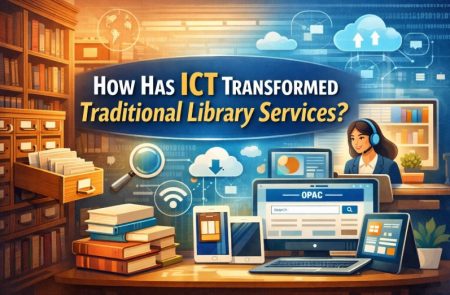
ICT plays a transformative role by shifting academic libraries from traditional, manual operations to automated and digital services. Through ICT applications, academic libraries can provide Online Public Access Catalogues (OPACs), institutional repositories, and digital library platforms. For instance, students can search the OPAC from anywhere on campus to check the availability and location of books, while researchers can access theses and dissertations through an institutional repository built on platforms such as DSpace. Similarly, access to e-journals and e-books through databases such as JSTOR, ScienceDirect, or SpringerLink enables users to retrieve scholarly content instantly without needing to visit the physical library.
Furthermore, ICT enhances communication, collaboration, and user engagement in academic libraries. Library websites, email alerts, virtual reference services, and social media platforms allow libraries to disseminate information about new resources, training programs, and service updates. For example, a student may receive an automated email reminder for due dates or use a live chat service to consult a librarian remotely. The integration of library resources with learning management systems, such as Moodle or Google Classroom, also supports teaching and learning by embedding academic content directly into course materials.
Why Do Academic Libraries Need ICT Support?

Academic libraries require Information and Communication Technology (ICT) support to keep pace with the exponential growth of information and the increasing demand for rapid, accurate, and convenient access to knowledge. In the contemporary academic environment, information is no longer limited to printed books and journals; it is now available in multiple digital formats, including e-books, e-journals, databases, and multimedia resources. ICT enables libraries to manage these diverse resources efficiently through automation and digital systems, reducing manual workload while improving the speed and accuracy of library operations.
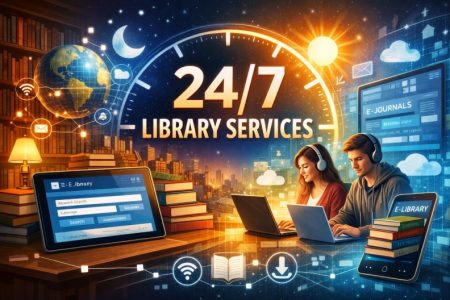
ICT support is also essential for improving access to information and enhancing user satisfaction. Through ICT-enabled services, such as Online Public Access Catalogues (OPACs), discovery platforms, and remote access systems, students and researchers can search library collections, access scholarly resources, and obtain information at any time and from anywhere. This is particularly important for supporting research, distance learning, and flexible academic schedules. ICT ensures that academic libraries are not confined by physical space or limited operating hours, thereby expanding their reach and usability.
Academic libraries require ICT support to strengthen research and learning services and to remain relevant in a rapidly changing educational landscape. ICT facilitates advanced research support services, including plagiarism detection, reference management, institutional repositories, and data management systems. It also enhances communication and engagement through library websites, email alerts, online training sessions, and virtual reference services. By adopting ICT, academic libraries transform into dynamic knowledge centers that support teaching, learning, innovation, and scholarly communication, ultimately contributing to the overall academic excellence of their institutions.
The Importance of ICT in Academic Libraries
Information and Communication Technology (ICT) has become an indispensable component of academic libraries in the modern knowledge society. The traditional role of academic libraries as storehouses of printed books has expanded significantly with the integration of ICT. Today, academic libraries are expected to provide rapid access to diverse information resources, support advanced research activities, and facilitate teaching and learning in both physical and virtual environments. ICT plays a central role in enabling libraries to fulfill these expectations efficiently and effectively.
- ICT and Automation of Library Operations: One of the most significant contributions of ICT to academic libraries is the automation of core library functions. Activities such as acquisition, cataloguing, circulation, serials control, and inventory management can be performed more accurately and efficiently using integrated library management systems. Automation reduces repetitive manual work, minimizes human error, and ensures faster service delivery. As a result, library professionals can devote more time to user support, information literacy instruction, and research assistance rather than routine administrative tasks.
- Enhancing Access to Information Resources: ICT has dramatically improved access to information in academic libraries. Through digital catalogs, online databases, and electronic collections, users can locate and retrieve information within seconds. Academic libraries now provide access to e-books, e-journals, institutional repositories, and open-access resources that are available beyond the physical boundaries of the library. ICT-enabled remote access systems enable students and researchers to utilize library resources at any time and from anywhere, which is particularly beneficial for distance learners and off-campus researchers.
- Supporting Teaching, Learning, and Research: The importance of ICT in academic libraries is closely linked to its role in supporting teaching, learning, and research. ICT tools help integrate library resources into academic curricula through learning management systems and online course platforms. Libraries utilize ICT to provide research support services, including literature searching, citation management, plagiarism detection, and research data management. These services enhance the quality of academic work and promote ethical research practices among students and faculty members.
- Improving User Services and Engagement: ICT enables academic libraries to deliver user-centered and interactive services. Library websites, email alerts, virtual reference services, and online tutorials allow libraries to communicate effectively with their users. Through these platforms, libraries can inform users about new resources, training programs, and policy updates. ICT also supports personalized services, such as automated notifications for due dates and reservation requests, which improve user satisfaction and engagement.
- Resource Sharing and Collaboration: Another important aspect of ICT in academic libraries is its role in resource sharing and collaboration. ICT facilitates networking among libraries through consortia, interlibrary loan systems, and shared digital platforms. Academic libraries can collaborate nationally and internationally to provide access to a broader range of scholarly resources, thereby reducing costs and minimizing unnecessary duplication. This collaborative approach strengthens the overall academic information infrastructure.
- Challenges and the Need for Continuous ICT Development: While ICT offers numerous benefits, academic libraries also face challenges such as high implementation costs, the need for continuous system upgrades, cybersecurity concerns, and staff training requirements. Despite these challenges, continuous investment in ICT is crucial for academic libraries to stay ahead of technological advancements and evolving user expectations. Proper planning, staff development, and institutional support are crucial to maximizing the benefits of ICT.
The importance of ICT in academic libraries cannot be overstated. ICT has transformed academic libraries into dynamic, technology-driven knowledge centers that support education, research, and innovation. By improving efficiency, expanding access to information, enhancing user services, and fostering collaboration, ICT ensures that academic libraries remain relevant and effective in the digital age. As higher education continues to evolve, sustained ICT support will be vital for academic libraries to fulfill their mission of facilitating knowledge creation and dissemination.
Information and Communication Technology (ICT) is widely regarded as the backbone of modern academic libraries because it underpins almost every aspect of library operations, services, and resource delivery. In the digital age, academic libraries are no longer confined to physical spaces or printed collections; instead, they function as hybrid or fully digital knowledge centers. ICT provides the technological foundation that enables libraries to manage vast information resources, deliver services efficiently, and support teaching, learning, and research in a rapidly evolving academic environment.
One of the primary reasons ICT is considered the backbone of academic libraries is its role in automating core library operations. Traditional manual processes such as cataloguing, circulation, acquisition, and serials control were time-consuming and prone to errors. With ICT-based integrated library management systems, these functions are automated and interconnected. For example, when a book is issued at the circulation desk, the system automatically updates the user record, item status, and due date. This not only improves accuracy and speed but also allows library staff to focus more on user support and academic engagement rather than routine clerical work.
ICT also forms the backbone of access to academic information resources. Modern academic libraries provide access to thousands of e-books, e-journals, online databases, and open-access materials that cannot be managed or accessed without a robust ICT infrastructure. Through online public access catalogues (OPACs), discovery tools, and library websites, users can search and retrieve information within seconds. A real-world example is a postgraduate student accessing peer-reviewed journal articles from home late at night through the library’s subscribed databases, something that would be impossible without ICT-enabled remote access systems.
Another crucial area where ICT acts as the backbone is in supporting teaching, learning, and research. Academic libraries are increasingly integrating their resources with learning management systems, enabling students to access recommended readings, lecture materials, and research guides directly from their online courses. ICT also supports advanced research services, including plagiarism detection, citation management, research data repositories, and digital theses and dissertations. For instance, a doctoral researcher can deposit their thesis in the university’s institutional repository, making it accessible worldwide and increasing the visibility of the institution’s research output.
ICT further strengthens communication, user engagement, and service innovation in academic libraries. Through email alerts, online chat services, virtual reference desks, and social media platforms, libraries can interact with users beyond physical boundaries. Automated notifications for due dates, renewals, and reservations improve user convenience and satisfaction. In real-world academic settings, students often rely on library websites and online help desks to resolve queries instantly, demonstrating how ICT has become central to user-centered library services. Moreover, ICT enables resource sharing and collaboration among academic libraries at local, national, and international levels. Through library networks, consortia, and interlibrary loan systems, institutions can share digital resources, reduce costs, and expand access. For example, a university library may provide its users access to resources subscribed to by partner institutions through consortium agreements, a practice that is entirely dependent on ICT infrastructure and networking technologies.
In addition, ICT supports data-driven decision-making and sustainable library management. Usage statistics, access logs, and digital analytics help librarians understand user behavior, evaluate resource utilization, and make informed collection development decisions. This strategic use of ICT ensures that academic libraries remain responsive to changing academic needs and budget constraints.