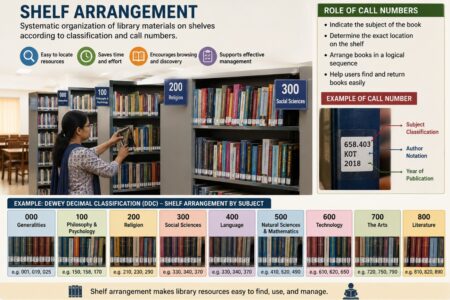
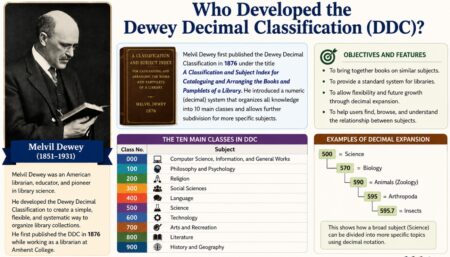
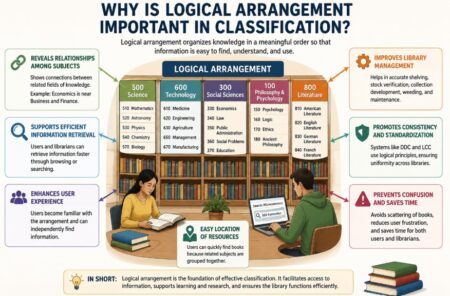
The absence of call numbers would severely disrupt the systematic arrangement of library materials, as call numbers provide a structured framework for organizing resources according to subject, author, and classification scheme. For example, in a library using the Dewey Decimal Classification system, all books on computer science are grouped under the 000 class, while literature is placed in the 800 class. Without call numbers, books on similar subjects—such as programming, database management, and networking—might be placed on different shelves based on size, arrival date, or staff preference rather than subject relevance. This would result in a scattered collection where related materials are no longer located together.
The lack of call numbers would make shelving and reshelving inconsistent. For instance, when a book on “Research Methodology” is returned, staff would have no precise guide to place it alongside other research-related books, increasing the risk of misplacement. Users attempting to browse a specific subject area, such as economics or biotechnology, would also face difficulties because there would be no logical sequence to follow on the shelves. Over time, this disorder would grow as the collection expands, making the library increasingly difficult to manage.
Difficulties Faced by Users in Locating Books Without Call Numbers
Users would encounter significant difficulties in locating books in a library without call numbers, as call numbers act as precise location identifiers that guide users from the catalog to the exact shelf position of an item. Without call numbers, users would have no clear direction on where a particular book is placed, even if the book is listed in the OPAC or catalog. For example, a student searching for a book on educational psychology might know that the library owns the title, but without a call number, they would be forced to search multiple shelves or sections, often relying on guesswork or staff assistance.
The absence of call numbers would also make subject browsing extremely challenging. For instance, a researcher looking for multiple books on data science or environmental studies would not be able to locate related materials grouped together, as there would be no systematic shelf order. This would increase frustration, waste valuable time, and discourage independent use of the library. New users and first-time visitors would be particularly affected, as they depend heavily on call numbers to navigate unfamiliar library spaces.
Time Wastage Caused by the Absence of Call Numbers for Users and Library Staff
The lack of call numbers in a library would significantly increase time wastage for both users and library staff, as call numbers provide a direct and efficient pathway to locating and managing materials. For users, the absence of call numbers means spending excessive time searching through shelves without clear guidance. For example, a student looking for a specific textbook may have to scan multiple shelves or sections before finding the correct book, even after confirming its availability in the catalog. This trial-and-error approach slows down research and study activities and often leads to frustration.
Library staff would also experience increased workloads and time loss. Without call numbers, staff would need to manually guide users to materials, repeatedly answer location-related queries, and spend additional time identifying where returned books should be shelved. For instance, during peak hours, circulation staff may have to escort several users to different shelves, rather than focusing on core services such as circulation management or reference support. Over time, this inefficiency would accumulate, resulting in reduced overall service productivity and operational efficiency. Thus, the absence of call numbers results in unnecessary delays, inefficient workflows, and increased dependency on staff assistance throughout the library.
Effect of the Absence of Call Numbers on Subject-Based Browsing
Subject-based browsing would be seriously hindered if call numbers were not used, as call numbers are designed to group library materials according to subject classification. They allow users to move systematically along shelves and discover related resources within a specific subject area. Without call numbers, books on the same topic would not be shelved together in a logical sequence, making browsing ineffective. For example, a student interested in sociology might expect to find books on social theory, research methods, and social issues placed side by side. In the absence of call numbers, these books could be scattered across different shelves or sections, breaking the natural flow of subject exploration.
This lack of structured arrangement would also limit serendipitous discovery, a key benefit of subject-based browsing. For instance, a researcher browsing books on artificial intelligence may unintentionally discover related titles on machine learning or data analytics when books are properly classified. Without call numbers, such connections would be difficult to identify, forcing users to rely solely on catalog searches rather than physical browsing. As a result, the library would lose its effectiveness as a space for exploratory learning, and users would find it harder to engage deeply with subjects through shelf browsing.
Importance of Call Numbers in Managing Growing and Diverse Library Collections
Call numbers are essential for managing growing and diverse library collections because they provide a systematic, scalable, and consistent method for organizing materials as collections expand in size and subject coverage. As a library acquires new books, journals, and multimedia resources across various disciplines, call numbers ensure that each item is placed in its appropriate subject location without disrupting the existing order. For example, when new titles on emerging fields such as data analytics or biotechnology are added, call numbers allow these materials to be integrated seamlessly alongside related subjects rather than being stored separately or randomly.
In large and diverse collections, call numbers also support efficient space management and long-term control. They help libraries accommodate continuous growth by maintaining logical shelf sequences and enabling easy shifting of materials when space needs change. Additionally, call numbers assist staff in inventory control, shelf reading, and collection evaluation, especially when managing thousands of items across multiple disciplines. For users, a well-maintained call number system ensures predictable access to materials and encourages independent use of the library.